Release Notes¶
Highlights since the v6.0 Knowledge Context Injection milestone, grouped by subsystem.
How to read this¶
Entries are grouped by subsystem, newest first within each, and dated. They record what changed and — more usefully — what the change was found to be hiding.
The recurring theme¶
A striking number of these entries are the same shape: something reported success while doing nothing. A backfill that measured its own conversion rather than trusting it found five silent data-losing bugs, three in the backfill itself, all before any write.
That is the pattern worth carrying: verification against ground truth, not against the thing being verified.
If you are catching up¶
Read the subsystem you work in rather than the whole file. Each group is self-contained, and the entries name the commits so a change can be traced from here.
What this file is¶
A running record of what changed since the v6.0 milestone, grouped by subsystem rather than strictly by date, so that catching up on one area does not mean reading everything.
Entries are written to be useful after the fact rather than at release time: alongside what changed, they record what the change revealed, which is usually the part that transfers.
The pattern across entries¶
Read enough of them together and one shape dominates: a process that reported success while doing nothing. A docs gate that skipped a build and went green. A backfill that was silently a no-op. An index serving the wrong tree, producing a benchmark result clean enough to be called "the finding". A classifier routed by a field nothing read.
None of these announced themselves. Each was found by measuring an outcome against ground truth rather than trusting the report — which is why so many entries here pair a fix with a guard, and why several guards have their own negative controls.
Using it¶
Each entry names its commits, so anything here can be traced back to the change that made it. Where a change altered a contract — a storage format, a routing key, a command — the entry says what the old behaviour was, because that is what you need when something in your own setup still assumes it.
Highlights since the v6.0 Knowledge Context Injection milestone (commit 0fdb7665). Grouped by subsystem.
LSL — pi session format, a Sessions tab, and two redaction defects (2026-08-28)¶
The LSL corpus now stores tranches as pi session JSONL instead of the ETM's bespoke markdown. Only the serialization changed: hourly files, the filename structure, the 5-layer classification, rotation and redirect handling are untouched by design.
- One emitter, two paths.
PiSessionWriteris shared by the live monitor and the backfill, so live and converted output cannot diverge. - Backfill run across all 7 history repos. 22,543 markdown parts → 20,186 session files. The unit of work is a chain, because rotation splits mid-token and a part cannot be parsed alone. Every repo carries a pushed
pre-pi-formattag; markdown was deleted only where git could restore it; 12 chains in unrecognised formats are quarantined with their markdown intact. - Sessions tab (before Observations) renders transcripts through pi's own export shell, in light and dark. See the Health Dashboard guide.
Measuring the conversion against ground truth — rather than trusting it — caught five silent, data-losing bugs, three of them in the backfill itself and all before any write:
| Defect | Effect |
|---|---|
| Chains with no anchor and no prompt-set heading | Produced nothing while their markdown was deleted (256 chains, 6,747 tool calls) |
| Blocks before the first anchor | Discarded (17 chains, 21,037 blocks) — one 34 MB chain carries its only anchor 23.5 MB in |
| A chain converting to nothing | Passed verification vacuously, then had every part unlinked |
aws_secret_truncated backtracking | Pinned the monitor at ~100% CPU — alive, so health checks passed, but silent for over an hour |
aws_secret_standalone matching any 40-char token | Every git SHA written as <AWS_SECRET_REDACTED> |
The last two had been corrupting the corpus at write time for as long as they existed. Both redaction defects are now guarded — the backtracking one by a time bound rather than a pattern assertion, so it keeps covering patterns added later.
See LSL — Session format.
Measurement & Experiments — cross-agent runner, live KB axis, grouped dashboard (2026-07-23)¶
The v7.3 cross-agent experiment harness became a genuine measurement instrument:
- Live knowledge-injection axis.
env: kb-onnow injects gated knowledge into each cell via the agent's native channel (lib/experiments/cell-injection.mjs); previously the axis was inert. The gate (src/retrieval/retrieval-service.js+relevance-judge.js) applies an IDF floor + an LLM relevance judge and fails CLOSED for experiment cells — "useful know-how, or nothing." Injection now defaults off unlesskb-on. - Sandbox hardening. Every cell restores into an isolated worktree;
neutralizeSandboxRules()strips restored rules files and a post-cell escape guard +PWD-pin keep the agent inside its sandbox (a restoredCLAUDE.md's hardcoded path had leaked opencode writes to the real repo). - Honest scoring. The judge is pinned to Opus 4.8;
runJudge({forceScore})scores empty spec cells as failures; a scratch-index diffstat + post-restore baseline commit make new-file deliverables scoreable without restore noise. - Dashboard. The Runs table now groups by experiment-run (collapsible parents + an ambient bucket); the Compare tab merged two-run and variant-matrix views; a new Avenues tab ranks forked spans (promote / prune); and per-value score tooltips surface the judge's rationale.
See the Measurement Tutorial and the new Dashboard Reference.
Knowledge Injection — Copilot per-turn injection is now version-adaptive multi-channel (2026-07-19)¶
GitHub Copilot previously received only a session-start baseline; per-turn injection was blocked because Copilot filesystem hooks can only inject via an additionalContext field, and which event's additionalContext is honored changes between Copilot versions (postToolUse on ≤ 1.0.71; userPromptSubmitted newly on 1.0.72+, where postToolUse went flaky). A fixed channel was never upgrade-safe.
src/hooks/copilot-channel-capabilities.js now maps the installed Copilot version to the set of channels to emit on, and that set is the deduplication:
| Copilot version | Emit set | Result |
|---|---|---|
| ≤ 1.0.71 | postToolUse only | injected once |
| 1.0.72 – 1.0.x | userPromptSubmitted only | injected once, no duplicate |
| unknown / ≥ 1.1.0 | both (fail-safe) | delivery guaranteed, tolerates one duplicate |
Retrieval runs at most once per turn (block cached in the session stash; the fail-safe second channel reuses it). Overrides: COPILOT_KB_CHANNELS (force set / none), COPILOT_VERSION (test). scripts/verify-copilot-hook-injection.sh reports which channel delivers after an upgrade, to keep the map honest. Resolver + end-to-end tests under tests/experiments/copilot-*.test.mjs.
See Knowledge Context Injection.
Observational Memory — SQLite → km-core cutover complete (2026-06-05)¶
Phase 44 Plans 12 → 18 finished cutting every production code path off the legacy .observations/observations.db SQLite file. The file was archived to .observations/observations.db.archived.2026-06-05 after Plan 44-18 Tasks 1-4 landed (commits cf6c8da45 → c837dc421).
| Surface | Path | Pre-cutover | Post-cutover |
|---|---|---|---|
| Write path | src/live-logging/ObservationWriter.js | SQLite single-owner writer (Plan 44-13) | km-core GraphKMStore.putEntity |
| Consolidator + insights re-synth | src/live-logging/ObservationConsolidator.js | SQLite reads for day-range scan + insight metadata | km-core findByOntologyClass + getEntity (Plan 44-17) |
| Retention pruner | src/live-logging/ObservationPruner.js | SQLite cutoff DELETE | km-core findByOntologyClass + per-entity deleteEntity (Plan 44-18 Task 2) |
| Retrieval freshness-rerank | src/retrieval/retrieval-service.js | SQLite json_extract over insights | km-core getEntity per insight id (Plan 44-18 Task 3) |
obs-api /health | scripts/observations-api-server.mjs | reported dbPath + dbExists for the SQLite file | reports km-core readiness only (Plan 44-18 Task 5) |
The deferred Plan 44-12 § "fully unused observations.db" success criterion — carried through 44-13, 44-14, 44-17 — is now honored. obs-api keeps running cleanly with no SQLite handle; the DB_PATH constant was dropped from the script in the Task 5 cleanup commit. The archived file is preserved in .observations/ (gitignored under *.db.archived*) for one-shot historical inspection should a regression need pre-cutover data.
Constraint System¶
A run-through of the persisted violation-history.json showed that 9,387 of 9,780 lifetime violations (96 %) were no-magic-numbers — its \b\d{2,}\b pattern matched any 2+ digit number including port numbers, PIDs, and Bash command digits. Critical-severity rules like no-hardcoded-secrets had fired exactly once in the same window. A second sweep uncovered a config split-brain: host hooks loaded ${CODING_REPO}/.constraint-monitor.yaml while the in-container dashboard loaded a stale integrations/mcp-constraint-monitor/constraints.yaml. Same rules diverged across the two — no-console-log ran as error on the host but warning in the dashboard.
| Change | Where | Effect |
|---|---|---|
no-magic-numbers retired | YAMLs across all projects + integration defaults | Dashboard noise dropped from ~9.8k entries to ~80 real violations |
| Single canonical config | .constraint-monitor.yaml is the only source; bind-mounted into the container; findProjectConfig() throws when missing instead of falling back | Dashboard, hooks and tests now agree on the rule set |
semantic_validation removed | Stripped flag from all YAMLs; deleted the LLM-suppression branch in constraint-engine.js | Regex matches are authoritative — no-hardcoded-secrets, no-eval-usage, debug-not-speculate, no-ukb-bash-command all fire reliably again |
| Engine errors re-thrown | checkConstraintsDirectly no longer returns zero violations on engine failure | Surface bugs (split-brain, missing config, …) instead of pretending nothing was checked |
no-backup-files rule corrected | Added applies_to: file_path + tool_filter: ['Edit','Write'] | The filename-only pattern now actually matches filenames |
See Constraint System.
Health Monitoring¶
Phase 33 follow-on: statusline + ETM pipeline (May 8)¶
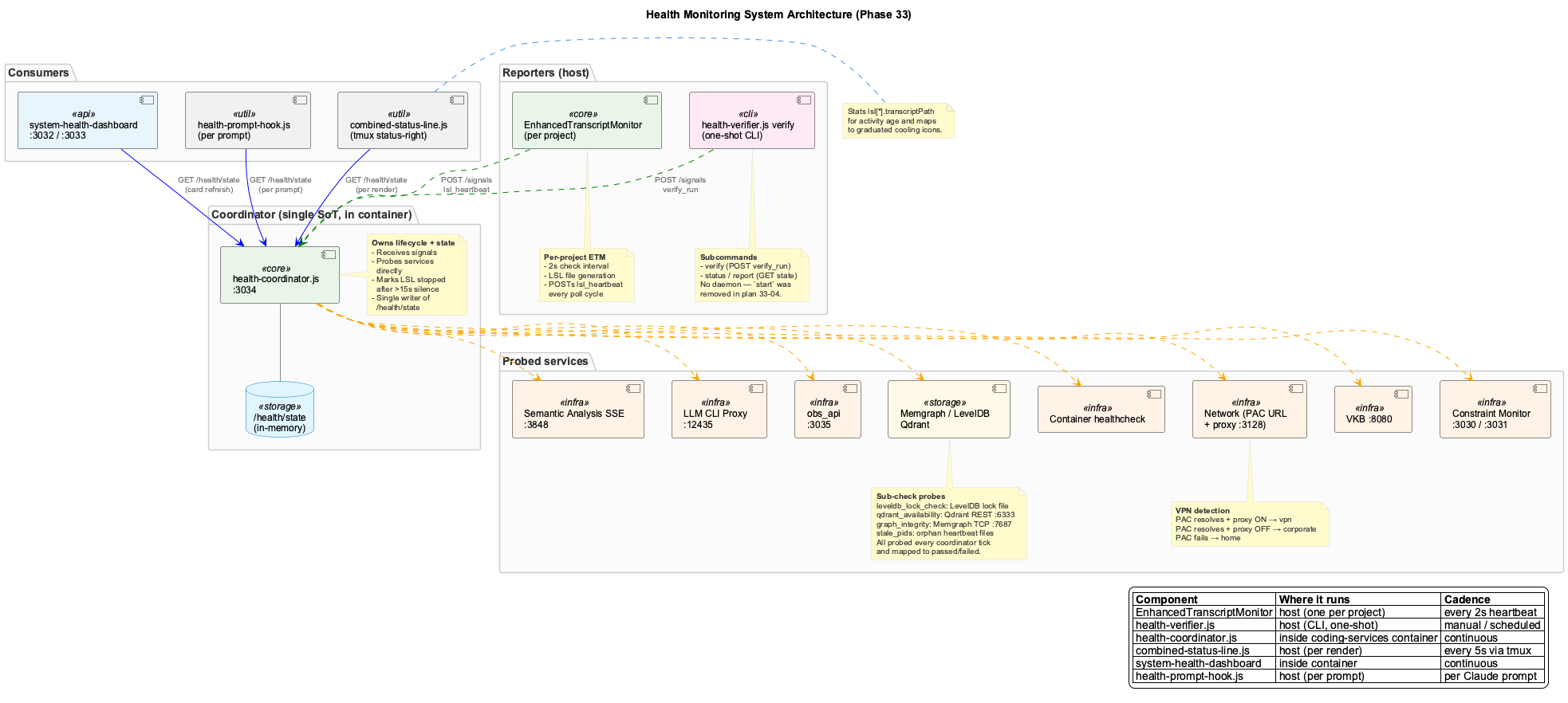
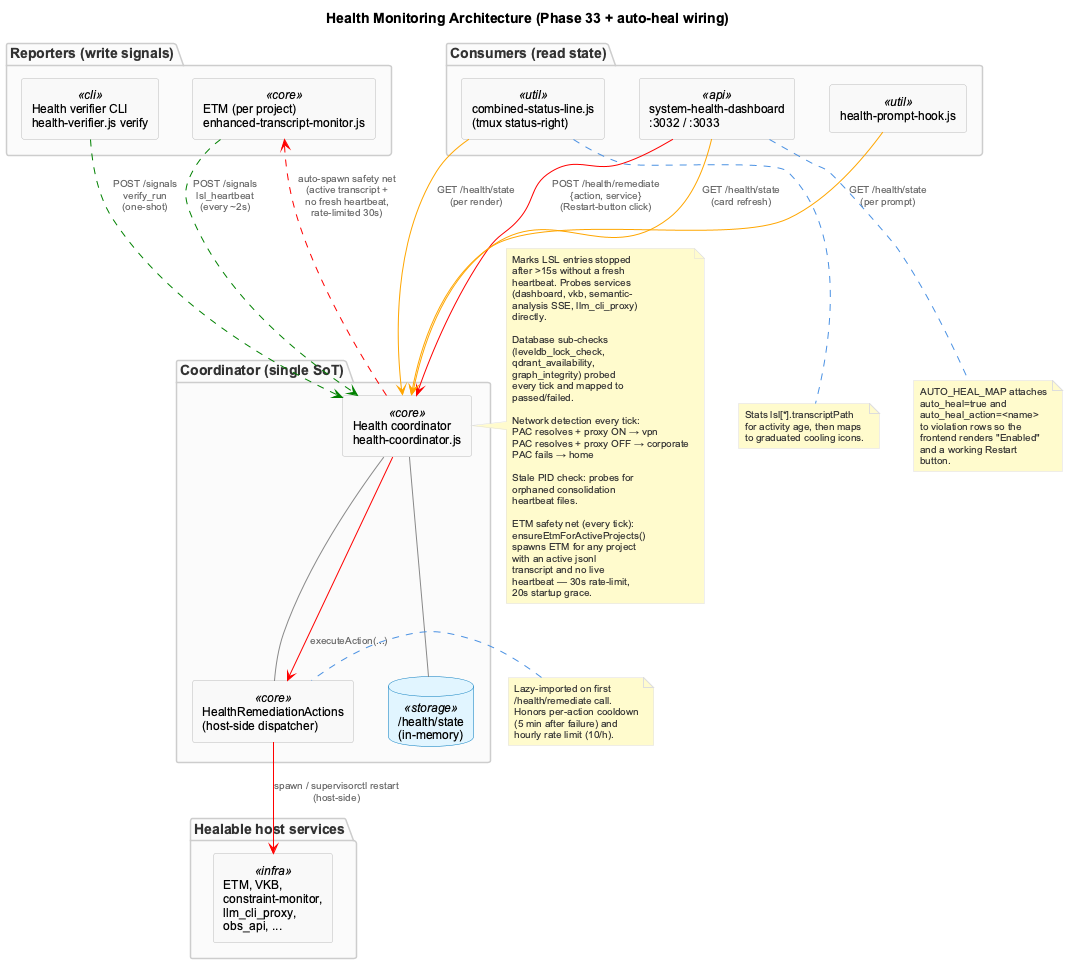
Five intertwined bugs surfaced during a single debugging pass after the Phase 33 coordinator cutover. All fixed; published-doc set rewritten.
| Symptom | Root cause | Fix |
|---|---|---|
monitoring:health-verifier STOPPED permanent on dashboard | [program:health-verifier] ran health-verifier.js start, but the daemon subcommand was deleted in plan 33-04. Block had been kept with autostart=false as a transitional shim. | Removed the supervisord block entirely (treatment matches the earlier browser-access removal). |
[LSL🔴] red on healthy panes; "RA" project missing from rollup | The badge logic in combined-status-line.js matched only by (tmuxPane, project) then (sid, project) keys; ETMs are project-singletons and inherit only the launcher's TMUX_PANE/CLAUDE_SESSION_ID, so per-pane lookups missed. | Added a project-level fallback that aggregates "best verdict" across all heartbeat entries for the project; also degraded heartbeats now correctly surface as [LSL🟡]. |
LSL files stop appearing; observations stop appearing; ETMs report running for hours with exchangeCount=0 | The host-side ETM inherited CODING_TOOLS_PATH=/coding (the in-container bind-mount path) from the claude-mcp launcher. The redactor tried to load /coding/.specstory/config/redaction-patterns.json (doesn't exist on host); initialize() threw after the singleton variable was assigned, so every later redact() call returned "not initialized" and stalled the whole pipeline. | New resolveHostCodingPath() rejects in-container paths and falls back to __dirname/... Redactor singleton is now assigned only after initialize() resolves so a thrown init doesn't poison the cache. |
[🏥⏰] stale verifier badge stuck for 28 h | getHealthVerifierStatus() read .health/verification-status.json. Plan 33-04 retired the file but the badge still tried. | Migrated to GET :3034/health/state; synthesizes criticalCount / overallStatus from coordinator services + databases + container probe. |
Right-edge residue: 12:411, 12:5096, 13:0656 | Two stacked layers: (a) the wrapper did .trim() on cached output, dropping all space padding; (b) tmux's #(shell-cmd) then strips trailing ASCII whitespace from the producer output. Padding was being lost twice. | Wrapper preserves trailing whitespace. Producer pads to ≥220 codepoints (lower-bound cell count, computed via [...s].length) and ends with a non-breaking space (U+00A0) that survives ASCII trim. tmux always truncates to exactly 200 cells, fully overwriting prior-render residue. |
| Project shows 🟢 despite hours of inactivity (cooling lifecycle broken) | Phase 33's coordinator surfaces lsl_by_project as a 3-state rollup; the per-project user-activity age (the signal the lifecycle depends on) was never plumbed through. | Statusline now stats lsl[*].transcriptPath mtime client-side and buckets into the documented thresholds. The 🟢 → 🟠 → 🟤 → ⚫ → 💤 lifecycle is restored. |
See Health Monitoring, Status Line, and the updated health-monitoring-overview.png / health-coordinator-architecture.png diagrams.
host.docker.internal rewriting¶
The host-side health-verifier daemon kept reporting the LLM CLI proxy "unavailable" because host.docker.internal doesn't resolve outside Docker (the rule is shared with the in-container verifier, where it works). checkHTTPHealth now rewrites host.docker.internal:* → localhost:* when running on the host (/.dockerenv not present).
Bind-mount staleness supervision¶
macOS Docker Desktop occasionally caches single-file bind-mounts and stops reflecting later host edits — what the dashboard saw inside the container was a truncated snapshot of server.js (195901 bytes vs 200086 on the host), which broke startup with a syntax error mid-line.
A new verifyBindMountFreshness check compares host stat vs docker exec stat for each watched file. On size mismatch it raises a bind_mount_freshness violation and the refresh_bind_mounts remediation runs docker-compose up -d --force-recreate coding-services.
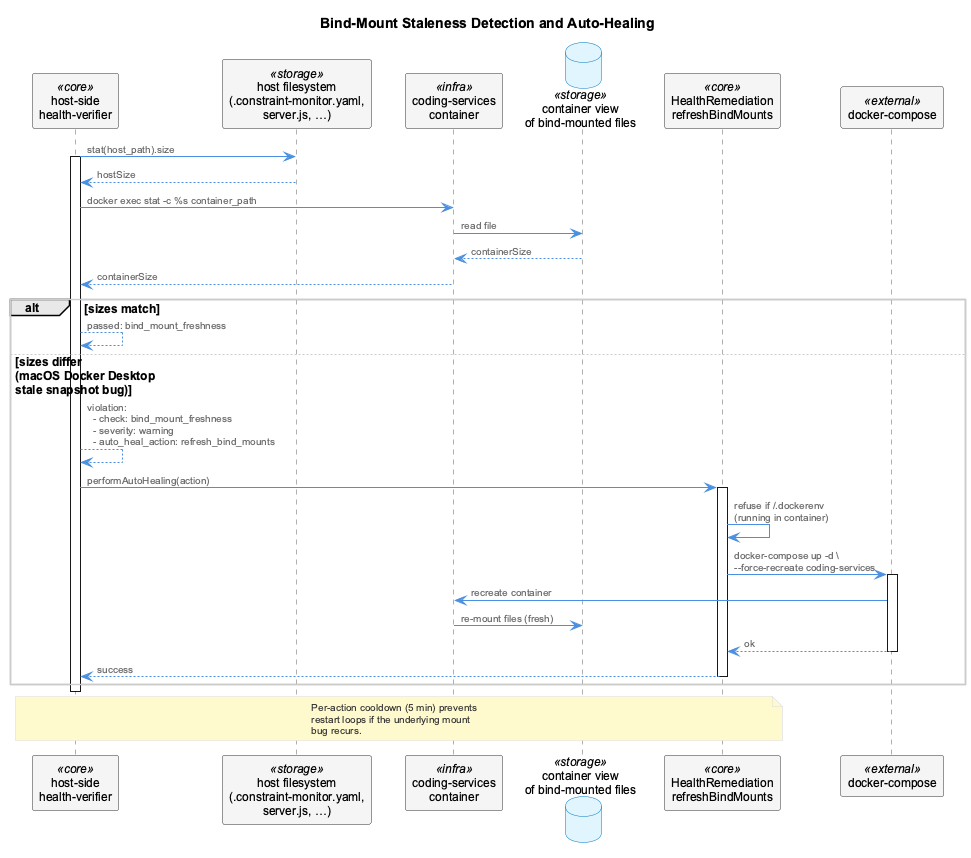
Watched files: .constraint-monitor.yaml, .global-lsl-registry.json, server.js, consolidate-observations.js. Add more in config/health-verification-rules.json under services.bind_mount_freshness.files.
See Health Monitoring.
Observational Memory¶
Single-owner observations gateway (May 3)¶
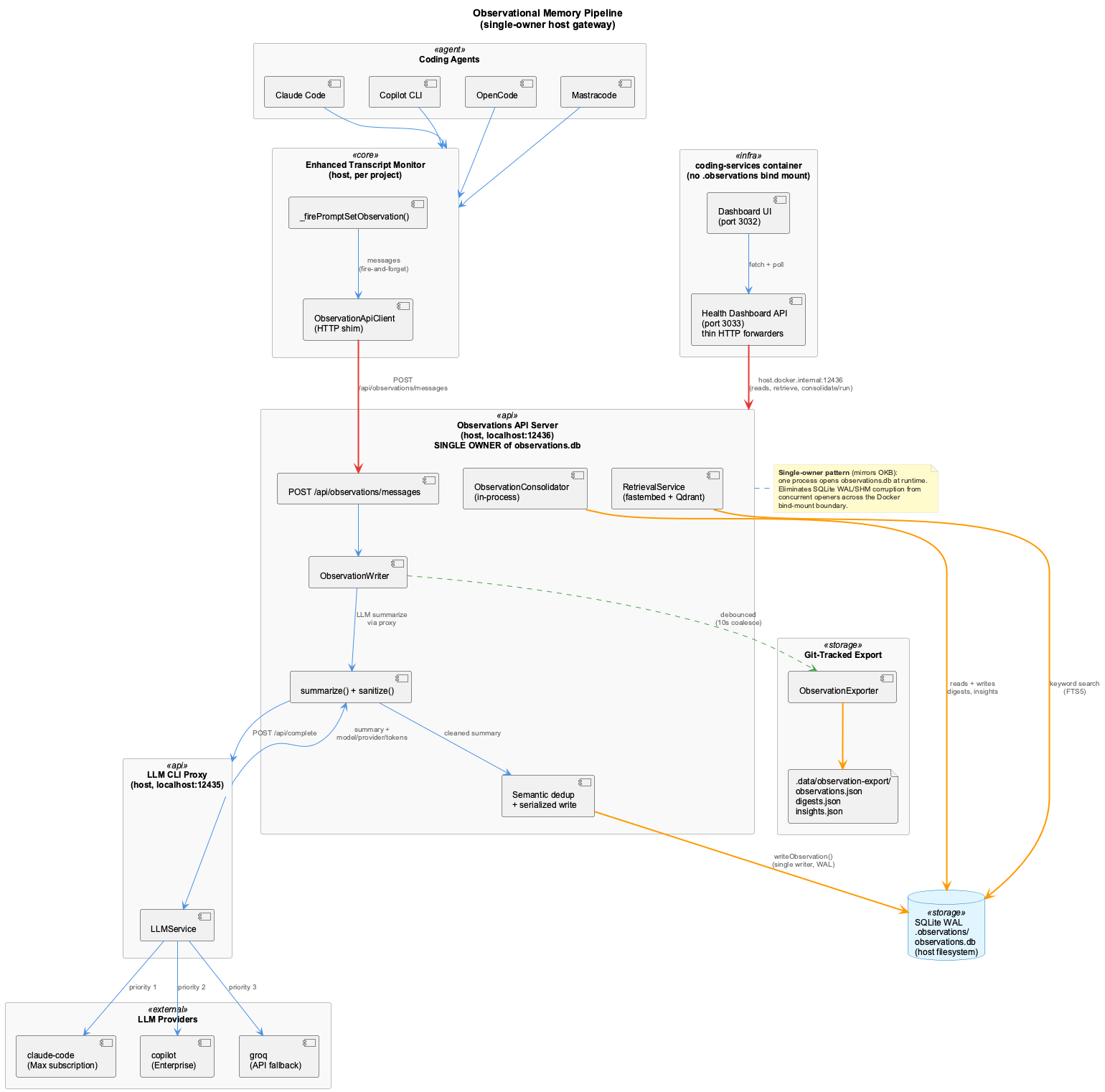
Periodic observations.db.corrupted-* files (10+ in 8 days) were traced to the canonical SQLite-on-Docker-Desktop-Mac corruption pattern: the host transcript monitor and the in-container dashboard both opened the file across the bind-mount boundary, and Apple Virtualization VM bind-mounts don't provide mmap coherence for SQLite's WAL/SHM shared memory.
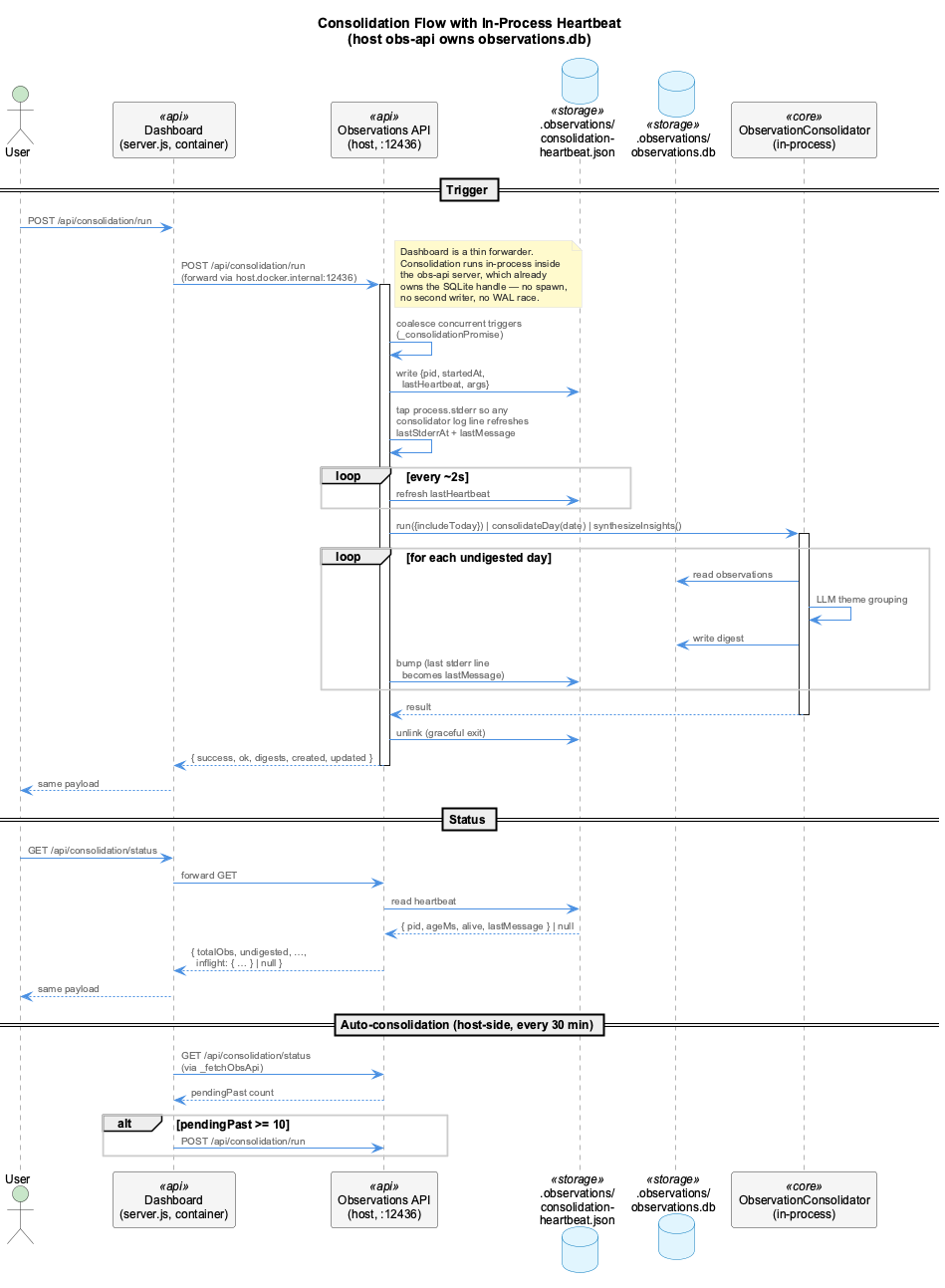
A new host service — the Observations API server at scripts/observations-api-server.mjs (port 12436) — is now the single owner of observations.db. Every other consumer reaches the DB exclusively through this HTTP gateway:
| Consumer | Before | After |
|---|---|---|
| Transcript monitor | new ObservationWriter() (direct SQLite) | new ObservationApiClient() POSTing /api/observations/messages |
| Dashboard reads (9 endpoints) | per-process readonly handle | thin HTTP forwarders to host.docker.internal:12436 |
Dashboard POST /api/retrieve | RetrievalService in container, opens DB | forward to host (RetrievalService runs in-process inside obs-api) |
Dashboard POST /api/consolidation/run | spawn consolidate-observations.js child | forward to host (ObservationConsolidator runs in-process inside obs-api) |
Container .observations mount | bind-mounted rw | mount removed entirely |
Pattern mirrors the OKB/VKB approach: one process owns the DB, everyone else over HTTP. Same five-phase rollout structure (build, migrate reads, migrate writes, migrate consolidation, drop bind mount). Verified by zero new corruption files in the 48 h window after cutover.
Per-project consolidation (Apr 26)¶
Phases A/B/C/D made the pipeline project-aware end-to-end:
- Observations carry a
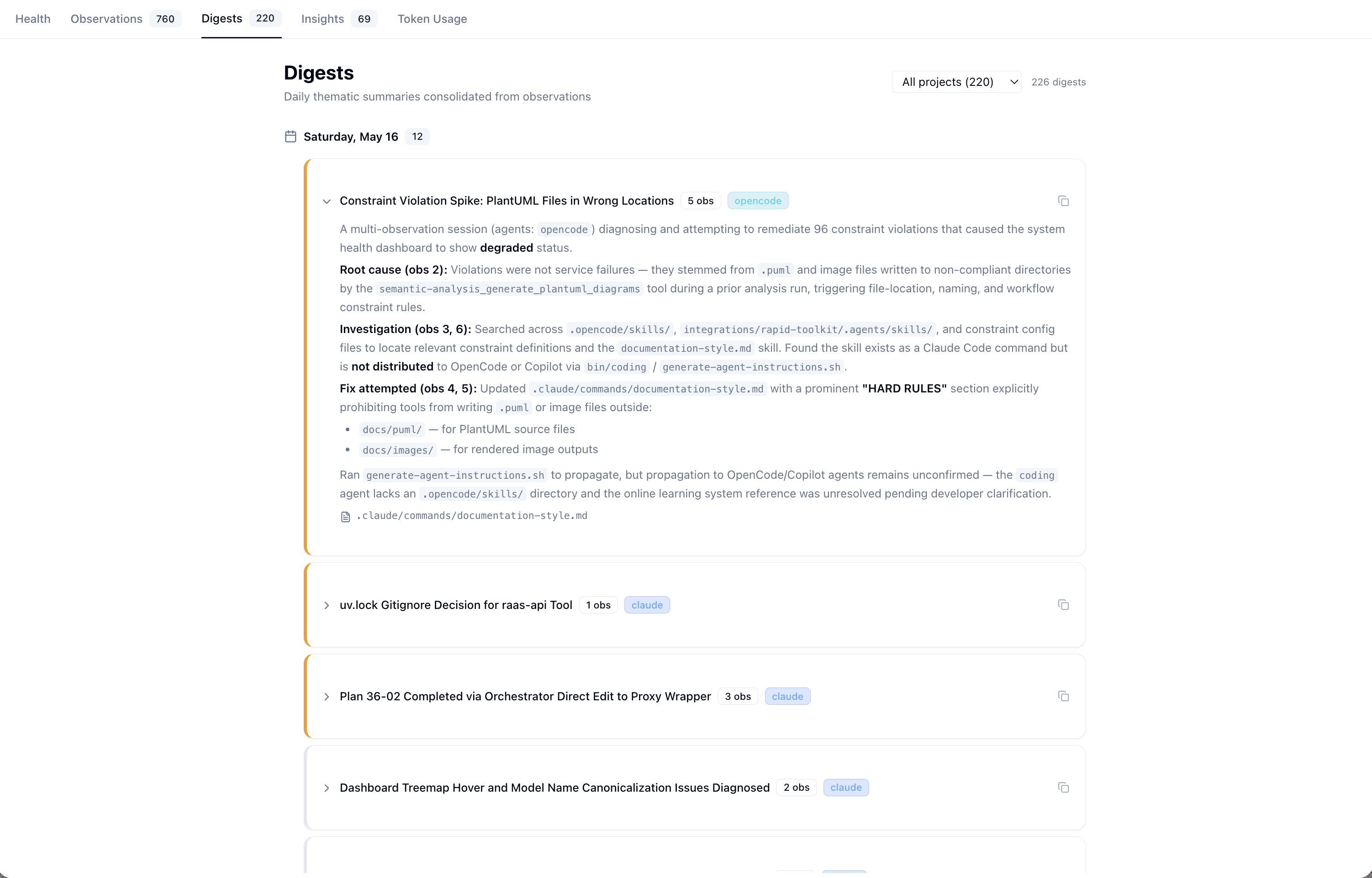
projectcolumn populated by the LSL classifier ObservationConsolidatorpartitions observations by project before LLM grouping- Insight synthesis runs per project — no more cross-project narrative bleed
- Digests/Insights pages have a project selector; API accepts
?project=<name>
Consolidator heartbeat + orphan sweep (Apr, superseded May 3)¶
Detached spawn originally protected the SQLite WAL across dashboard restarts but left orphans immortal — a 21-hour 0%-CPU run on the live dashboard prompted the work. The CLI wrote .observations/consolidation-heartbeat.json every ~2 s; any stderr line refreshed it; the dashboard swept stale heartbeats on startup.
This whole arrangement was superseded by the single-owner gateway above: consolidation now runs in-process inside the host obs-api server, which already owns the SQLite handle. No spawn, no second writer, no orphan-child timeout enforcement to worry about. The heartbeat file is still written (now by the obs-api itself) and surfaced via /api/consolidation/status so the dashboard's progress indicator continues to work.
Mixed-topic safeguards in the knowledge graph¶
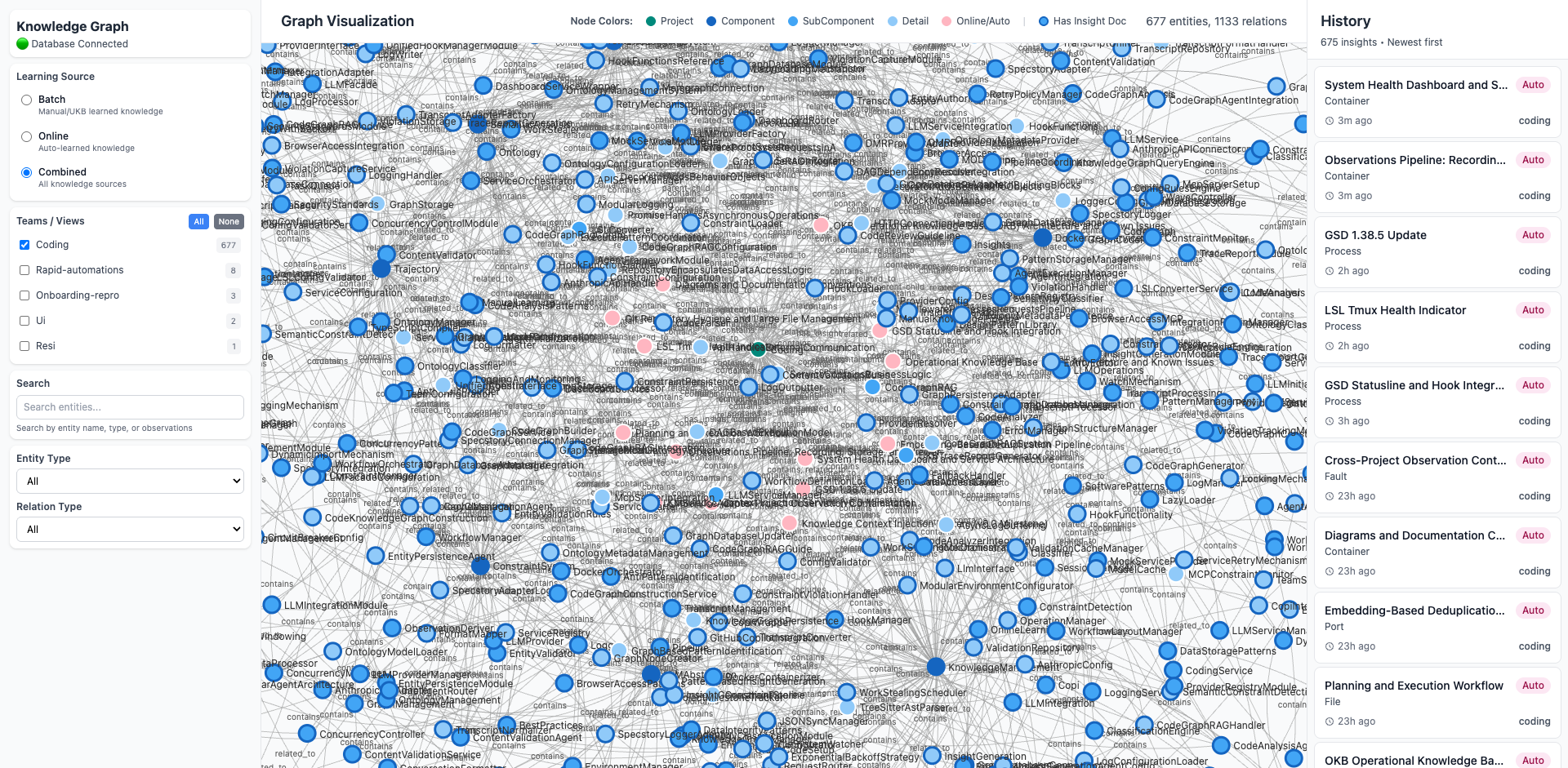
A bug walk-through discovered a "GSD Statusline and Hook Integration" entity that bundled a GSD changelog with an LSL tmux-indicator description. Cause: fuzzy name dedup at Jaccard ≥ 0.7 with no content check — hook + integration overlap was enough to trigger a merge.
Three guards now run in persistence-agent.ts:
| Gate | Threshold | Notes |
|---|---|---|
| Name match | Jaccard ≥ 0.85 over non-generic words; stop-list filters hook, integration, system, … | Requires ≥1 shared non-generic word |
| Content veto | Observation Jaccard ≥ 0.15 | Refuses merges where content disagrees |
| Mixed-topic detector | Pairwise observation Jaccard < 0.10 sets metadata.mixed_topics: true | Surfaced as an amber panel in the VKB Node Details |
Sanitizer + redaction-pattern correction¶
ObservationSanitizerrepairs legacy<AWS_SECRET_REDACTED>fragcorruption using sibling fields as the recovery oracle (e.g. matches by basename acrossmodifiedFilesarrays).- The
aws_secret_standaloneregex got lookarounds so a 40-char run inside a base64-like path can no longer be eaten as a "secret".
See Observational Memory.
Token Usage¶
Phase 36: per-(window, user) hourly exports + model-name canonicalization + treemap hover (May 16)¶
The Token Usage dashboard had two structural problems and one cosmetic one. All three closed in Phase 36 (7 plans).
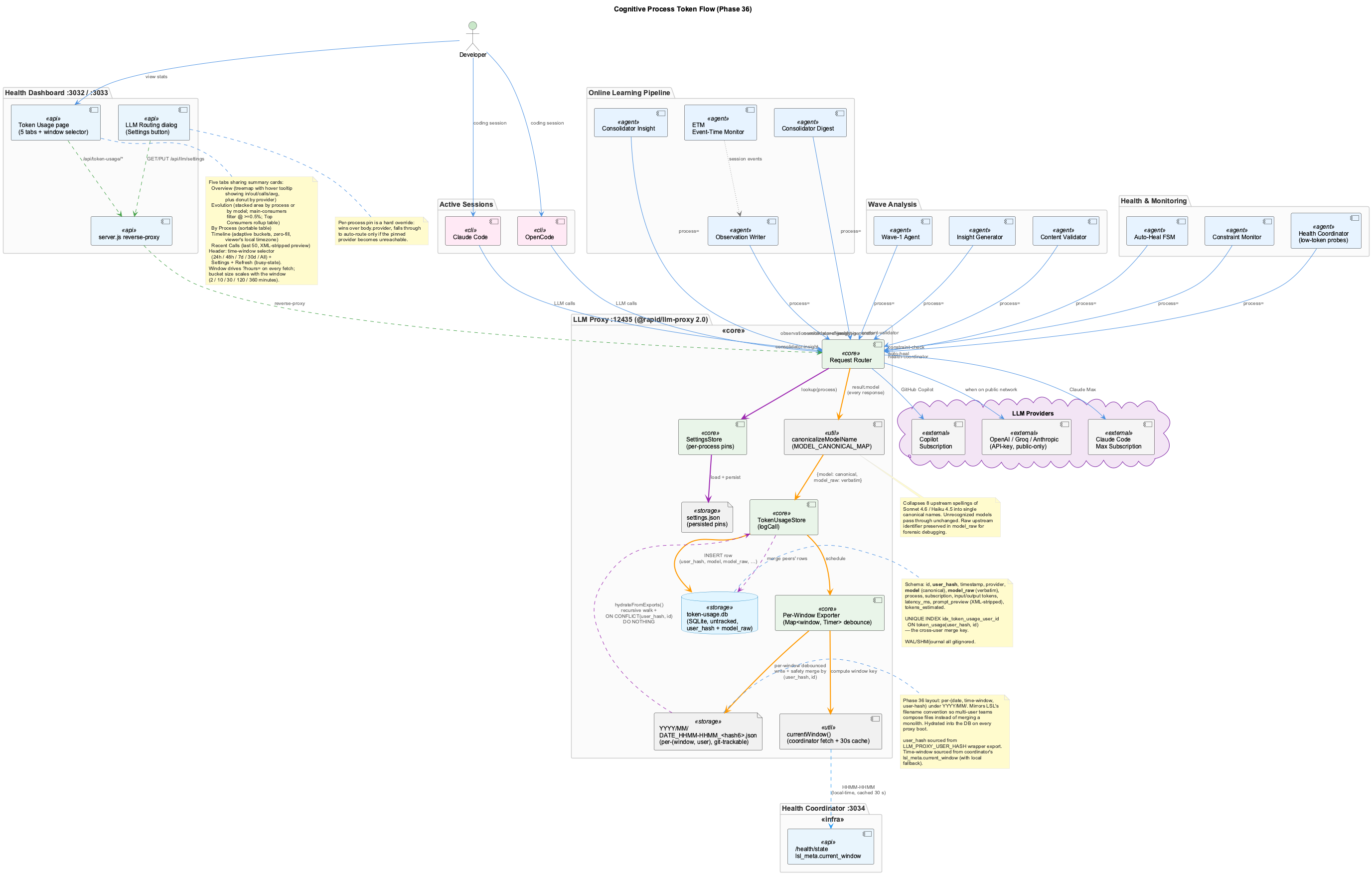
Per-(window, user) hourly exports. The single .data/llm-proxy-export/token-usage.json blob ballooned past 600 KB / 1457 rows after ~24 h on a single contributor and would have caused git merge conflicts as soon as a second user pushed exports. Switched to the same filesystem convention LSL uses: YYYY/MM/YYYY-MM-DD_HHMM-HHMM_<hash6>.json. The time-window string is now sourced from the health coordinator's new /health/state.lsl_meta.current_window field (single source of truth, computed by getTimeWindow(utcToLocalTime(now))); the proxy fetches with a 30 s cache + local fallback. The 6-char user-hash is exported by the wrapper script (_work/rapid-llm-proxy/bin/start-llm-proxy.sh) as LLM_PROXY_USER_HASH before exec node, derived from scripts/user-hash-generator.js — same hash logic used everywhere else in the project so it cross-machine-reproduces deterministically.
Cross-user merge contract. A user_hash column and UNIQUE INDEX (user_hash, id) discriminate rows. hydrateFromExports() runs on every proxy boot (the old count > 0 → return early-exit is gone) and recursively walks <baseDir>/**/*.json, inserting with ON CONFLICT(user_hash, id) DO NOTHING. After git pull brings down a peer's ..._<other-hash>.json, the next proxy kickstart ingests it and the peer's rows appear in the dashboard alongside yours. The composite key supplies idempotency, not skipping.
.gitignore cleanup. .db-wal / .db-shm / .db-journal weren't covered by the old *.db rule, so .data/llm-proxy/ kept showing dirty in git status whenever the SQLite WAL had data. Replaced the single *.db line with explicit per-suffix entries matching the existing .data/knowledge.db precedent. !.data/llm-proxy-export/ allow-list preserves the new per-hour files for git.
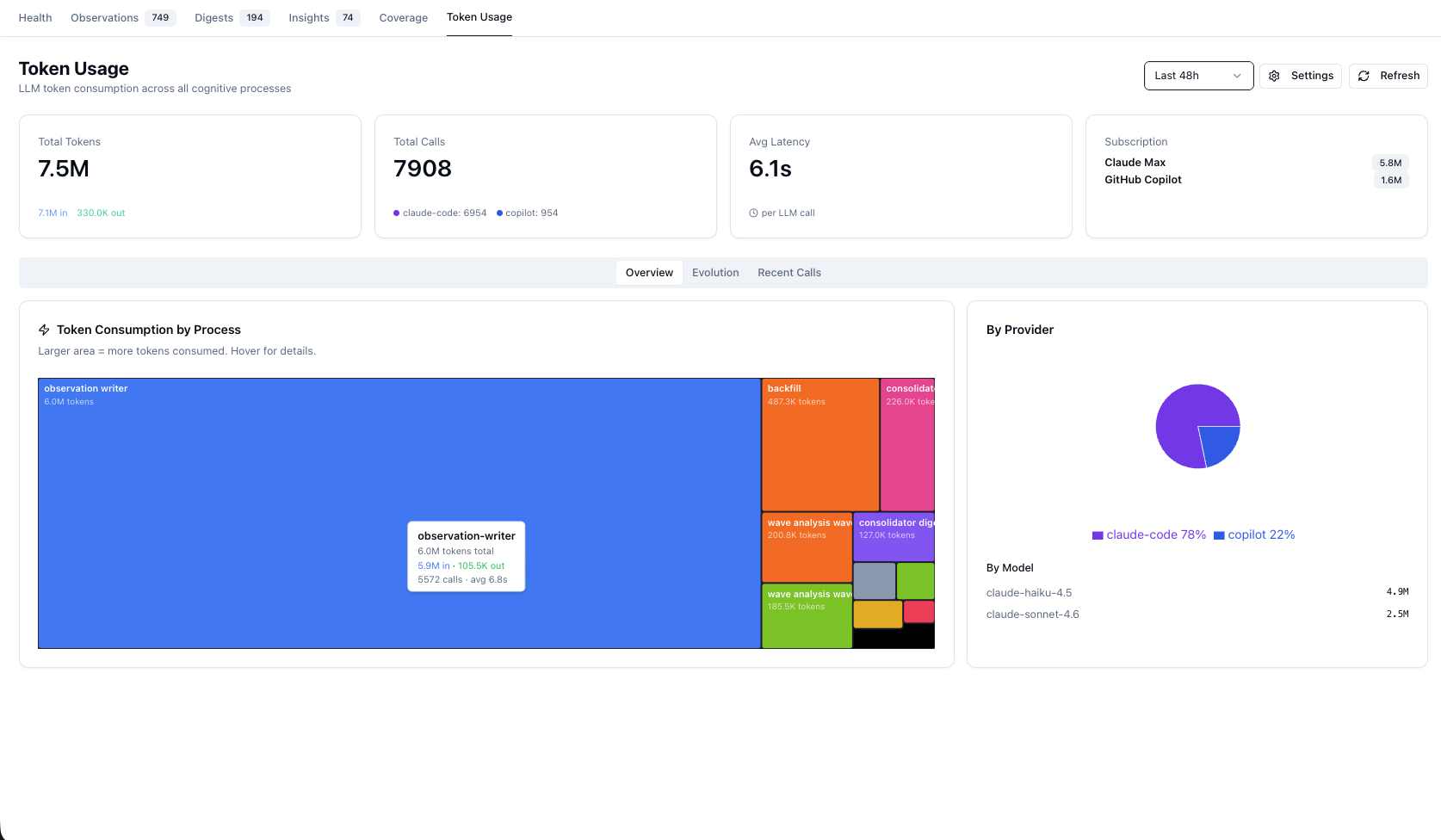
Model-name canonicalization. The "By Model" panel was showing 8 rows for what is really 3 Claude models — each provider returns its own spelling and the proxy was recording the raw string verbatim. canonicalizeModelName(raw) now lives next to the existing model-maps in proxy-bridge/server.mjs and is applied once at the logTokenCall site. The raw spelling is preserved per row in a new model_raw column (same PRAGMA-guarded ALTER pattern as user_hash) so debugging "did Copilot serve the dated snapshot or the rolling alias?" still works. An idempotent backfill on proxy init rewrites pre-existing rows once (WHERE model_raw IS NULL); re-runs are no-ops.
| Family | Variants seen pre-canonicalization | Canonical |
|---|---|---|
| Sonnet 4.6 | claude-sonnet-4-6 (CLI), claude-sonnet-4.6 (Copilot), Claude Sonnet 4.6 (Anthropic), bare sonnet (CLI fallback) | claude-sonnet-4.6 |
| Haiku 4.5 | claude-haiku-4-5-20251001 (Copilot dated), claude-haiku-4.5, Claude Haiku 4.5 | claude-haiku-4.5 |
| Opus 4.6 | (proactive) | claude-opus-4.6 |
Treemap hover tooltip. The "Hover for details" subtitle on the Token Consumption by Process treemap was aspirational — recharts.Treemap had no <Tooltip> child, and the inline label only renders for boxes ≥ 40×30 px so smaller processes were silent. Added a TreemapTooltip component (process / total / in/out split / calls / avg latency) wired as a Tooltip child, plus an SVG <title> element inside each rect for screen-reader/native-browser fallback. Playwright-verified on both small (reap-final, 81×44 px) and large (observation-writer, 981×352 px) boxes.
See Token Usage and the updated token-usage-architecture.png / health-mon-tokens-usage.png diagrams.
Dashboard / VKB rendering¶
| Fix | Symptom |
|---|---|
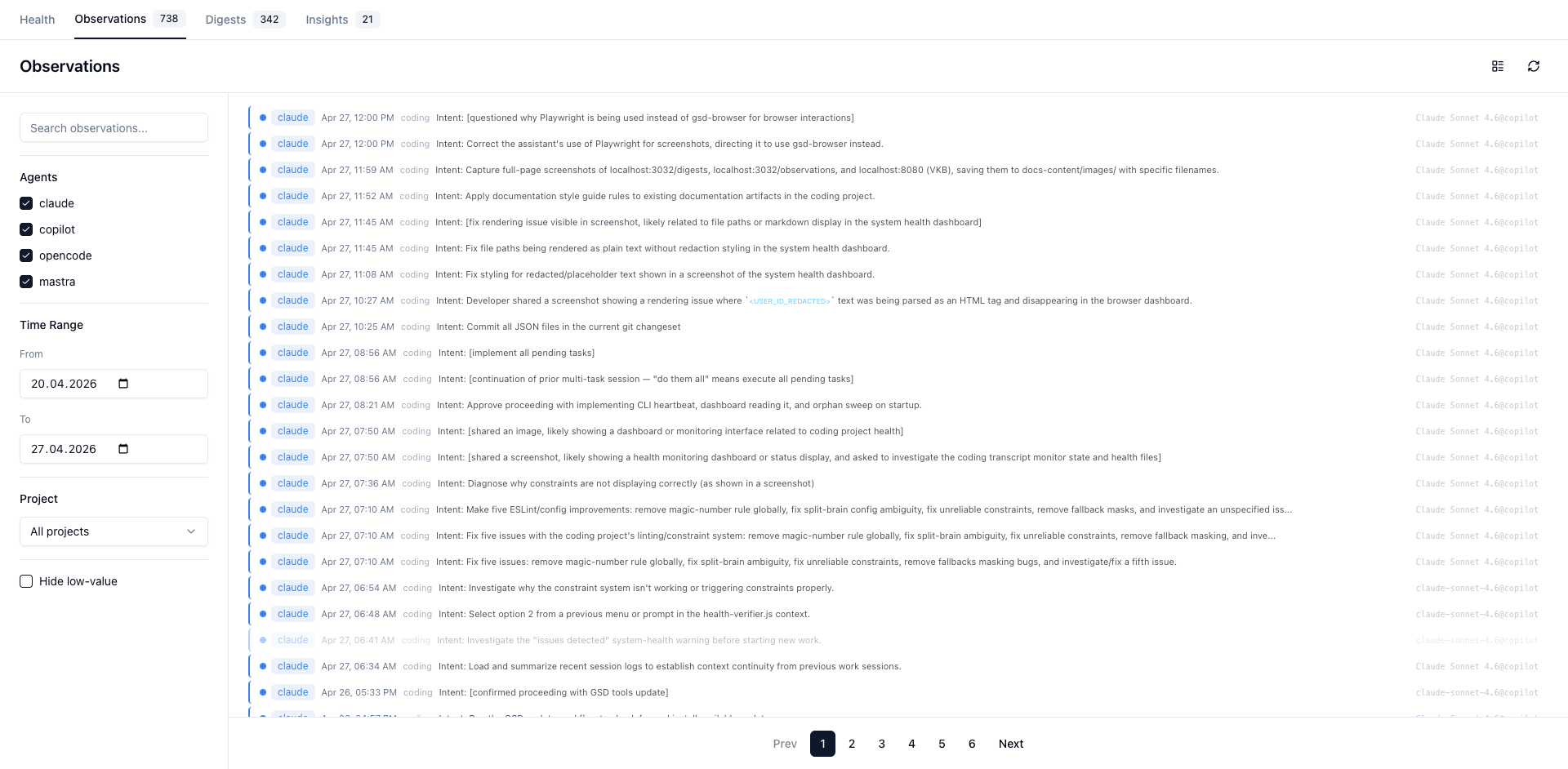
escapeHtml pre-pass in renderMarkdown | <USER_ID_REDACTED> rendered as an unknown HTML element and disappeared, producing visually broken paths like /Users//Agentic/... |
| Redaction-token styling | All <*_REDACTED> markers now render as smaller (text-[0.78em]) sky-blue spans across observations, digests, and insights |
renderWithRedactionStyling helper | Plain-text path renders (digest filesTouched, observation compact-row summaries) get the same treatment |
| VKB mixed-topic panel | Entities with metadata.mixed_topics: true get an amber warning in the Node Details sidebar |
| Hanging-indent bullets | Wrapped bullet text now aligns to the body, not under the marker |
Other¶
coding-servicesDocker config:CODING_REPO=/codingenv var; bind-mounts for.constraint-monitor.yaml,.mcp-sync/, the dashboardserver.js, and the consolidator CLI.gsd-updateworkflow: bumped to GSD1.38.5after the previous run; 7 custom skills (codecraft-zuul-api, ddad-rpu, find-docs, fix-vulnerabilities, get-codeowner, raas-api, s3-session-search) were preserved across the install.- Cross-team relations + project-anchor connection in the KG so insights from online learning attach to the right project node.