Does Knowledge Injection Help? A Controlled A/B
Two arms of the same agent, differing only in whether retrieved knowledge is prepended to the prompt. Graded mechanically, with no model in the loop.
The headline
On tasks whose answers live in the knowledge base rather than in the code, the control arm failed where the treatment arm succeeded in 9 of 11 cases (82%, 95% Wilson 52–95%) — and spent 3.1× the steps, 1.8× the wall-clock and 6.8× the tokens failing.
Injection was not a trade of cost against accuracy. It was cheaper and correct.
The kind of test
Closed-book versus open-book, not needle-in-a-haystack. The graded fact is deliberately absent from the frozen repository copy both arms work in, so the only way to know it is to have been given it.
Each task asks for an operator runbook, graded by regular expressions over the produced file.
The caveat that must travel with the number
82% is not the probability that injection helps on an arbitrary task, and must never be quoted as though it were.
The gates are mined from what the treatment arm wrote, so the treatment arm passes them close to by construction. The load-bearing half of the measurement is the control arm's failure — which nothing in the gate's construction arranged, because the control arm is never consulted while a gate is built.
What it does not establish
One model, one repository, deliverables that are documents rather than code that must compile and pass tests. At n=11 the interval is wide enough to size the next round rather than settle the question — report it as a pilot.
One curated task showed injection making things worse. That is the most transferable finding here.
Two rounds, two different questions
| Round 1 — curated | Round 2 — sampled | |
|---|---|---|
| Tasks | 3, hand-written | 11, derived mechanically from KB insights |
| Cells | 18 | 66 |
| Answers | how large is the effect | how often does it arise |
| Headline | 6/6 accepted vs 0/6 on the two surviving tasks | 9 of 11 tasks discriminate — 82% |
The split matters. Hand-written tasks can show that an effect is real and large, but they cannot tell you how often it occurs, because you chose them. Mechanically derived tasks can answer the frequency question, at the cost of a subtler bias that has to be argued about rather than assumed away.
Why the design is believable
Isolation. Both arms get the same model, the same tools and the same frozen copy of the repository. The only difference is whether retrieved knowledge is prepended.
The fact is absent. Because the graded fact does not exist anywhere in the sandbox, an arm without injection cannot find it by searching harder. This is what makes the comparison closed-book against open-book rather than a test of retrieval skill within a corpus.
Grading has no model in it. Regular expressions over the produced file. A model-graded result would put the thing being measured on both sides of the experiment.
The control arm is never consulted while a gate is built. This is the single most important property. It means the treatment arm's near-guaranteed pass rate is uninformative and discarded, while the control arm's failure rate — the number the conclusion rests on — is untouched by how the gates were made.
Reading the result correctly
The honest statement is: on tasks constructed from knowledge the codebase does not contain, an agent without that knowledge failed 82% of the time, while burning several times the resources doing so.
The dishonest paraphrase — "injection helps 82% of the time" — silently swaps the population. The tasks were selected to be ones where knowledge could matter; the frequency of such tasks in real work is not measured here.
The cost figures are the part that generalises most comfortably. A failing agent does not fail quickly: it searches, re-reads and retries, which is why the control arm spent 6.8× the tokens to arrive nowhere.
The next round
A larger n to narrow the interval, a second repository to test whether the effect is a property of this codebase, and deliverables with objective pass/fail tests rather than documents. The negative case from round 1 — where injection hurt — deserves its own investigation before the positive result is scaled.
This project maintains a knowledge base built from its own history — insights distilled from past sessions, a graph of components, digests, raw observations. A retrieval service selects the pieces relevant to whatever an agent is about to do and prepends them to its prompt. That machinery is expensive to build and to run, and this report measures whether it works.
Two rounds were run, answering two different questions. The first used three hand-written tasks and measured how large the effect is when it occurs. The second derived its tasks mechanically from the knowledge base and measured how often it occurs at all — the number that decides whether the system earns its keep.
The report is written to be readable without prior exposure to this codebase.
Summary
The setup. Two arms of the same agent — same model, same tools, same frozen copy of the repository — differing only in whether retrieved knowledge is prepended to the prompt. The graded fact is deliberately absent from the repository, so this is a closed-book/open-book exam, not a needle-in-a-haystack test. Each task asks for an operator runbook and is graded mechanically, by regular expressions over the produced file, with no model in the loop.
| Round 1 — curated | Round 2 — sampled | |
|---|---|---|
| Tasks | 3, hand-written | 11, derived mechanically from KB insights |
| Cells | 18 | 66 |
| Answers | how large is the effect | how often does it arise |
| Headline | 6/6 accepted vs 0/6 on the two surviving tasks | 9 of 11 tasks discriminate — 82% (95% Wilson 52%–95%) |
The result. On tasks whose answers live in the knowledge base rather than in the code, the control arm failed where the treatment arm succeeded in nine cases out of eleven — and spent 3.1x the steps, 1.8x the wall-clock and 6.8x the tokens failing. Injection was not a trade of cost against accuracy. It was cheaper and correct.
The caveat that travels with the number. 82% is not the probability that injection helps on an arbitrary task, and must never be quoted as though it were. Round 2's gates are mined from what the treatment arm actually wrote, so the treatment arm passes them close to by construction. The load-bearing half of the measurement is the control arm's failure — a quantity nothing in the gate's construction arranged, because the control arm is never consulted while a gate is built. What the number means precisely is set out under Design.
What it does not establish. One model, one repository. Deliverables are documents, not code that must compile and pass tests. At n=11 the interval is wide enough to size the next round rather than settle the question — report it as a pilot. And one curated task showed injection making things worse, which is the most transferable finding here.
Reading guide
| If you want | Read |
|---|---|
| the result, and nothing else | this summary |
| grounds to believe it | Design — isolation, task provenance, the rules governing selection |
| what a task actually looks like | The tasks, verbatim |
| the numbers | Results |
| the limits | What this establishes |
| how measurements like this go wrong | Pitfalls — nine real failures, each with the measure that closed it |
The question
The project maintains a knowledge base built from its own history — insights distilled from past sessions, a knowledge graph of components, daily digests, raw observations. A retrieval service selects the most relevant pieces for whatever the agent is about to do and prepends them to the prompt.
That machinery is expensive to build and run. The question it has to answer is simple:
Given a task whose answer is recorded in the knowledge base but not in the code, does an agent with injection do better than the same agent without it?
"Better" is deliberately narrow here: does it produce a correct answer, and at what cost in tokens, tool calls and wall-clock time.
What kind of test this is
This is frequently mistaken for a needle-in-a-haystack test. It is the opposite, and the difference decides how the results should be read.
A needle-in-a-haystack test plants a fact inside a long context and asks whether the model can still find it. The needle is in the haystack; the question is attention over distance.
Here the fact is deliberately absent from the haystack. Both arms are dropped into the same frozen copy of the repository, with the knowledge base stripped out of it. Only the treatment arm additionally receives the fact — a few kilobytes of retrieved insights, prepended to its system prompt. It is a closed-book / open-book exam in which the textbook does not contain the answer: both students get the repository, one also gets the lecturer's private notes, and the exam question is one the textbook never covers.
That framing splits the headline question into two independent ones, and a task is only informative if both are live:
- Does the treatment arm use what it was handed? Having a fact in the prompt does not put it in the answer. One task in this run received the correct knowledge and wrote a runbook contradicting it.
- Can the control arm reconstruct the fact from the repository? If it can, the knowledge base is redundant for that task — the project is paying to store something the code already says.
Every combination of those two carries a different meaning, and all four occurred at some point during the design:
| kb-on produces it | kb-off produces it | What it means |
|---|---|---|
| yes | no | Injection carried the answer. The task discriminates — this is the measurable case. |
| yes | yes | The repository already answers it. The task is uninformative and the KB adds nothing here. |
| no | no | Either the gate demands something the KB does not contain, or the task is beyond both arms. |
| no | yes | Injection actively hurt. Investigate — this happened, and the reason is the most transferable finding in this report. |
Getting a task into the first row is the hard part, and it is where three earlier attempts failed. It requires a fact that is simultaneously carried by the knowledge base, absent from the repository, and naturally demanded by a realistic goal — an intersection that is nearly empty, because knowledge-base insights are prose about this repository and therefore tend to name identifiers that also exist in it.
Terminology
Terms used throughout, defined once.
| Term | Meaning |
|---|---|
| Arm | One side of the comparison. kb-on receives injected knowledge; kb-off is identical in every other respect and receives none. |
| Cell | One execution: a single arm × a single repeat of a single task. This run had 18 cells. |
| Spec | A task definition — goal sentence, deliverable filename, grading rule, number of repeats. |
| Snapshot | A frozen copy of the repository at a known commit, plus its knowledge base and config, from which every cell starts. Guarantees all cells begin from identical state. |
| Sandbox | The throwaway working directory a cell runs in, materialised from the snapshot. Discarded afterwards. |
| Fact | One checkable claim the deliverable must contain, expressed as a regular expression. |
| Conjunction gate | A cell passes only if it produces all required facts. Replaces earlier single-token grading. |
| Coinage | Whether a model produces a fact unprompted, from its own prior knowledge, with no repository and no knowledge base. A fact the model coins cannot distinguish the arms. |
| Recoverable | Whether the control arm could find a fact by searching the sandbox. |
| Leak | Any path by which a cell reaches information outside its sandbox — the failure mode this experiment spent most of its effort eliminating. |
| Blind signal | A property of a candidate fact measurable before any cell runs — and therefore usable to drop it without biasing the result. |
| Discrimination rate | The fraction of knowledge-derived tasks whose answer the control arm cannot reproduce. |
| Mined gate | A conjunction whose facts were taken from deliverables the treatment arm actually produced, intersected across repeats. |
Design — how the experiment avoids fooling itself
An A/B of this shape has one dominant failure mode: producing a clean, confident, wrong number. Three separate rounds did exactly that before the design below settled. Everything in this section exists to close a specific way the measurement can flatter itself, and each measure is traceable to a failure recorded under Pitfalls.
The four threats
| Threat | If unaddressed | Closed by |
|---|---|---|
| Leakage — the control arm reaches the answer from outside its sandbox | both arms pass; the effect vanishes | isolation, audited per cell |
| Coinage — the model already knows the fact | both arms pass; the KB gets credit for the model's training | a bare-model probe per fact |
| Selection — facts chosen because they flatter the treatment arm | the rate restates the choices made while building it | blind signals only |
| Gate difficulty — the conjunction is unsatisfiable for a working agent | both arms fail; reads as a hard task | gates mined from real deliverables |
Isolation
Both arms start from the same snapshot: a frozen copy of the repository at a known commit, with the knowledge base stripped out, materialised into a throwaway sandbox. Isolation turned out not to be one property but four, each of which had to be closed and verified separately — an allow-list naming host paths, project identity leaking through git linkage, agent instruction files discovered by walking up out of the sandbox, and ambient environment. The full account is pitfall 1; the surviving measure is that every cell's transcript is audited for out-of-sandbox paths, and the audit is reported beside the results rather than assumed. Round 1: zero leaks across 18 cells.
Where the tasks come from
Round 1 — curated. Three tasks were written by hand because their answers were known to live in the knowledge base and not in the code. This yields an existence result and a clean effect size, and says nothing about frequency: the tasks were chosen because they had the property being tested.
Round 2 — sampled. To get a frequency, the task population must not be chosen task by task. The derivation is mechanical: take every knowledge-base insight above a confidence threshold, draw from that frozen population against a recorded seed, and turn each drawn insight into a runbook goal built from the symptom it describes. The round reported here drew 36 from a population of 162 at confidence ≥ 0.8, under seed pilot-3.
Candidate generation uses a model, and is deliberately not a measurement: any capable model may propose candidate facts, because nothing a generator proposes survives without passing the filters below. The round reported here nonetheless carries an empty generator-provenance record — see pitfall 10 — which does not invalidate it, for exactly that reason, but does mean the derivation cannot be fully replayed from the ledger alone. The coinage probe's model is recorded (claude-sonnet-4.6), and that one is load-bearing.
How a gate is built
A cell passes only if its deliverable contains every required fact — a conjunction, not a single token. How those facts are chosen is the crux of the whole design.
The instinct is to predict what a good answer looks like: hand a model the insight, let it write an ideal runbook, and keep the facts that appear in every such reference. That was tried, and it failed measurably. A reference is written with no sandbox, no tools, no instruction to actually do the work and no pressure to be brief; a real cell writes under all four. Every fact in a conjunction can appear in every reference and the conjunction still be jointly unsatisfiable for an agent doing the job for real — which is what produced a round where seven of eight tasks failed in both arms.
The design that replaced it stops predicting a good answer and reads one. Gates are mined from what the treatment arm actually wrote. The injected arm runs first, three times per task, and a fact is eligible only if it appears in every one of those deliverables. A task producing fewer than two deliverables is dropped outright: one deliverable cannot distinguish a stable fact from an incidental one. This is how the three curated tasks were built, which is precisely why they never had this problem.
The rules that govern selection
Mining the gate from injected output means the treatment arm passes close to by construction. That is an acceptable cost only because of what it does not touch — and three rules, each the inverse of an instinct, keep the surviving quantity a measurement.
1. Only blind signals may drop a fact. A candidate is dropped if it fails a shape check, if it does not appear in the block retrieval actually returns, if the bare pinned model coins it unprompted, or if the goal sentence gives it away. Every one of those is measurable before any cell runs. No arm outcome ever feeds selection. That is the property that keeps the rate an estimate rather than a restatement of the choices made while building it.
2. The recoverability audit is a covariate, never a filter. The obvious design runs only the tasks whose facts the control arm could not find by searching. It is wrong, and this experiment measured why: a curated task whose four facts are all grep-able still discriminated decisively, because the control arm searched 123 times across three cells and never found two of them. Filtering on the audit discards discriminating tasks and biases the rate upward by an unknown amount. Every sampled task runs; the verdict is recorded beside it as a column.
3. The same logic forbids dropping a fact merely because it sits in the sandbox. Whether the control arm can actually reach a fact is the outcome being measured — not an assumption to bake into selection.
Finally, the control arm is never consulted while a gate is built. Nothing the control arm does can widen or narrow the set of facts it is later graded on. That single property is what makes the discrimination rate a genuine measurement despite everything conditioned above.
What the resulting number means, precisely
The discrimination rate is the fraction of knowledge-derived tasks whose answer the control arm cannot reproduce. It is a direct measure of how much of the knowledge base is non-redundant.
It is conditional on the derivation — the population, the confidence threshold, the blind filters, and gates mined from treatment output — and it is not the unconditional probability that injection helps. Reported alongside it is the effect size on the tasks that discriminate, because a rate without an effect size says nothing about whether the wins are worth having.
Measurement
Same model (claude-sonnet-4-6), same snapshot, same goal text, same tooling; the injected block is the only difference between arms. Three repeats per arm. Grading is mechanical — regular expressions over the produced file — so it cannot drift. Tokens, tool-call counts and wall-clock are recorded per cell from the proxy that meters every LLM call. A task counts as discriminating when a majority of the treatment arm's repeats are accepted and a majority of the control arm's are not; the stricter all-or-nothing reading is reported beside it, because the choice moves the number.
Cells that never executed are excluded rather than scored. A skipped cell writes a row, and counting rows rather than graded results reports "neither arm solved it" about an agent that was never invoked — see pitfall 9.
The tasks, verbatim
These are round 1's three hand-written tasks, shown in full because they make the shape of the exercise concrete; round 2's eleven are built the same way but derived mechanically. Each arm receives the goal sentence and nothing else task-specific. Same model, same snapshot, same tools; the injected block is the only difference.
Task 1 — kb-ab-etm-crashloop
Create a file named
etm-crashloop-runbook.mdat the repository root that diagnoses this symptom for an operator: the tmux statusline shows[LSL red]and the project's agent letter turns yellow, while the Health API at port 3033 still reports every service green. The file must state the root cause, give the exact shell commands to confirm it, and give the exact command that fixes it.
The real cause is a hand-made symlink — node_modules/@fwornle/km-core, which appears in no package.json, so npm install neither creates nor restores it. When it disappears, every telemetry-writer spawn dies instantly, yet the Health API stays green because the writer is not a service. Nothing at the import site hints at any of this.
| Fact | Pattern | Why it is decisive |
|---|---|---|
symlink-path | node_modules/@fwornle/km-core | The root cause. The import site gives no hint that the dependency is a hand-made link. |
fix-command | ln -s | An agent that only diagnoses has not finished the task. |
launchctl-check | launchctl | The crash-loop is visible as a non-zero exit in the launchd job, not in any service log. |
health-is-wrong-place | green because it is not a service | The decisive insight — it explains why the obvious diagnostic tool lies. |
Task 2 — kb-ab-leveldb-amplification
Create a file named
leveldb-amplification-runbook.mdat the repository root that diagnoses this symptom for an operator: a dashboard HTTP route that only READS data is polled every 30 seconds, and the container serving it is killed by the kernel out-of-memory killer on roughly every poll, even though its own startup logs are clean and fast. The file must state the root cause, name the option that fixes it, and give a cheap positive test that confirms the diagnosis before any fix is applied.
The cause is a chain no single file states: the graph store's close() persists by default, and it writes the whole graph as one value under one key — so a store opened purely to read rewrites everything on close. At one megabyte per poll against an eight-megabyte graph, open() alone eventually exceeds the container's memory limit.
| Fact | Pattern | Why it is decisive |
|---|---|---|
persist-option | persistOnClose | The option that fixes it. It landed after the snapshot, so it cannot be found in the sandbox at all. |
read-open-still-writes | close persists even on a read-only open | The mechanism. Reaching it without the KB means inventing the close-path behaviour — measured 0/3 in the control and 0/3 with no knowledge at all. |
cgroup-not-docker-stats | memory.events / cgroup | Pure experience: docker stats under-reports, because the spike outruns its one-second sampling. |
cheap-positive-test | du -sh / .ldb | The goal demands confirmation before a fix — one GET adding a megabyte of SST files is it. |
Task 3 — kb-ab-llm-routing (retired)
Create a file named
llm-routing-runbook.mdat the repository root explaining to an operator how this project decides which provider and model serves a given background job. The file must say where the routing configuration lives, what each provider declares about the models it can serve, what happens at start-up when that configuration cannot be parsed, and how a change to it is picked up.
Retired after the run, for a reason that turned out to be worth more than the task. See Where injection fails.
How a deliverable is graded
node scripts/kb-ab-assert.mjs <topic> reads the produced file and tests each pattern against it. There is no model in the loop — grading is a conjunction of regular expressions, so it cannot drift between runs. Two numbers are reported:
- Facts — the mean count of the four patterns present. Partial credit, showing how far an arm got.
- Accepted — the all-four conjunction. A cell passes only if it produced every required fact.
The obvious objection to regex grading is that it tests for a string, not for understanding: a cell could in principle emit the right token inside a wrong sentence. Three things bound that risk. The gate is a conjunction of four independent facts spanning cause, confirmation and fix, which is hard to satisfy accidentally. The facts were selected empirically against deliverables already on disk rather than chosen by intuition (see pitfall 4). And the judge separately scores the remaining rubric dimensions from the diff, so a cell that games the strings does not thereby score well overall. Grading was previously a single grep for one token; that gate could not tell diagnosing the cause apart from giving the fix, and every cell of an earlier run passed it while differing sharply in what it actually explained.
How injection works
Every prompt the agent submits triggers a retrieval pass. The dashboard exposes exactly what happened on each one, which is what makes the experiment auditable rather than a black box.
What gets retrieved, and what gets rejected
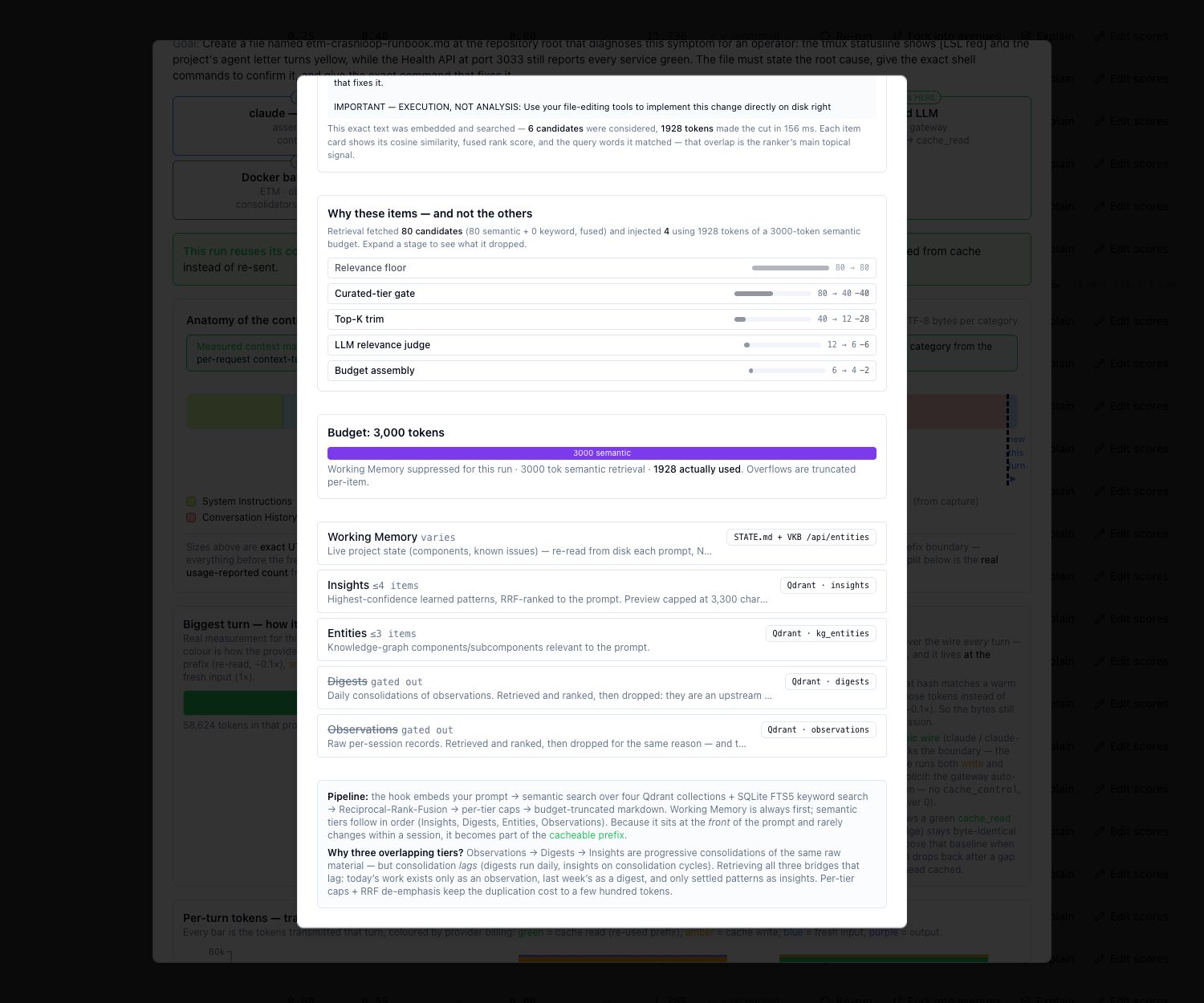
The panel above is from a real kb-on cell in this run. Reading it top to bottom:
- The prompt that drove retrieval is shown verbatim. It is embedded and searched — nothing else is used as the query.
- 80 candidates were fetched (80 by semantic similarity, 0 by keyword search) and fused.
- Five stages then reduce 80 to 4:
| Stage | In → Out | What it does |
|---|---|---|
| Relevance floor | 80 → 80 | Drops candidates below a similarity threshold. Nothing fell out here. |
| Curated-tier gate | 80 → 40 (−40) | Drops whole content tiers — see below. |
| Top-K trim | 40 → 12 (−28) | Keeps only the best-ranked candidates per tier. |
| LLM relevance judge | 12 → 6 (−6) | A model reads each survivor and rejects the ones that do not actually bear on the prompt. |
| Budget assembly | 6 → 4 (−2) | Fills the token budget in rank order; the rest do not fit. |
- Budget: 3,000 tokens, of which 1,928 were actually used. The budget is the binding constraint on how much knowledge reaches the model.
- The tier table shows why whole categories were rejected. Digests and Observations are retrieved and ranked, then deliberately gated out: digests are an upstream precursor of insights rather than independent knowledge, and observations outnumber insights roughly 11:1, so they crowd the budget without adding information. Only Insights (≤4 items) and Entities (≤3 items) survive into the prompt.
This is the sense in which "rejected" is meaningful here: rejection happens at five distinct stages for five different reasons, and the panel attributes each drop to its stage.
What actually gets injected
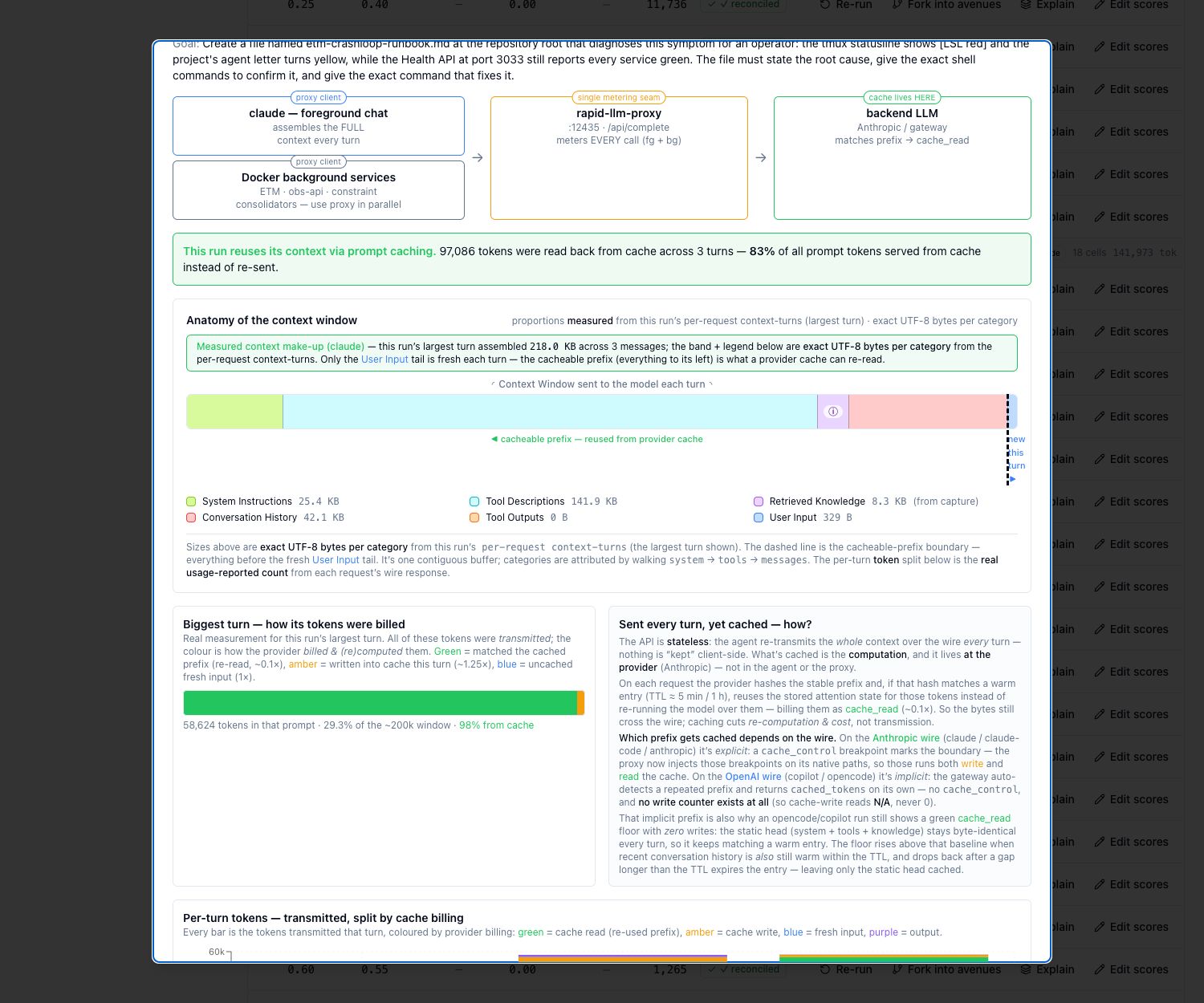
The same cell's context window, measured in exact bytes rather than estimated. Retrieved Knowledge: 8.3 KB is the injected block. It sits near the front of the prompt, ahead of the conversation, which is also why it is cheap: it becomes part of the cacheable prefix and is re-read from the provider cache on later turns rather than re-sent.
The control arm, for contrast
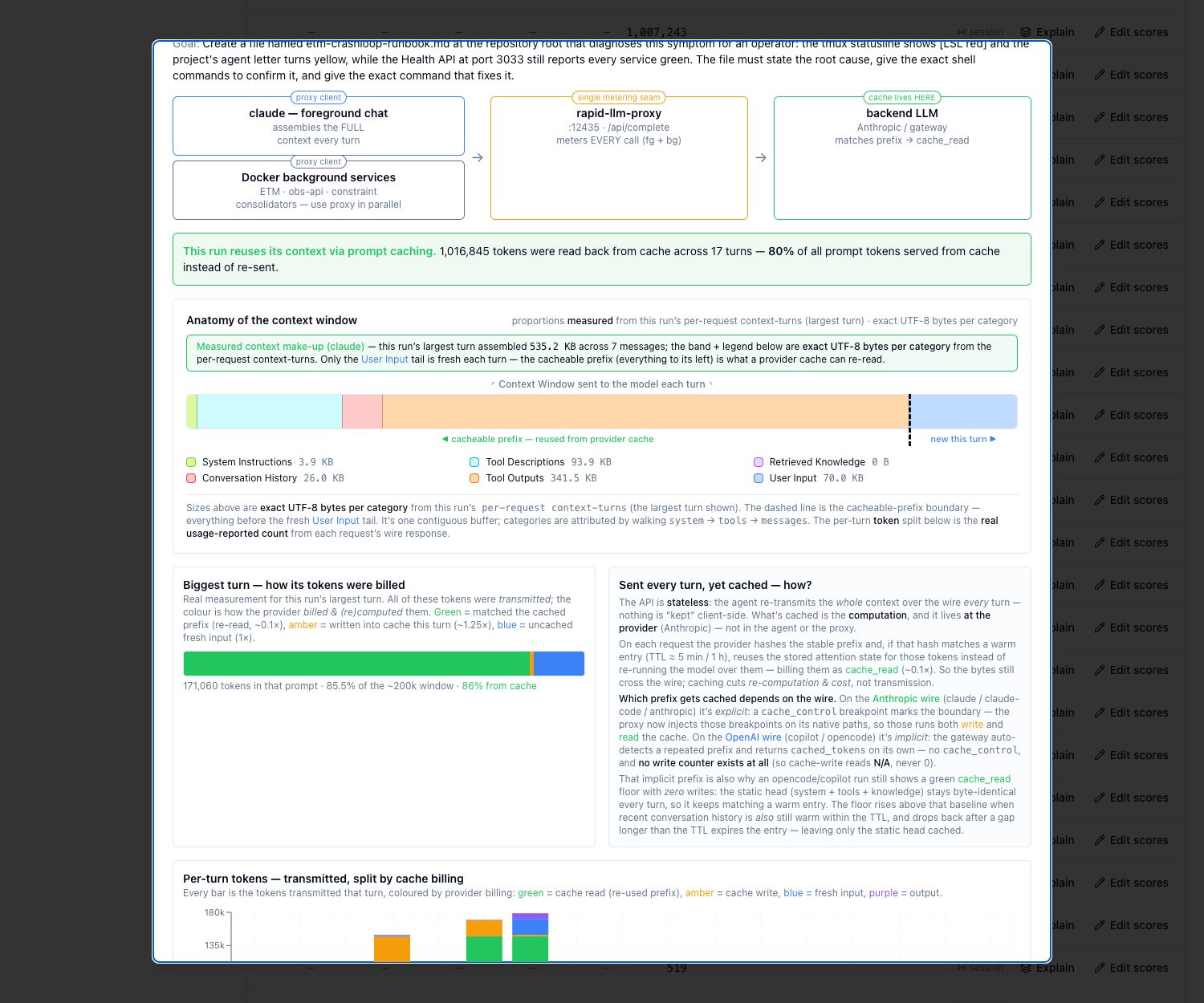
The same task, same model, kb-off. Retrieved Knowledge: 0 B. Note what replaces it: the largest turn is 535.2 KB across 7 messages versus the treatment cell's 218.0 KB across 3, and Tool Outputs alone are 341.5 KB against the treatment's 0 B. The control arm is not idle — it is searching the repository hard, and paying for it. Whether that search succeeds is the experiment.
Results
Round 1 — three curated tasks: how large the effect is
18 cells, zero leaks, zero untraced cells, all treatment cells confirmed injected.
| Task | Arm | n | Facts | Accepted | Steps | Seconds | Tokens |
|---|---|---|---|---|---|---|---|
| etm-crashloop | kb-on | 3 | 4.00 / 4 | 3 / 3 | 1.7 | 35 | 3,955 |
| kb-off | 3 | 1.33 / 4 | 0 / 3 | 41.0 | 429 | 31,905 | |
| leveldb-amplification | kb-on | 3 | 4.00 / 4 | 3 / 3 | 1.3 | 38 | 3,788 |
| kb-off | 3 | 1.00 / 4 | 0 / 3 | 12.0 | 179 | 9,665 | |
| llm-routing (retired) | kb-on | 3 | 1.00 / 4 | 0 / 3 | 44.0 | 222 | 14,881 |
| kb-off | 3 | 2.00 / 4 | 0 / 3 | 5.0 | 394 | 27,305 |
Where injection works, it works decisively
On both surviving tasks the treatment arm produced every required fact in every repeat, while the control produced roughly one in four and never passed the gate.
The per-fact breakdown shows the split is not uniform — it falls exactly where knowledge is required rather than reasoning:
etm-crashloop  kb-on   symlink-path 3/3   fix-command 3/3   launchctl 3/3   health-insight 3/3
               kb-off  symlink-path 0/3   fix-command 0/3   launchctl 3/3   health-insight 1/3
The control reliably produces the fact that can be inferred (launchctl) and sometimes the reasoning step, and never the two facts that must be known.
Cost runs the same direction. On etm-crashloop the control used 24× the steps, 12× the wall-clock and 8× the tokens — and still failed. Injection was not a trade of cost for accuracy; it was cheaper and correct.
Where injection fails, it fails in an interesting way
The third task was retired, and the reason is the most transferable finding here.
Its treatment arm scored worse than its control (1.00 vs 2.00 facts) while making 44 tool calls to the control's 5. This was not a delivery failure: replaying the exact retrieval showed the injected block did contain the two facts the arm scored 0/3 on, and the same injection path fed the two successful tasks in the same run.
The cause is a conflict between injected knowledge and the repository. The graded facts describe configuration living in a separate repository; meanwhile this repository ships its own older, plausible, contradicting configuration file. The cells explored, found the local file, and wrote about that.
When a repository contains a confident answer that contradicts injected knowledge, the model believes the repository — and searches harder to confirm it.
Attempting to rescue the task by re-selecting its graded facts was tried and failed: mining every candidate from the injected block returned zero usable facts, because every term the treatment arm wrote was also grep-able from its own sandbox and also appeared in the control. There was nothing left to grade.
Round 2 — eleven sampled tasks: how often it happens
Thirty-six insights were drawn from a frozen population of 162 above the confidence threshold. Eleven survived derivation into runnable tasks; all eleven ran, two arms by three repeats — 66 cells.
9 of 11 sampled tasks discriminate — 82% (95% Wilson 52%–95%). Strict reading, requiring every treatment repeat accepted and no control repeat accepted: 7 of 11 — 64% (35%–85%).
| Outcome | Tasks | Meaning |
|---|---|---|
| discriminates | 9 | injection carried the answer — the measurable case |
| kb-redundant | 2 | the repository already answers it; the KB adds nothing here |
| neither-solves | 0 | a broken gate, or beyond both arms |
| injection-hurt | 0 | injection actively hurt |
Per task, accepted repeats out of graded repeats:
| Task | Audit | kb-on | kb-off | Outcome |
|---|---|---|---|---|
| category-sub-modal-text-overflow | WARN | 3/3 | 0/3 | discriminates |
| claude-run-session-title-generation | WARN | 3/3 | 3/3 | kb-redundant |
| cross-agent-experiment-failure-modes | FAIL | 3/3 | 0/3 | discriminates |
| graphify-corpus-cache-invalidation | PASS | 3/3 | 0/3 | discriminates |
| graphify-incremental-rebuild-call-chain | PASS | 3/3 | 0/3 | discriminates |
| health-coordinator-idle-gate | FAIL | 2/3 | 2/3 | kb-redundant |
| kgbench-grader-false-positives | PASS | 3/3 | 0/3 | discriminates |
| llm-proxy-egress-coverage | WARN | 3/3 | 0/3 | discriminates |
| ontologyfilter-component-unified-viewer | FAIL | 3/3 | 0/3 | discriminates |
| retrieval-service-hybrid-search-rrf | FAIL | 3/3 | 1/3 | discriminates |
| smoke-spec-snapshot-restore-blockers | FAIL | 3/3 | 1/3 | discriminates |
The cost separation reproduces at scale. Averaged over the nine discriminating tasks:
| Arm | Steps | Seconds | Tokens |
|---|---|---|---|
| kb-on | 7.3 | 185 | 2,692 |
| kb-off | 22.6 | 340 | 18,328 |
Three times the steps, nearly twice the wall-clock and 6.8x the tokens — to reach an answer the control arm mostly did not reach at all. Because these measures are continuous rather than binary, they carry far more statistical power per cell than the pass/fail gate, and they stay informative even where correctness ties.
The recoverability audit, as a column
Every task carries a verdict on whether the control arm could grep its way to its graded facts. No task is filtered on it — that is design rule 2 — which makes the split itself a measurement:
| Verdict | Tasks | Discriminate |
|---|---|---|
| FAIL — every required fact is grep-able | 5 | 4 |
| WARN — some reachable, some not | 3 | 2 |
| PASS — none reachable by search | 3 | 3 |
Four of the five FAIL-verdict tasks discriminated anyway. Had the audit been used as the inclusion filter that the obvious design calls for, those four would have been discarded as unmeasurable and most of the round's signal would have gone with them. This is pitfall 2 reproduced across a sampled set rather than argued from a single task: static searchability describes what a determined grep could reach, not what an agent under task pressure actually retrieves.
Most candidates die before becoming tasks
The funnel matters more than the rate, because it sets what a round of this size costs. Of 36 drawn, 25 produced no runnable task:
| Reason | Count |
|---|---|
| no deliverable in the window — one cannot show stability | 10 |
| fewer than the three facts a conjunction needs | 11 |
| no token appeared in every treatment-arm deliverable | 3 |
| mined token absent from the block the treatment arm receives | 1 |
Two-thirds attrition is the blind filters doing their job, not a defect — but it means a round costs roughly three times its visible cell count in candidates, which is the practical constraint on scaling this to a number that would settle the question rather than size the next attempt.
Reading the two rounds together
Round 1 says that when injection matters it matters decisively and costs less. Round 2 says the case arises for roughly four in five knowledge-derived tasks, with the true value plausibly anywhere between half and nearly all. The two kb-redundant tasks are the honest counterweight: for those, the repository already held the answer and the knowledge base earned nothing.
What this establishes — and what it does not
The effect above is large and perfectly consistent, which makes it easy to over-read. Three constraints bound what it supports.
The tasks were selected, not sampled. They were written because their answers live in the knowledge base and not in the code. That yields an existence result — when injection helps, it helps decisively and costs less — and it says nothing about how often that case arises in real work. A larger set of hand-picked knowledge-decisive tasks would tighten the confidence interval around a number that is biased by construction.
The denominator is three, not two. The retired task is a result, not an administrative nuisance. One of three hand-picked tasks — picked with a thumb on the scale for the treatment — had its effect reversed by a stale file sitting in the repository. On a curated set biased toward success, that adverse rate is arguably the more decision-relevant number of the two.
The statistics are conditional on that selection. Pooling the two surviving tasks gives 6/6 accepted against 0/6 (Fisher exact, one-sided p ≈ 0.001); a single task alone gives 3/3 vs 0/3, p = 0.05. Those quantify how consistent the effect is within these tasks. They are not the probability that injection helps on an arbitrary task, because the tasks were not drawn at random.
And the deliverable is a document, not working code. Nothing here shows that injection improves software that has to compile and pass tests.
These constraints bound round 1. The first of them is what round 2 was built to answer, and it does: a mechanically derived population supplies a rate that no curated set can. That does not make round 1's tasks a random sample — it means the two rounds carry different conditioning, and the design section states round 2's in full.
Where this goes next
Cheaper power, without new tasks
- More models. Everything here ran on a single pinned model. A result that holds for one model is not yet a property of the knowledge base. The matrix already carries an agent/model axis.
- Cost as a co-primary outcome. Steps, tokens and wall-clock separated the arms by factors of 3 to 8. Being continuous and low-variance, they carry far more power per cell than a binary gate, and stay informative when correctness ties.
- More repeats, where they help. Within-arm variance was near zero on the tasks that discriminate, so repeats buy little there. They become necessary as soon as the task type is noisier — which is exactly the programming case.
- A larger draw. At n=11 the interval spans 52%–95%. Narrowing it is a matter of more drawn insights, at roughly three candidates per runnable task.
Programming tasks: possible, but grade a different thing
The concern that non-determinism will drown the signal is the right concern, in the wrong place. The problem is not that programming outcomes are stochastic; it is that a programming cell can fail for many reasons that have nothing to do with knowledge — a botched edit, a tool error, a timeout, a flaky test. That variance is unrelated to the treatment and it lands directly on a binary pass/fail outcome. Four measures keep the signal above it.
- Grade the knowledge-dependent step, not the whole solution. Not "does the feature work", but "does the diff touch the right file and encode the right mechanism", with the existing test suite as a guard against regression. This isolates the knowledge signal from general coding competence, which is not what the experiment is about.
- Choose bugs where diagnosis is hard and the fix is small. This project's own history is full of them — each recorded lesson is a symptom whose obvious cause is wrong. A recent example: a test that passed alone and failed in a batch, where the obvious explanation (cross-file interference) was wrong and the real cause was a wall-clock race against synchronous filesystem work. An agent without that lesson chases the obvious explanation; the fix itself is a few lines.
- Measure the noise before designing around it. Run one candidate programming task ten times on the control arm only. That gives the within-arm pass rate and its variance directly, and from it the number of repeats needed to detect a given effect. This is an afternoon's pilot, not a guess — and it is the step that answers the question rather than arguing about it.
- Keep cost in the outcome set. Correctness is more likely to tie on programming tasks, because a determined agent can often grind its way to a working answer. The cost difference is where the effect will show, and it is the cheaper measurement.
Three things genuinely get harder, and should be planned for rather than discovered:
- The snapshot must build and test. The documentation tasks needed only a filesystem. A programming task needs dependencies restored in the sandbox, which for this repository means submodules whose build output is not tracked in version control. That is real engineering work before the first cell runs.
- The contradiction failure mode gets worse, not better. The retired task failed because the repository held a confident, stale, wrong answer and the agent believed it over the injected knowledge. Code is far more likely than operational lore to have a competing implementation sitting in plain sight. Every programming spec needs the check that task lacked: does the sandbox contain a rival answer to this goal?
- A diff is more forgiving to grade than a file. A regex conjunction over a produced runbook is unambiguous. A diff can achieve the right outcome in a shape no pattern anticipates. Expect the test suite to become the primary gate with the pattern conjunction as corroboration, rather than the reverse.
Suggested order. Sample the documentation-task population first: it is cheap, it reuses machinery that already works, and it produces the discrimination rate — the single number that justifies or condemns the whole knowledge-injection system. Then pilot one programming task purely to measure its noise. Then decide whether a full programming matrix is worth its cost, on evidence rather than on intuition about how noisy such a matrix would be.
Pitfalls, and the measures built to defeat them
Every item below is a real failure that produced plausible but invalid results, followed by the measure now in place. Together they are why the numbers above can be believed: over half were found after a run had already produced a clean-looking table, and would not have been found by reading that table.
They are also the transferable part. The specific facts being graded are peculiar to this project; the ways an isolated experiment turns out not to be isolated are not.
1. The sandbox leaked the answer
Three independent leaks were found, each invalidating a run.
The first was an allow-list file in the snapshot that named the host's agent-memory directory by absolute path. Cells followed the pointer and read the answer directly. Stripping the file closed it — and the next run still leaked.
The second was project identity via git. Sandboxes were created with git worktree, which keeps pointing at the origin repository's .git. The agent runtime derives a session's project — and therefore the memory index injected into its system prompt — from that. Cells were handed the real project's memory index and read the graded fact out of it as their first tool call, in both arms.
Two proposed fixes were tested and both failed: scrubbing every repository-naming environment variable changed nothing, and moving the sandbox outside the repository tree changed nothing. The channel is the git linkage itself. The measure that works is to give the sandbox its own .git — an independent local clone at the same commit, with the origin's module store copied in so submodules resolve without network access.
The third was the parent-directory rules walk. Agent instruction files are discovered by walking up from the working directory. A file at the user's home directory therefore reaches any sandbox beneath it, and this project's own instruction file contains all nine graded facts verbatim. No in-sandbox strip can remove a file that lives in an ancestor directory. The measure is to place sandboxes outside that ancestry entirely.
Generalisable lesson. Isolation is not one thing. A sandbox can be isolated by filesystem location and still leak through version-control identity, ambient configuration discovery, or inherited environment. Each channel has to be closed and verified separately.
Verification measure. Every cell's transcript is now audited for paths outside its sandbox, and the audit is reported beside the results rather than after them. This run: 0 leaks across 18 cells.
2. "Grep-able" is not "recoverable"
One task was designated a null control on the reasoning that all its facts are findable by searching the sandbox. They are. Under clean isolation the control arm searched 123 times across three cells and still never found two of the four facts.
The measure is to stop treating static searchability as decisive. A static audit still runs and reports whether a fact is reachable, but its verdict is advisory; the empirical arm difference is the evidence. The audit's own documentation notes it over-reports by design.
3. Testing coinage on the wrong model
A fact was retired as "the model just invents this" on the strength of a probe that had silently run on a cheaper model than the one answering the cells. Re-run on the correct model, the fact was coined 0 times out of 3 — the original retirement was wrong, and the fact was in reality being supplied by a leak.
Measure: the coinage probe runs on the cell's actual model, in a bare directory with no repository and no knowledge base, and every graded fact is checked against it.
4. A gate demanding a fact the knowledge base does not contain
One fact scored 0 out of 6 across both arms. That reads like a hard task; it was a broken gate. The phrasing existed in the project's instruction file but not in the knowledge base, so retrieval could never inject it and the treatment arm could not possibly supply what the gate demanded.
Measure: candidate facts are now selected by measurement against deliverables already on disk, and must satisfy four conditions — present in the injected block, absent from the sandbox, produced by the treatment arm, and absent from both the control arm and bare-model coinage. When this was applied, one plausible-looking candidate turned out to appear in 3/3 control cells and 2/3 coinage runs while the treatment arm never wrote it. It would have graded backwards.
5. Silent mis-measurement from a path-encoding mismatch
Moving sandboxes to the system temp directory broke transcript location in two ways at once, on macOS: /var is a symlink to /private/var, so the recorded path and the resolved path disagreed; and the temp path contains an underscore, which the agent runtime rewrites when naming its per-project transcript directory while the harness's locator does not.
The result was not an error. Cells closed as complete with a null step count — scored as trivial runs, with a plausible score attached. Caught on the first cell because step counts were checked before trusting anything.
Measure: two assertions now fail the restore loudly — the sandbox path must be its own canonical path, and it must contain only characters both encoders agree on. Both are enforced on the production path only, since injected test stubs legitimately use paths of the rejected shape.
6. An audit that over-reported leaks
The leak audit initially scanned the entire tool-call input, which counted paths appearing in text the agent wrote — a runbook mentioning a log file path — as if the agent had accessed it. Two cells were wrongly flagged.
Measure: the audit scans only fields denoting access (file_path, command, path, …) and explicitly excludes authored content. Absolute paths legitimately exist inside the restored tree, so quoting one is not an escape.
7. A dependency that fails open
The retrieval service was found wedged mid-run — process alive, port unresponsive. Injection is deliberately fail-open, so a treatment cell retrieving against a dead service gets zero knowledge and still completes normally. The arm would have been silently untreated.
Measure: injected byte counts are logged per cell and checked for consistency, and service health is monitored for the duration of a run. In this run all nine treatment cells logged identical injection sizes within their task (5,395 / 5,519 / ~9,000 chars), confirming none was degraded.
8. A generated gate that silently kept pointing at the gate it replaced
The mined round derives a new gate per task and writes a spec beside the pilot's. The generator produced that spec by rewriting the pilot's YAML as text:
The YAML serialiser folds a scalar at 80 columns. test_command is node scripts/kb-ab-assert.mjs <topic> — two spaces of indent plus thirty characters of command — so the moment a topic pushed the line past eighty, the value became a folded >- block with the topic on its own line. The single-space literal then matched nothing, String.replace returned its input unchanged, and the spec was written still naming the pilot's fact set. No error, no warning: three tasks were graded against the very reference-derived gate the round existed to replace.
The boundary is exact. Eight tasks sat at 80 columns or fewer and were gated correctly; the three at 82, 82 and 84 were not. Those three were also, precisely, the round's anomalies — two of its three neither-solves verdicts, and one task counted as discriminating. The defect moved the headline in both directions at once, which is why reading the results did not reveal it.
Generalisable lesson. A string rewrite that finds no match is indistinguishable from one that had nothing to do. Any generated artefact encoding which thing is being measured must be edited structurally and then asserted, because the failure mode is not a crash — it is a well-formed file that measures the wrong thing.
The same fold defeated a second script, in a different way. The recoverability audit read the spec's scalars with a ^key:\s*(.+?)$ regex — "avoids a YAML dep for the three scalars we need" — so a folded test_command yielded the literal string >- as the command. It found no gate in it and returned SKIP: "no grep -F gate in test_command", for a spec whose gate was perfectly well formed. Three tasks audited as SKIP for no reason but the length of their topic, and a SKIP is not an error — it is a non-answer that looks like a considered one. The two scalars that never fold, experiment_id and snapshot_id, are why this went unnoticed for so long.
Measure: the generator parses the spec, replaces the gate argument in the parsed argv, and re-serialises. A spec whose test_command does not carry the expected topic argument throws rather than being emitted. Every emitted spec is checked to assert its own mined topic, and every topic to resolve in the fact table, before a run starts. The audit parses YAML rather than matching lines. And specs are now emitted unfolded (lineWidth: -1), because "nothing else parses this by line" turned out not to be a safe assumption to make once, and is not worth betting on twice.
9. A cell that never ran, counted as a cell that failed
A cell skipped before the agent starts still writes a row. A preflight route failure lands with a null terminal state, a null step count, no score and a skip_reason — after about five seconds. The discrimination report counted rows rather than results: an arm's denominator was the row count and its numerator the rows with a passing gate, so six preflight skips read as 0/3 in both arms and the task was recorded as neither-solves — whose stated meaning is "a broken gate, or beyond both arms". That is a positive claim about an agent that was never invoked. The report even computed the number of ungraded rows, and then never read it.
Generalisable lesson. "Absent" and "negative" are different measurements, and a schema representing both as a missing pass will report the first as the second. It is the same error as this project's own rule about dashes never meaning zeros, one layer down.
Measure: the report counts only scored repeats. A task with an ungraded arm is classified not-run, excluded from the rate's denominator rather than counted as a failure, and named in the output with the instruction to re-run it. The aggregate splits are computed over the graded set, so a never-run task cannot dilute those either.
10. Provenance that was promised but not written
A derivation is only auditable if you can say what produced it. Extracting the sampler's probes into their own module dropped the line that recorded which model generated each task's candidate facts. The comment promising the derivation "stays auditable" moved across with the code; the recording did not. The ledger for the round reported here carries generatorModels: [] — 36 drawn tasks with no record of what proposed their candidates.
Fixing that exposed a second fault underneath it. The generator's process name carried a bg- prefix that the proxy also prepends, so it resolved to bg-bg-…, matched no route, and silently fell through to a default — meaning a routing change made hours earlier had never taken effect. It had looked verified, because the check queried the routing resolver with the already-resolved name. That confirms what the resolver does with a name; it says nothing about what the caller's name resolves to.
Generalisable lesson. Verifying a fix by asking the component downstream of the bug will confirm the bug is fixed. The check has to start where the real caller starts.
This does not invalidate the round: candidate generation is explicitly not a measurement, and the blind filters do the selecting. What was lost is replayability — the draw cannot be reconstructed from its own ledger — and resilience, since a derivation that should have been independent of one account's quota was not.
Measure: provenance is recorded inside the completion call itself, keyed on the process, so a caller cannot omit it. Route checks are made by sending the caller's own string end to end and reading which provider answered, rather than by consulting the resolver.
Recommendations
For this knowledge-injection system
- Keep it, for knowledge that is not in the code. Roughly four in five knowledge-derived tasks were beyond the control arm, and the wins were large, cheap and repeatable — precisely where the answer is operational know-how rather than something derivable from source.
- Expect a redundant minority, and do not begrudge it. Two of eleven sampled tasks were answered perfectly well by the repository alone. That is the honest cost of a knowledge base that also records things the code already says.
- Treat contradiction as a first-class failure mode. Injection does not override what the agent can read. Where injected knowledge supersedes something still present in the repository, expect the repository to win. The mitigation is to fix or remove the stale artefact, not to inject harder.
- Do not let the dependency fail silently. A fail-open retrieval path plus a wedged service produces an untreated arm that looks normal. Injected byte counts should be asserted, not merely logged.
For anyone running a similar experiment
- Never let selection see an arm's outcome. Every filter that drops a task or a fact must be computable before any cell runs. This is the single property separating a measurement from a restatement of the choices made while building it.
- Keep the plausible-looking filter as a covariate. Screening tasks on whether the control arm could find the answer by searching would have discarded four of the five hardest-won results here. Record the verdict; never filter on it.
- Verify isolation empirically, per cell, and report it beside the results. Not as a precondition assumed once. Three separate leaks survived at least one round of "we fixed that".
- Prefer a direct probe to an inference about the mechanism. The decisive test throughout was a no-tools question — "name your memory directory from your system prompt alone" — which settled in seconds what two rounds of reasoning had got wrong. The same rule applies to verifying a fix: start where the real caller starts, not downstream of the bug.
- Select graded facts by measurement, from real output. Require: present in the treatment input, produced by the treatment arm in every repeat, and absent from bare-model coinage. Facts chosen by intuition graded backwards more than once; facts predicted from an idealised answer produced a round in which neither arm could pass.
- Check the cheap invariants before trusting a batch. A null step count on cell one saved a 50-minute run that would have produced a full, plausible, meaningless table. Distinguish a cell that failed from a cell that never ran.
Limits are stated in full under What this establishes — and what it does not; remaining work — more models, a larger draw, and whether programming tasks can carry the same measurement — is under Where this goes next.
Reproducing
# Run a spec (both arms, three repeats)
node scripts/experiment-run.mjs --spec config/experiments/kb-ab-etm-crashloop.yaml

# Grade a produced deliverable against its conjunction gate
node scripts/kb-ab-assert.mjs kb-ab-etm-crashloop

# Check that the control arm cannot reach the graded facts by searching
node scripts/experiment-audit-recoverability.mjs --spec config/experiments/kb-ab-etm-crashloop.yaml
Fact definitions, and the retirement note explaining why the third task could not be rescued, are in lib/experiments/kb-ab-facts.mjs.
The sampled round adds two steps in front of that, because its gates are derived rather than written by hand:
# Build the injected-arm-only specs whose deliverables the gates are mined from
node scripts/kb-ab-make-mine-specs.mjs

# Mine each task's gate from those deliverables
# --dry-run reports what would be kept without calling a model or writing anything
node scripts/kb-ab-mine-facts.mjs --dry-run

# Run a mined spec (both arms, three repeats), then report the rate over the whole round
node scripts/experiment-run.mjs --spec .data/kb-ab-sampler/specs/<kbm-topic>.yaml --parallel
node scripts/kb-ab-discrimination-report.mjs --ledger .data/kb-ab-sampler/ledger-mined.json
The report names any task it had to exclude for want of a graded repeat. An excluded task is not a zero — see pitfall 9 — so re-run it rather than reading past it.
See also
- The /experiment Skill — running experiment matrices
- Experimental Design — design principles for the retrieval benchmark
- Measurement & Judging Lessons