Experimental Design
Every control standing between a benchmark run and a number you should not trust — and, for each, the specific failure that made it necessary.
Nothing here is hypothetical
Every control below exists because a run without it produced a plausible, publishable, wrong result.
The seven parts
| Part | Controls |
|---|---|
| 1 | Containment — what the system is allowed to read |
| 2 | Enforcement — what it is allowed to do |
| 3 | The asymmetry that cannot be fixed |
| 4 | The environment it inherits |
| 5 | Making token counts comparable |
| 6 | Scoring without fooling yourself |
| 7 | What is still not controlled |
Part 7 is not an omission. A design document that lists only solved problems is telling you less than it appears to.
The one principle
Measure the thing you claim to be measuring. Every failure catalogued here is a case of something else varying at the same time — the answer reachable by an unaccounted route, the harness overhead differing between arms, or the grader itself being under test.
If you read one part
Part 3. Some asymmetries between arms cannot be engineered away, only stated. Knowing which ones those are is the difference between a limitation and a flaw.
Containment and enforcement
The first two parts are about the gap between what an arm is supposed to see and do, and what it can.
An agent with tools can reach an answer by routes the design never considered: the repository itself, output it produced earlier in the same run, environment it inherited, or an artefact cached from a previous run. Six such channels were found here — and one of them was structurally invisible to the sandbox built specifically to prevent that class of leak, which is the more useful lesson. A containment mechanism you cannot see through is a containment mechanism you cannot verify.
Enforcement is the other half: restricting what an arm may do — which tools it may call — is what makes an arm a strategy rather than a label. An arm whose restriction is not actually enforced is measuring the unrestricted system under a different name.
The asymmetry that cannot be fixed
Some differences between arms are not engineering defects; they are properties of the comparison. Where that is the case the honest response is to state it prominently rather than to add machinery that appears to address it. A control that looks like it removes a bias, but does not, is worse than no control — it converts a known limitation into an unknown one.
Comparable token counts
Raw totals are not comparable across arms because each arm carries different harness overhead. The floor is measured with dedicated probes and subtracted, so what remains is attributable to the strategy.
This is also where double-counting hides. A token column that sums two overlapping sources produces numbers that are wrong by a consistent factor, which is exactly the kind of error that survives review — everything is internally consistent and merely wrong.
Scoring
Two rules. Grade mechanically where possible, because a model in the grading loop puts the thing under test on both sides of the experiment. And test the grader against known-bad answers, not only known-good ones: a grader that has never rejected anything has not been shown to discriminate.
Storing full answers rather than verdicts is what makes a grading defect recoverable — the grader can be corrected and re-applied offline, and results that change under the correction can be recognised as artefacts rather than findings.
What is still not controlled
Part 7 of the Deep Dive enumerates the known-open items. They are listed deliberately: the checklist at the end of that section is a tool for reading someone else's benchmark as much as for running this one.
This is the deep section. It documents every control that stands between a benchmark run and a number you should not trust, and — for each one — the specific failure that made it necessary.
Nothing here is hypothetical. Every control below exists because a run without it produced a plausible, publishable, wrong result.
Terms used here (arm, cell, axis, gated, leak, containment, baseline) are defined in the Glossary.
The governing principle
A benchmark result is a claim of the form "A differs from B." That claim is valid only if A and B differed in the way you intended and in no other way that matters.
So the work of experimental design is entirely negative: enumerate the ways they could differ that you did not intend, and eliminate or record each one. The uncomfortable part is that the dangerous differences are precisely the ones that do not announce themselves. A crashed run is obvious. A run where the restriction silently did not apply looks exactly like a run where it did — except that all the arms score the same, which reads as "the questions are too easy."
Three properties follow, and they shape everything below:
- Failures of control are silent. So controls must be verified, not configured.
- Verification must precede spending. A four-hour matrix that turns out to be void is four hours plus the temptation to publish it anyway.
- What cannot be controlled must be recorded next to the number, not averaged over and footnoted.
Part 1 — Containment: what the system is allowed to read
The failure
A benchmark's questions live somewhere. In this project they live in the repository the agents search, and every agent has a file-read tool.
The first pilot produced an answer that began, in effect, "this question is a known probe from `config/kgbench/questions/coding-v1.json:184" — and then answered it correctly, scoring 1.00 by quoting the question's own provenance note.
That is the whole hazard in one line. A leaked answer key produces correct answers. It does not look like cheating in the data; it looks like retrieval working extremely well. There is no statistical signature to catch it after the fact. It has to be prevented, and the prevention has to be verified.
Six channels, only one of them obvious
Removing the answer key was necessary and nowhere near sufficient. The leaks actually found:
| # | Channel | Why it was not obvious |
|---|---|---|
| 1 | The answer key itself | Obvious in hindsight |
| 2 | Telemetry exports under .data/ | This project records its own sessions; the exports echoed prompts verbatim. Three questions' full prompts appeared in a single export file |
| 3 | Session logs of the sessions in which the questions were authored | The act of writing the benchmark created a searchable record of it |
| 4 | The published report of a previous run | Publishing the questions was the right call for readers — a benchmark whose questions are secret cannot be judged — but it puts every prompt into the tree |
| 5 | Source comments explaining a previous leak | Four separate times. Each was a comment written to explain the previous leak, and it quoted the thing it was explaining — including, once, the warning comment that said not to do this |
| 6 | A knowledge-injection hook, outside the tree entirely | See below. The sandbox is structurally incapable of seeing this one |
Channel 5 generalises. The instinct on finding a leak is to document it thoroughly so it does not recur; if your documentation lives inside the measured surface, thorough documentation is the recurrence.
Channel 6 generalises further, and is the most important entry in this table.
The channel a sandbox cannot see
Everything above is about what is in the tree. That framing has a blind spot, and it took a contaminated cell in a live run to expose it.
This project registers a knowledge-injection hook at user level, so it fires for every agent session in every working directory — including a throwaway worktree with no project context. It semantically retrieves the project's knowledge base against the prompt and prepends what it finds. Reproduced from an empty temporary directory:
prompt      "Which file defines the shell variable MANAGED_MCP_KEYS?"

injected    ## Digests
            Smoke Test Execution: MANAGED_MCP_KEYS Answer File Written  (2026-08-08)
              Located definition via grep in install.sh at line 1180
            Locate definition of MANAGED_MCP_KEYS constant             (2026-08-05)
              Found it is defined in install.sh
That is the answer, handed to the agent before it retrieves anything. Note what those digests are: records of previous benchmark runs answering that same question. The leak is self-reinforcing — running the benchmark generates observations about the answers, and the next run is handed them. Each run makes the next one easier while looking like a retrieval improvement.
Three properties make this worse than any tree-based leak:
- Containment is structurally blind to it. The sandbox governs the tree. This never touches the tree, so verifying the tree proves nothing about it.
- It is prompt-targeted. A file in the tree still has to be found. This retrieves against the question itself, so it delivers precisely the most relevant knowledge — the answer.
- It is asymmetric across agents. The hook belongs to one agent's hook system, so a cross-agent comparison silently advantages that agent.
There was already an off switch, CODING_KNOWLEDGE_INJECTION=0. The sibling experiment harness sets it; this benchmark was written later and did not inherit the lesson. It is now set in the one function every spawn path goes through, so cells, baseline probes and tool discovery are all covered — and a test asserts it, including that an operator's inherited =1 does not win.
A footnote that is its own small lesson: the injected answer said line 1180. Real retrieval, with injection off, returned line 1292 — the code had moved. The leaked knowledge was not only unearned, it was stale, and would have produced a subtly wrong answer that still scored, because the checklist matches the filename. A cache of past answers is a liability twice over.
The general form
Enumerate every channel by which information reaches your system, not just the corpus you intended it to search. Ask specifically: what is injected into the prompt that I did not put there? Hooks, middleware, memory systems, system prompts, retrieval augmentation, tool descriptions, and the agent's own prior-session state are all channels, and none of them are visible to a check that inspects your data.
The controls
A throwaway sandbox. Each run creates a git worktree of the exact commit under test, removes the sensitive paths, and points the agents at that. The live repository is never searched. The worktree is discarded afterwards, so a run cannot contaminate the next one.
An exclusion set that is a category, not a list of files. The removed paths are: the answer key; the telemetry and session-log directories; the project's agent-instruction files; the previously published report; and — structurally — the grading and containment machinery itself. Those last two source files describe what a right answer looks like and which subjects are traps. Prose discipline was the old control for them and it failed four times, so the fix was structural: remove the files. Neither is any question's evidence, so removing them costs the benchmark nothing and ends the class of failure rather than the instance.
Verification, not assumption. After building the tree, the harness scans it for each question's own prompt using five-word windows. If a question's content survives, the harness refuses to return the tree and the run does not start.
Leak terms for what a scan cannot catch. The five-word window catches a copy of a question. It cannot catch a description of one: paraphrased prose shares four words with a prompt but never five in a row, which is exactly how channel 5 slipped past. So a question may declare leak_terms — strings that must appear nowhere, where a single occurrence is decisive and no coverage threshold applies. Coverage exists to tolerate shared vocabulary; a term declared must-not-appear has no innocent reading.
An exclusion must never delete a question's own evidence. This control exists because a too-broad glob once matched a document that was one question's ground truth. That question would have become unanswerable and every arm would have scored 0 on it — which reads as a finding about the arms rather than a bug in the exclude list. The harness now cross-checks removed paths against every question's declared evidence and refuses to run if any was deleted.
The general rule: containment removes the answer KEY, never the ANSWERS. Those are different things, and conflating them manufactures findings.
A scoring-time backstop. Even with all of the above, grading independently detects an answer that cites the ground truth. Such a row keeps its raw score as score_if_clean but scores null, so a leak can never rank as a win.
Transferable lesson
Enumerate every surface your system can read, not just the one you put the answers in. Then assume you have missed one, and make the run fail loudly when you did.
Part 2 — Enforcement: what the system is allowed to do
The failure
The arms in this benchmark are defined by their tool surface. The runner passed a flag intended to restrict each arm to its own tools.
The flag did nothing. It was a permission-prompt allowlist, and the harness ran with permission prompts skipped — so the allowlist was never consulted. Every arm silently received the full default tool surface. Recorded from the first matrix before it was killed:
grep arm      Grep ×144, Bash ×59, Read ×38, Glob ×4, Agent ×2, SendMessage, TaskStop
graphify arm  Bash ×27, Read ×4        ← not one graph tool
The arms were the same agent wearing different labels. Every number comparing them was one configuration measured against itself.
The tell had already appeared and been misread. An earlier replication run had both arms scoring 1.00 on every class, and the write-up concluded the arms "could not be told apart" because the questions were too easy. The arms could not be told apart because they were identical.
It also breached containment: an arm used a shell to check out a submodule inside the worktree, and answered a question from files the containment scan had never seen — because the scan verified the tree before the arm mutated it.
The controls
Deny, do not allow. The mechanism that actually restricts is the deny list: every built-in tool minus the arm's grant. Verified live — the model attempts the denied tool and is told it is disabled.
Discover the tool surface; do not maintain a list. The first deny list was hand-written and missed one entry, which an arm promptly used to invoke this project's own skill for a competing retrieval strategy. A hand-maintained list of built-ins was never going to hold. The CLI reports its real surface at session start, so that is now the source of truth: a tool added upstream is denied automatically instead of quietly becoming a hole.
Union, not replacement. Discovery alone under-denies, because what the CLI reports depends on the probing flags — with an empty allowlist it omits two search tools. Trusting it verbatim left both graph arms holding text search: a "graph versus grep" comparison in which the graph arm can grep. The deny list is now the union of discovered and static.
Assert isolation before the matrix runs. The token-floor probes are real sessions with each arm's real flags, so what they report as available is free evidence. If any denied tool is still present, the run aborts — rather than producing 200 voided cells and finding out afterwards.
Audit what executed, not what was attempted. The guarantee is the post-hoc check: a cell that executed a tool outside its grant becomes tool_escape and cannot be scored. Attempts are not violations — models routinely try a tool, get refused, and fall back, so counting attempts would void nearly every cell. Tool calls are matched to their results and refusals classified out; anything unrecognised counts as executed, so the failure mode is a visible void rather than a silent escape.
Scope violations to the strategy, not the tool. A backend's server may advertise more tools than the arm's config names. Flagging per-tool would void a cell for using a legitimate query method of its own backend. Crossing to a different strategy is the thing that must never happen, and that is what the check enforces.
Transferable lesson
Do not trust a configuration flag to have configured anything. Record what your system actually did, compare it to what it was permitted to do, and make the mismatch unscorable. Every silent-configuration failure in this project was caught by that check and by nothing else.
Part 3 — The asymmetry that cannot be fixed
Adding the agent axis exposed a control that simply does not exist everywhere.
Only one of the three agents can be held to a tool surface. The flags that gate tools belong to one CLI. For the others, the retrieval backends they reach can be restricted — by writing the configuration file each one reads — but their built-in file and search tools are always present and cannot be withheld.
There is a real distinction even among the ungated:
- One agent can gate tools in principle; the harness has no verified mapping from arm tool names to that CLI's own naming, and passing an unrecognised name fails in one of two silent ways (the model ends up with no tools, or the flag is ignored and the cell runs ungated while labelled otherwise). It is recorded as
not_enforced— unfinished work. - The other exposes no tool allowlist at all. It is recorded as
ungated— a capability limit.
Collapsing those two into one label would make a fixable gap look permanent. (That collapse happened once, when a generic descriptor overwrote the specific one, and it took a real run to notice.)
Refusal as a design choice
Given that asymmetry, what should an arm defined by withholding text search do on an agent that cannot withhold it?
The harness refuses the combination. It is decided before anything executes, printed with the reason, and recorded in the run manifest:
run    grep         copilot    [builtins not_enforced, answer via answer-file]
REFUSE graphify     opencode   arm "graphify" is defined by WITHHOLDING built-in search
                               (it grants Read without Glob/Grep), and opencode exposes no
                               tool allowlist, so built-ins cannot be withheld. The cell
                               would run with more capability than its label claims.
Arms that withhold only backends survive on every agent, because that restriction is enforceable everywhere. Arms that withhold built-ins do not.
The alternative — running the cell anyway and noting the caveat — produces a table where a number sits under a label that does not describe it. A matrix that quietly shrinks is worse than one that says what it will not do.
Transferable lesson
When your control surface is not uniform across the things you are comparing, do not paper over it. Refuse the combinations you cannot measure honestly, record the refusals as data, and keep the distinction between "cannot" and "not yet".
Part 4 — The environment the system inherits
A subprocess inherits far more than intended, and each inheritance is a way for the measurement to differ from the thing it claims to measure.
Working directory. Placing a child process in a sandbox by setting its working directory does not change the PWD environment variable it inherits — that still points at the parent's directory, which is the live repository. An agent that reads PWD to find its project root will work there instead.
Not hypothetical: the first cross-agent smoke run had an agent search the sandbox correctly and then write its answer into the live repository. Worse than losing one cell — every subsequent cell would have run against a tree the benchmark had contaminated itself, and the containment verifier inspects the worktree, so it would never have noticed.
Both the working directory and PWD are now pinned, and the stale OLDPWD dropped, for every agent rather than the one that was caught.
Credentials. An API key present in the environment silently bypasses the measured path: the CLI prefers a key over the subscription login, and the calls go direct to the provider instead of through the local proxy — unmeasured, and on the wrong billing path. The keys are stripped and the proxy base URL is pinned rather than merely inherited.
Inherited agent configuration. The interactive launcher exports a configuration variable that was reaching cells verbatim, carrying a model override and a disabled provider from whichever session happened to start the benchmark. Part of each cell's configuration was therefore inherited from the operator's shell. It is now dropped, so the pinned configuration file is the only configuration a cell sees.
Prompt-injection hooks. Covered in full under the channel a sandbox cannot see. Restated here because it belongs to this category as much as to containment: a user-level hook is part of what a subprocess inherits, and it can add content to the prompt that no inspection of your data will reveal. CODING_KNOWLEDGE_INJECTION=0 is set for every spawned agent.
Global instruction layers. Agent rule files (CLAUDE.md and equivalents) are removed from the tree for two reasons: they carry absolute paths that let a sandboxed agent walk back to the real tree, and this project's own rules told agents to prefer one arm's tool "instead of blind greps" — a thumb on the scale for one arm, in the run tree, in every cell.
There is a residual asymmetry worth stating: pinning one agent's configuration directory also removes its global instruction file, which the other agents still receive from their own home directories. That is a known parity gap, recorded rather than claimed as solved.
Machine load. A wall-clock timer that fires far past its deadline means the process was starved, not that the arm was slow. On one clean run, three cells were logged as five-minute timeouts with sixteen-minute wall times because background virus scanning was saturating the machine over the harness's own worktrees. Recording those as timeouts blames the arm for the host. host_stalled is now a separate outcome: void, not scored, not counted against anything — and three in a row aborts the run, because a starved machine will otherwise burn hours producing voids.
Transferable lesson
Enumerate what your subprocess inherits: working directory, environment, credentials, configuration files, home directory, and the machine's own state. Each is a channel by which the thing you measured differs from the thing you meant to measure.
Part 5 — Making token counts comparable
This is the subtlest part, because every failure here produces a number rather than an error.
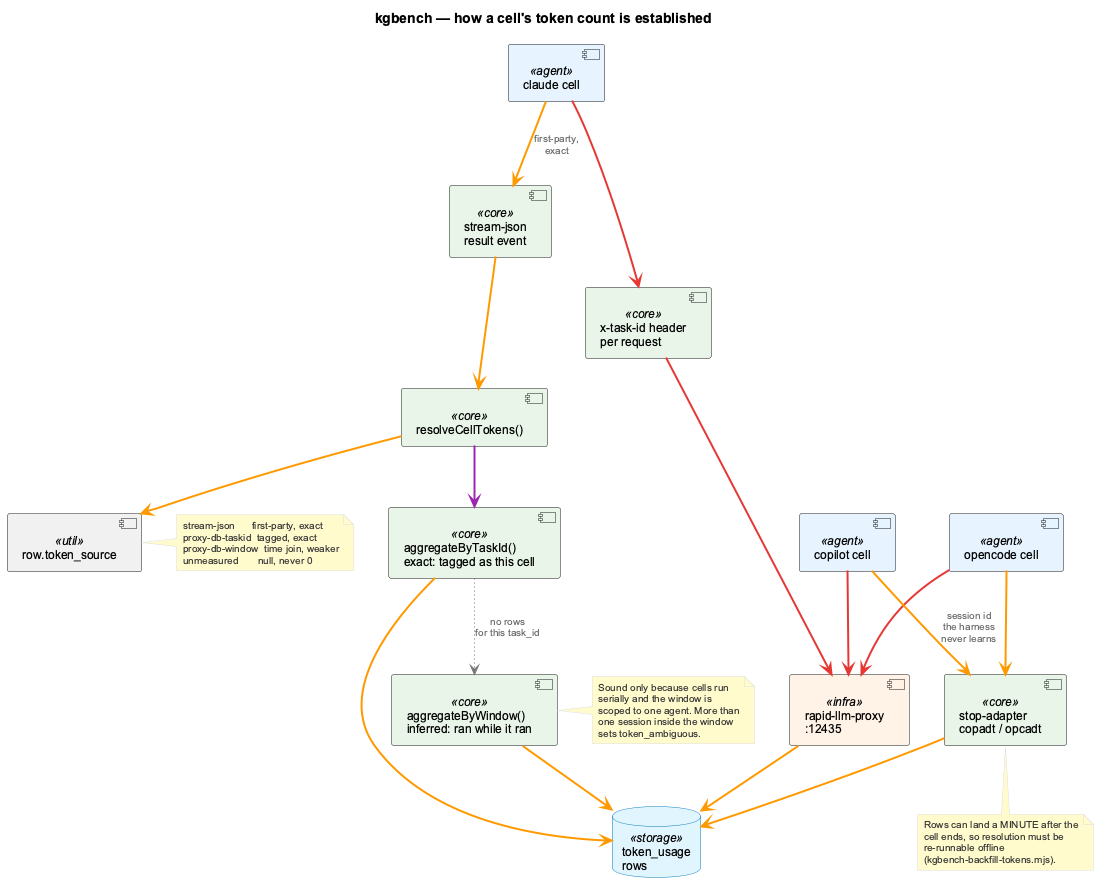
Problem 1 — Not every agent reports its own usage
One agent emits structured output including exact token usage. The other two emit nothing usable.
The first instinct is to record 0. That is a lie that reads as "this agent used no tools and cost nothing" — plausible, and it would make the least measurable agent look the cheapest in every median. So the fields were left null.
Correct, and useless: a benchmark whose token column is empty for two of three agents cannot compare cost across agents at all.
Problem 2 — The numbers existed, under a key nobody could predict
Every LLM call in this environment routes through one local proxy, which records it. The unreported agents' calls were in that database — written by each agent's stop-adapter, and stamped with the agent's own session identity: an opaque session id, a UUID. The harness that spawned the process never learns those.
So a lookup by the harness's own cell identifier returns nothing, while the tokens sit in the database under a key it cannot guess.
The control: rank the sources and record which one was used
| Source | Strength | Meaning |
|---|---|---|
stream-json | Exact, first-party | The agent reported its own usage |
proxy-db-taskid | Exact, reconstructed | The request carried the cell's identifier |
proxy-db-window | Inferred | Proxy rows recorded while the cell was running |
unmeasured | None | No rows found — null, never 0 |
A first-party number is never replaced by a reconstructed one. Preferring the reconstruction would quietly swap exact per-call accounting for a window sum.
proxy-db-window is the honest name for a weaker claim: it attributes by "ran at the same time" rather than "was tagged as this cell". That is sound only because cells run serially and the window is scoped to a single agent. When it is not sound, the harness says so rather than assuming: the aggregate returns the distinct sessions it summed, and more than one sets token_ambiguous, which the report surfaces as a warning.
Why per-request tagging is not simply switched on everywhere
Tagging a request with the cell's identifier means changing how the agent reaches its model — moving one agent onto a different authentication path, giving another a task-scoped endpoint. Both alter the thing being measured in order to improve the label on the measurement, and both have already produced silent failures in this project.
So it is enabled by default only where it is free: for the gated agent it is a request header on a connection already going to the proxy — it labels traffic without redirecting it. For the others it is opt-in, to be switched on once a real run shows the cell still answers.
Problem 3 — Tokens arrive after the cell has ended
The stop-adapters write on their own schedule. A measured cell:
cell ran        09:57:01.869 → 09:57:35.267
row timestamp   09:57:34.810      ← inside the cell; the join is correct
row WRITTEN     ~60 s later       ← after the runner had already moved on
The runner polls for a couple of seconds. That is enough for one agent and not the other, and no poll budget can reliably be long enough — waiting a minute per cell would put a 384-cell matrix to sleep for six hours.
So token resolution must be re-runnable offline. The runner records what it can see; a separate command fills in the rest afterwards from the identifier and wall-clock window stored on every row. It is idempotent, never overwrites a first-party figure, and keeps a backup.
This mirrors a discipline the framework already applied to grading: store enough to re-derive offline, because re-running a trial to fix a measurement bug changes what you are measuring.
Problem 4 — Cache accounting is not uniform, and summing it double-counts
The most instructive failure of the three, because it produced a number that looked entirely reasonable.
The structured output reports input tokens, cache-creation tokens and cache-read tokens as three separate figures the parser sums. Folding the database's two cache columns into input the same way seemed like the move that keeps the metric comparable across sources.
It reported one cell's 121,413 tokens as 242,103:
cache_read + cache_write ≈ input_tokens. For that writer the cache columns are a breakdown of input, not an addition to it. Other writers store the opposite shape (input of 2 alongside a cache read of 277,173). There is no uniform rule.
The one invariant that holds across every cache-carrying row checked is total_tokens = input + output. So stored values are used as stored, and the cache columns are kept for provenance but kept out of the arithmetic.
The residual caveat is recorded rather than papered over. A database-derived input figure may account for caching differently from a first-party one. Therefore content tokens — total minus a measured floor — is strictly comparable only within a token source, and the report prints the source next to every figure.
Problem 5 — The floor is a property of the session, not the arm
Content tokens exist because whole-session totals are dominated by a fixed floor — system prompt plus tool schemas — that compresses every ratio toward 1.0 and makes different strategies look identical. Subtracting a measured floor is what recovers the signal.
But whose floor? Measured on the same question, in one run:
| arm | agent | floor | source |
|---|---|---|---|
| grep | claude | 22,437 | stream-json |
| grep | copilot | 63,609 | proxy-db-window |
| grep | opencode | 66,558 | proxy-db-window |
| graphify | claude | 22,875 | stream-json |
| codegraph | claude | 21,677 | stream-json |
| hybrid | claude | 25,699 | stream-json |
Two things are visible. Within one agent, the floor tracks the tool surface — the arm with 14 tools starts 4,000 tokens above the arm with 2. That difference is the schema tax, and it is a real finding about the cost of merely having a backend registered.
Across agents, the floor differs by 3×. Subtracting one agent's floor from another agent's total would measure the difference between two CLIs, not between two retrieval strategies.
So the floor is measured per (arm, agent, model), and it records the token source it came through. When a cell's source differs from its baseline's, content tokens is left null — a database-derived total minus a first-party floor is not a difference of anything. The schema tax is likewise computed within an (agent, model), never across CLIs.
Transferable lesson
For any cost metric: know which of your numbers are first-party and which are reconstructed, never mix them in a subtraction, make "not measured" impossible to confuse with zero, and make the whole resolution re-runnable after the fact — because telemetry arrives late.
Part 6 — Scoring without fooling yourself
Grading has its own detailed case notes in Measurement & Judging Lessons. The design principles:
Deterministic first. The primary score comes from a checklist with no LLM involved, so it is reproducible and can be re-applied to stored answers offline. A grader bug costs a re-grade, not a re-run.
The judge is an alarm, not an authority. A second LLM scorer never overrides the deterministic score. Its value is disagreement. But be precise about what a disagreement means: it names a symptom and never a cause. Across every investigation on this question set the cause was a rubric, a false key, a regex, a shared match token, or a matcher simultaneously too loose and too narrow — and never a badly written question. Twice the arms were right and the key was wrong.
And the detector is blind to the most common defect of all: because the judge's prompt is built from the same checklist, a wrong key makes both graders agree and produces zero disagreements.
Record what was served, not what was requested. Two published runs stated a judging model that no provider serves — every call had in fact been answered by a small, cheap model, because the endpoint ignores the requested model. Provenance is now taken from the responses, and a substitution is announced.
Absence questions need their own machinery. A correct abstention — "this repository does not contain such a service" — was scored as a fabrication, because the phrasing was not in the recognised list and the fallback then flagged it hallucinated. The pilot's headline finding, that one arm fabricated an answer, was a grader artefact.
Forbidden facts must encode claims, not shapes. A rule intended as "must not name any file as doing X" was written as a regex matching any filename — which every correct answer contains while explaining what the thing actually is. Forbidden facts now bind a subject to the claim it is forbidden to make, and match only in assertive segments.
Gate the winner declaration. A winner is declared only at a ≥1.25× median gap with non-overlapping spread. Anything weaker prints "tie". At these sample sizes a 1.3× gap is not a result, and an earlier report declared winners at exactly that margin.
Part 7 — What is still not controlled
A design document that lists only its successes is not usable. These are the known gaps.
Elicitation differs by agent. The gated agent streams a structured answer. The others are told to write their answer to a file, because an analysis-shaped prompt makes one exit within seconds and the other yield on its first toolless step — both "succeeding" having answered nothing. That difference is a confound in every cross-agent comparison, and it is not removable: it is what makes those cells produce an answer at all. It is recorded per cell as elicitation.
No tool trace exists for the ungated agents. So no post-hoc audit is possible for them — recorded as tool_audit: "unavailable", which is deliberately weaker than an empty violation list.
Global instruction files are asymmetric. Pinning one agent's config directory removes its global rules file; the other agents still read theirs.
Baselines can fail to resolve. If a floor probe's tokens arrive after the wait, that combination's floor is null and its content-token column stays empty for the whole run. Unlike cells, baselines have no offline backfill yet.
Sample sizes are small. Three repetitions per cell is enough to see variance, not to characterise it. The winner gate is the mitigation.
One repository, one question set. Everything here measures retrieval over this codebase. Generalisation to other corpora is unproven.
Corpus scope differs between backends. One indexes documentation and PDFs; the code-only ones do not. Node and edge counts are not comparable at face value.
Checklist
Before trusting a run:
- [ ] Containment verified — the harness built and cleared the tree, and did not warn
- [ ] No denied tool appeared in the pre-matrix isolation assertion
- [ ] Zero
tool_escaperows, or the escapes understood - [ ] Zero contamination flags
- [ ]
host_stalledcount is zero or small — otherwise the machine was busy and those cells are void - [ ] Refused combinations reviewed — is the matrix the shape you intended?
- [ ] Token sources checked — how many cells are
unmeasured? Run the backfill - [ ]
token_ambiguouscount is zero, or those cells excluded from cost claims - [ ] Baselines resolved for every combination you intend to quote content tokens for
- [ ] The judge's served model recorded, not just requested
- [ ] Disagreements read as an alarm about the key or the matcher, not about the questions
Before publishing:
- [ ] Per-agent numbers shown separately, never pooled across agents
- [ ] Enforcement and elicitation stated next to the figures
- [ ] Winner claims pass the effect-size and spread gate
- [ ] Refusals and limitations stated in the document, not omitted