Network Configuration
Corporate VPN, proxy detection, and how each agent's API traffic is routed on either network.
Three environments, one detector
| Where you are | Proxy |
|---|---|
| On the corporate network | Required — proxydetox on 127.0.0.1:3128 |
| On VPN | Required — same proxy |
| At home or anywhere public | None; direct |
The health coordinator is the single authority on which one you are in. It probes every 15 seconds; the launcher, the status line and the LLM proxy all read its answer rather than detecting independently.
Check where the system thinks you are
vpn and corporate mean the same thing
The coordinator says vpn, corporate or open. The LLM proxy says corporate or public. vpn and corporate are the same network — comparing the two vocabularies as raw strings is a real and recurring source of restart loops.
When calls fail on the corporate network
Routing can look perfect while every off-premises call fails. Check egress, not routing:
A proxy pinned to a network you have since left produces exactly this. Restarting the proxy while on the network you are actually on re-pins it.
How the network is detected
Three signals, in priority order, first match wins:
| Priority | Signal | Gives |
|---|---|---|
| 1 | Cisco VPN CLI reports a connected tunnel | vpn |
| 2 | An active utun* interface with an address | vpn |
| 3 | Internal DNS resolves, plus a latency measurement | corporate under 100 ms, else vpn |
| — | DNS does not resolve at all | open |
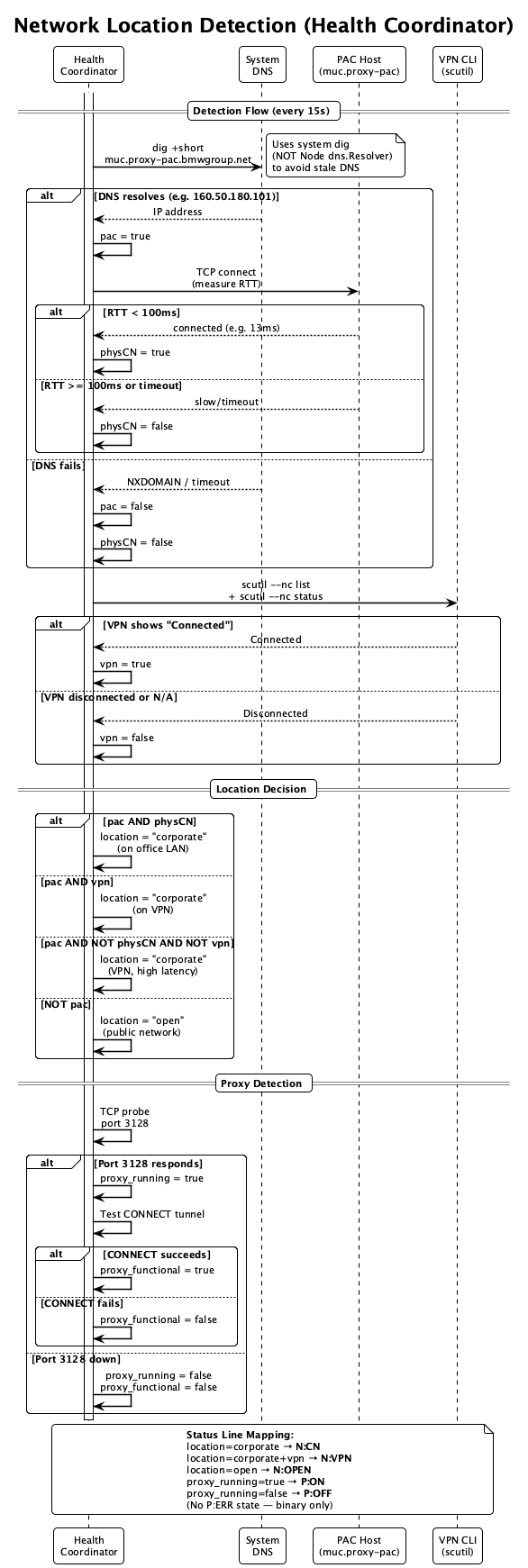
The DNS probe deliberately shells out to dig rather than using Node's resolver. Node caches the system DNS servers at process start, so a coordinator that started on a hotspot and then moved onto the office LAN would keep querying the public resolvers, fail to resolve internal names, and report open indefinitely. Spawning dig reads the current OS configuration every time.
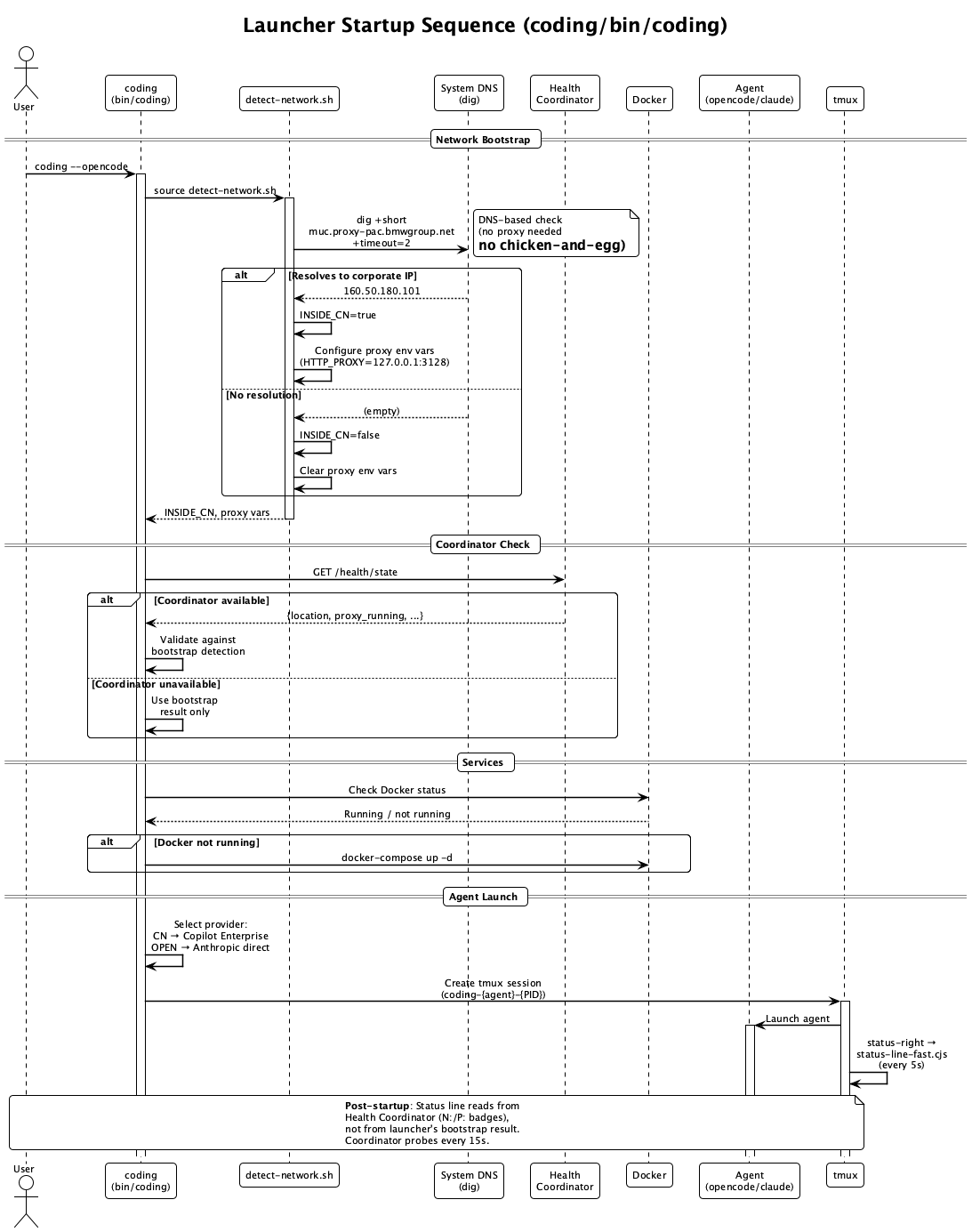
The launcher has its own one-time bootstrap check for the moment before the coordinator is up, also DNS-based — the previous version fetched a corporate URL, which required the proxy to already be configured, which required knowing the network. Once the coordinator is running, everything defers to it.
What each agent does on each network
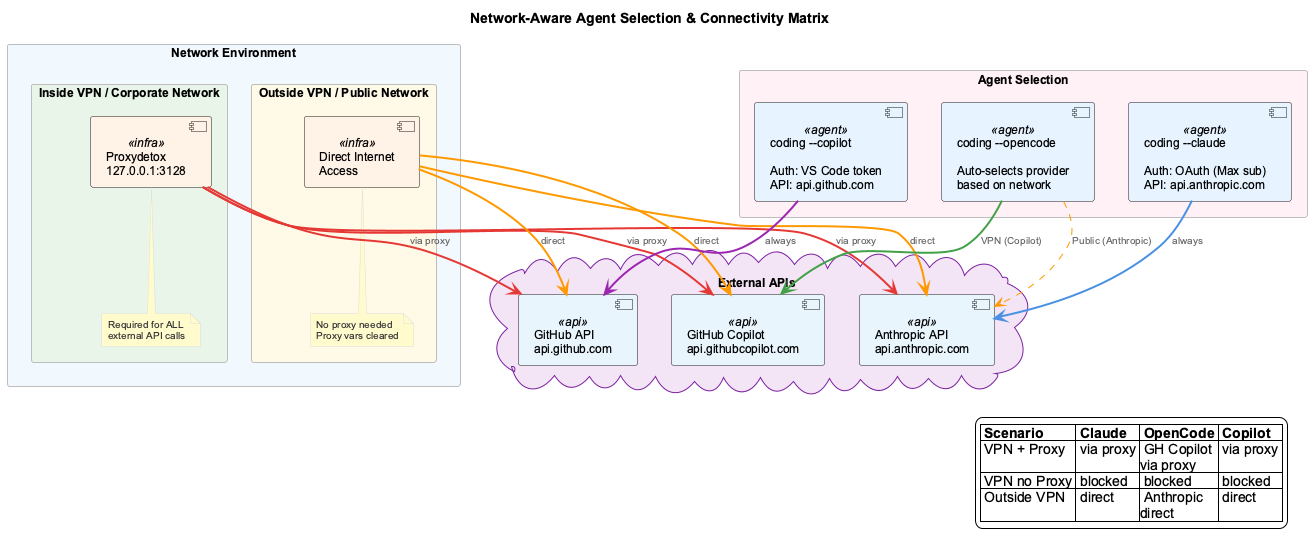
Inside the corporate network the launcher auto-detects proxydetox and sets HTTP_PROXY and HTTPS_PROXY. Outside, it actively clears those variables — a stale proxy setting pointing at a proxy that is not there fails in a way that looks like an API outage.
The two network vocabularies
This is worth stating plainly because it has caused real restart loops: the coordinator speaks corporate | vpn | open, and the LLM proxy speaks corporate | public. vpn and corporate are the same network under two names. Any code comparing the two must map them first, and the flip detector must compare against the last settled classification rather than the last raw reading, or a single transitional sample triggers a restart.
The bug this describes is invisible on a public network, where both sides happen to spell it the same way. Diagnose it on the VPN specifically.
Egress can fail while routing is perfect
Distinguish two questions that look identical from the outside: where was this call routed, and could the process reach the internet at all. On the corporate network with direct egress, every off-premises provider fails with a bare connection error while the routing decision was entirely correct.
The tell is one on-premises provider succeeding while everything else fails. Fallback depth does not help — every hop in a chain shares the same egress pin, so a stale pin fails all of them identically.
Diagnosing
curl -s localhost:3034/health/state | jq .network       # what the coordinator sees
curl -s localhost:12435/health | jq '.networkMode'      # what the proxy believes
If those two disagree after mapping vpn to corporate, the proxy is holding a stale reading; kickstarting it while on your current network re-pins it.
How the Coding launcher handles corporate VPN, proxy detection, and agent-specific API routing.
Overview
The Coding system operates in three network environments:
- VPN — connected to corporate network via VPN tunnel; proxy (proxydetox on
127.0.0.1:3128) is running and required for external API calls - Corporate Network (CN) — physically on the corporate network (e.g. office ethernet/Wi-Fi); proxy is running and required for external API calls
- Home / Public Network — direct internet access, no proxy needed
The health coordinator is the single source of truth for network state. It probes every 15 seconds and exposes the result via GET /health/state → network. The launcher, status line, and LLM proxy all consume this endpoint — there is no independent detection elsewhere.
Connectivity Matrix
| Agent | Auth Method | Inside VPN (proxy) | Outside VPN (direct) |
|---|---|---|---|
coding --claude | OAuth (Max subscription) | Works via proxy | Works direct |
coding --opencode | Auto-selected | GH Copilot Enterprise via proxy | Anthropic direct |
coding --copilot | VS Code Copilot token | Works via proxy | Works direct |
OpenCode Model Switching
OpenCode automatically switches its LLM provider based on network location:
- VPN:
github-copilot-enterprise/claude-opus-4.6(free via corporate subscription) - Public:
claude-opus-4-6(personal Anthropic API key or subscription)
Detection Flow
Unified Detection (Health Coordinator)
The coordinator (scripts/health-coordinator.js) is the single authority for network location. It probes every 15 seconds using three independent signals — evaluated in order, first match wins:
| Priority | Signal | Method | Result |
|---|---|---|---|
| 1 | Cisco VPN CLI | /opt/cisco/secureclient/bin/vpn state → output contains "Connected" | vpn |
| 2 | utun interface | ifconfig → any utun* with an inet address | vpn |
| 3 | BMW internal DNS | dig +short muc.proxy-pac.bmwgroup.net (spawns a fresh process — never stale) + TCP latency to resolved IP | corporate (<100 ms) or vpn (≥100 ms) |
| — | None match | DNS resolution fails entirely | open |
Why dig instead of Node.js dns.Resolver
Node.js caches the system DNS servers at process start. If the coordinator starts on a hotspot (public DNS like 8.8.8.8) and the user later connects to the office LAN (corporate DNS 160.50.x.x), dns.getServers() returns the stale startup servers — BMW internal hostnames can't resolve, and the coordinator reports open indefinitely. Spawning dig as a subprocess reads the current OS DNS config on every probe, eliminating this class of bugs.
Launcher Bootstrap (detect-network.sh)
The startup script runs a one-time DNS-based check before the coordinator is available:
# DNS-based — works without proxy (no chicken-and-egg)
dig +short muc.proxy-pac.bmwgroup.net +timeout=2
dig +short cc-github.bmwgroup.net +timeout=2
If either resolves to a corporate IP → INSIDE_CN=true. This replaced the previous curl https://cc-github.bmwgroup.net approach, which required the proxy to already be configured (circular dependency on CN).
Once the coordinator is running, the launcher defers to GET http://localhost:3034/health/state for all subsequent network state.
Startup Sequence
Proxy Management
The px Toggle
The px shell alias is the only way to toggle the proxy. It performs three actions atomically:
- Toggles the proxydetox daemon via
launchctl unload/launchctl loadof the plist — this truly stops/starts the daemon and closes/opens port 3128 (previous implementations usedlaunchctl stopwhich was ineffective due to launchd socket activation respawning the process immediately) - Invalidates status line caches — deletes all per-pane cache files so the next tmux render reflects the new state
- Notifies the health coordinator —
POST /health/refreshtriggers an immediate network re-probe (bypasses the 15s poll interval)
Update Propagation After px
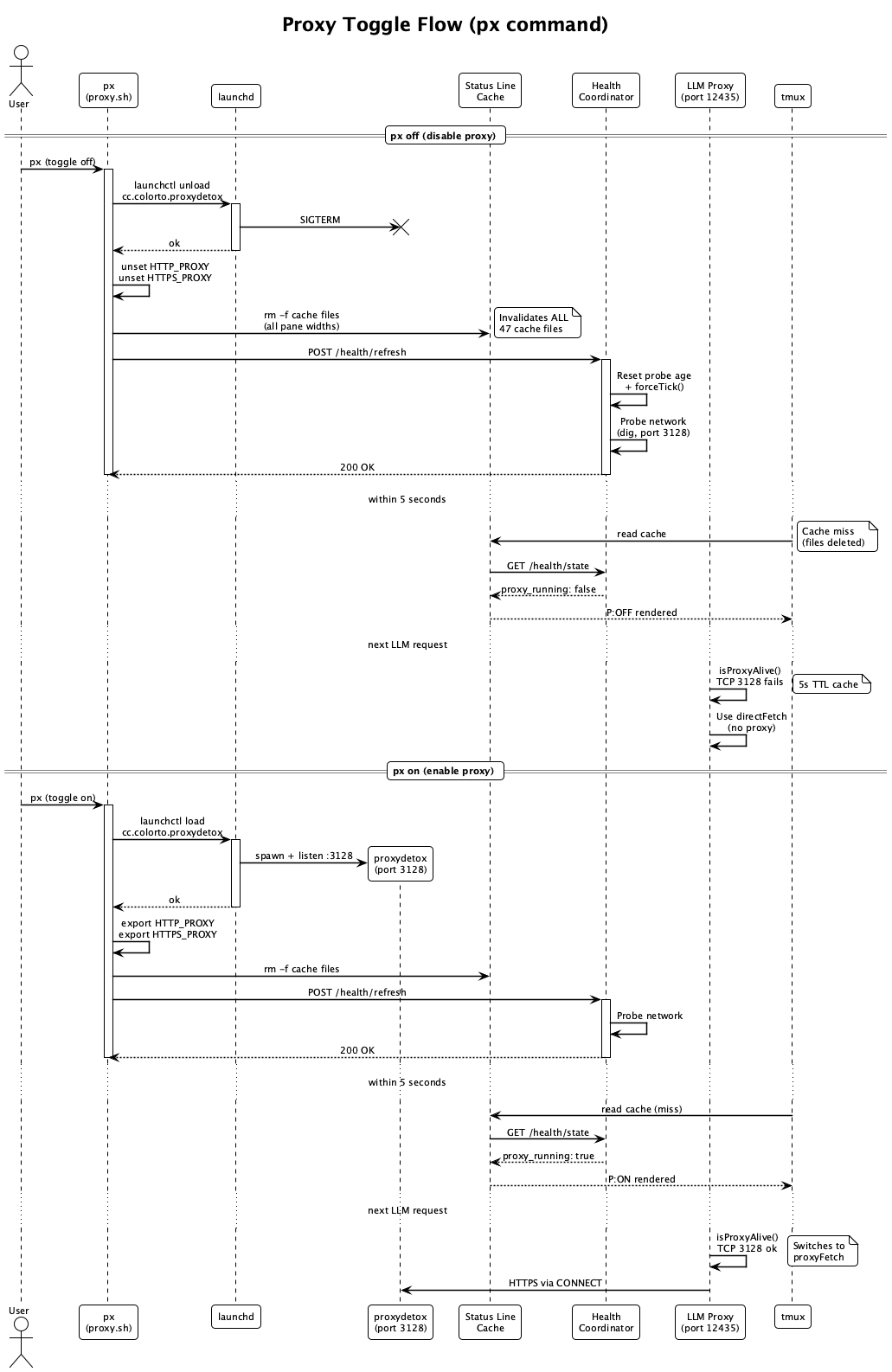
The status line reflects the new P: state within ≤5 seconds (one tmux refresh cycle):
| Step | Latency | Mechanism |
|---|---|---|
| proxydetox stop/start | instant | launchctl unload/load |
| Cache invalidation | instant | rm .logs/combined-status-line-cache-*.txt |
| Coordinator re-probe | instant | POST /health/refresh resets rate-limiter + forces tick |
| tmux renders | ≤5s | status-interval 5 picks up fresh state |
LLM Proxy Dynamic Routing
The LLM proxy (rapid-llm-proxy, port 12435) dynamically adapts to proxy availability without restart:
- On each outbound request,
smartFetch()TCP-probes port 3128 (with 5s cache) - If proxydetox is up → routes via
undici.ProxyAgent(corporate proxy) - If proxydetox is down → routes via native
fetch(direct internet)
This means px off on a hotspot (direct internet) works immediately — the LLM proxy stops trying to route through the dead proxy within 5 seconds.
Proxy Auto-Heal
When the coordinator judges the LLM proxy unhealthy it can dispatch launchctl kickstart. Three rules constrain that, each added after an incident where the previous behaviour made things worse.
A failed probe is not a failed service
probeHttpHealth/probeTcpPort used to map every failure onto stopped, collapsing two facts that are not the same:
| Probe outcome | Actually evidence of |
|---|---|
ECONNREFUSED | Nobody is listening — real evidence of death |
timeout | Nothing at all — a slow target, a loaded machine, a saturated event loop, a network blip |
lib/network/probe-result-semantics.mjs softens a timed-out probe to unknown rather than stopped. unknown rather than the previous value, because a failed probe must never assert health — and asserting death on no evidence is the same mistake pointed the other way.
Observed twice before it was generalised: on 2026-08-09 the prompt hook reported "service obs_api stopped" about a service that never stopped, and on 2026-08-30 a two-minute host network outage produced llm_cli_proxy stopped, obs_api stopped, db degraded while all three were provably fine. Three simultaneous false negatives from one transient is a property of the probe semantics, not of any one service.
A proxy that cannot parse its config is not one a restart fixes
A config file that will not parse aborts proxy boot by design. Restarting it produces an identical failure, so the coordinator distinguishes this cause and does not spend a kickstart on it.
One incident spends one kickstart, not three
From the coordinator's own log on 2026-08-31:
07:02:52.046  proxy auto-heal: dispatching restart (consecutive_failures=1, kickstart_count=1)
07:02:52.063  proxy auto-heal: dispatching restart (consecutive_failures=2, kickstart_count=2)
07:02:52.114  proxy strong-probe escalation: dispatching restart  (kickstart_count=3)
07:04:34      proxy auto-heal cooldown engaged — 3 kickstarts in last 300s
One underlying failure, three restarts in 68 ms, and the whole budget spent before the first restart had finished — a genuine fault arriving in the next five minutes would have found no remediation left. At 07:04:33 a kickstart errored outright because the service was still mid-restart.
Two distinct faults produced that, and a debounce alone fixes only one:
- The cheap-probe FSM counted invocations, not probe outcomes. It is called from three places, one of them every tick from
/health/refresh. Every call whilesemantic_okwas false incremented the counter and, past the 60 s sustained gate, dispatched — two of the three restarts above are one FSM firing twice, 17 ms apart, off a single probe result.isFreshProbeOutcome()supplies the missing edge detection, keyed onlast_probe_end: a caller arriving with the same stamp as last time is re-reading one conclusion, not observing a second failure. - Five independent paths could each dispatch without knowing another just had (cheap FSM, strong-probe escalation, passthrough frozen-502,
networkModeflip, location mismatch). They shared a count cap and no time gate, so "3 in 5 minutes" was satisfiable in 68 ms.decideKickstart()is the shared gate.
lib/network/kickstart-gate.mjs holds both, as pure functions:
| Constant | Value | Why |
|---|---|---|
KICKSTART_MAX_IN_WINDOW | 3 | Retry a genuine fault a few times |
KICKSTART_WINDOW_MS | 5 min | The budget window |
KICKSTART_DEBOUNCE_MS | 60 s | The cheap probe's interval, so consecutive dispatches are necessarily separated by at least one fresh observation of the restarted process |
A restart takes 3–8 s to come back and a probe cycle to prove anything, so a second dispatch inside that window cannot be acting on evidence about the new process — it is responding to the old one, or to the gap the restart itself created.
Both modules are pure (every input an argument; no env, no I/O, no clock) and live outside health-coordinator.js, which binds ports on import and therefore cannot be imported by a test. Covered by tests/network/kickstart-gate.test.mjs, which replays the 2026-08-31 cascade, and tests/network/probe-result-semantics.test.mjs.
Inside VPN / Corporate Network
The corporate proxy (proxydetox) runs on 127.0.0.1:3128. The launcher:
- Checks if
HTTP_PROXYis already set in the environment - If not, probes
127.0.0.1:3128and auto-configures:
export HTTP_PROXY="http://127.0.0.1:3128"
export HTTPS_PROXY="http://127.0.0.1:3128"
export NO_PROXY="localhost,127.0.0.1,.bmwgroup.net"
All external API calls (Anthropic, GitHub, OpenAI) require this proxy when inside VPN/CN. Direct connections time out.
Outside VPN (Public Network)
The launcher clears any proxy env vars inherited from shell profiles:
This prevents opencode/claude from trying to route through a non-existent proxy.
Agent API Endpoints
Each agent validates its required API endpoint before launch:
| Agent | Required API | Endpoint Tested |
|---|---|---|
| Claude Code | Anthropic | https://api.anthropic.com |
| OpenCode (VPN) | GitHub Copilot | https://api.github.com |
| OpenCode (public) | Anthropic | https://api.anthropic.com |
| Copilot CLI | GitHub | https://api.github.com |
If validation fails, the launcher logs a warning but does not block startup (the agent may still work via cached tokens or fallback mechanisms).
Testing & Debugging
Dry Run
Test network detection without launching an agent:
Output includes:
[OpenCode] 🏢 Inside Corporate Network (cc-github.bmwgroup.net reachable)
[OpenCode] Proxy active: http://127.0.0.1:3128/
[OpenCode] ✅ External access working (via proxy)
[OpenCode] DRY-RUN: Network: CN=true, Proxy=true, Required=true
[OpenCode] 🏢 VPN → GitHub Copilot Enterprise (claude-opus-4.6)
[OpenCode] ✅ GitHub API reachable (for Copilot provider)
Force Network Mode
Override detection for testing:
# Simulate outside VPN
CODING_FORCE_CN=false coding --opencode --dry-run

# Simulate inside VPN
CODING_FORCE_CN=true coding --opencode --dry-run
Troubleshooting
| Symptom | Cause | Fix |
|---|---|---|
N:OPEN when on office LAN | Coordinator started on hotspot; stale DNS servers (pre-dig fix) or process running old code | Restart coordinator: launchctl stop com.coding.health-coordinator && launchctl start com.coding.health-coordinator |
P:ON after px off | Pre-2026-07-26 badge showed daemon truth only | Fixed: badge is now three-state — px off with the daemon loaded renders P:AUTO (expected; the always-on daemon auto-DIRECTs off-CN). P:OFF now only means the daemon is down |
| Status line takes >10s to show P: change | Cache files not invalidated; coordinator not notified | Ensure px does rm .logs/combined-status-line-cache-*.txt AND curl -s -X POST http://localhost:3034/health/refresh |
LLM proxy 500s after px off | Proxy dead but LLM proxy still routing through ProxyAgent | LLM proxy now has smartFetch() with 5s proxy-alive cache — recovers automatically |
| 502 Bad Gateway in OpenCode | Proxy interfering with streaming API | Check proxydetox is running: lsof -i :3128 |
| All API calls timeout (000) | Inside VPN/CN without proxy | Run px to start proxydetox, or set HTTP_PROXY |
| "Credit balance too low" | Using API key instead of OAuth | Log in via claude auth login for Max subscription |
| OpenCode uses wrong model | Network detection mismatch | Use --dry-run to check, or CODING_FORCE_CN=true/false |
| Semantic readiness yellow (brain badge) | processOverrides routing health-coordinator through claude-code (slow subprocess) | Set override to copilot: curl -X POST http://localhost:12435/api/llm/settings -H 'Content-Type: application/json' -d '{"settings":{"processOverrides":{"health-coordinator":{"provider":"copilot"}}}}' |
Environment Variables
| Variable | Set By | Purpose |
|---|---|---|
HTTP_PROXY / HTTPS_PROXY | detect-network.sh | Route traffic through corporate proxy |
NO_PROXY | detect-network.sh | Bypass proxy for local/internal hosts |
INSIDE_CN | detect-network.sh | true when on corporate VPN |
PROXY_WORKING | detect-network.sh | true when external APIs are reachable |
PROXY_REQUIRED | detect-network.sh | true when proxy is needed (= inside CN) |
CODING_FORCE_CN | User override | Force true/false to skip detection |
OPENCODE_CONFIG_CONTENT | opencode.sh | JSON config for model/provider selection |
Health Coordinator Network State
The coordinator exposes live network state at GET http://localhost:3034/health/state → network:
{
  "network": {
    "internet_reachable": true,
    "proxy_running": true,
    "proxy_functional": true,
    "proxy_port_listening": true,
    "location": "vpn",
    "last_check": "2026-05-29T07:48:52.982Z",
    "last_probe_end": "2026-05-29T07:48:52.980Z"
  }
}
| Field | Type | Description |
|---|---|---|
internet_reachable | boolean | Whether external endpoints are reachable (via proxy or direct) |
proxy_running | boolean | Whether proxydetox process is alive |
proxy_functional | boolean | Whether CONNECT through proxy succeeds |
proxy_port_listening | boolean | Whether port 3128 accepts TCP connections |
location | string | vpn, corporate, open, or unknown |
last_probe_end | ISO string | Timestamp of last completed network probe |
The POST /health/refresh endpoint triggers an immediate network re-probe (resets the rate-limiter so the probe runs on the next tick, regardless of the 15s interval).
The dashboard's LLM Proxy Health card and the statusline's [N:xx] / [P:xx] badges both consume this state. N reflects location; P reflects proxy_port_listening (binary ON/OFF — there is no ERR state).