Ontology System
Automated knowledge classification with a six-facet upper ontology, team-specific lower ontologies, hybrid classification, and schema validation.
The ontology lives inside @fwornle/km-core (/ontology/) and is shared by all three knowledge systems on the kernel — the UKB (System B), Observational Memory (System A), and the OKB (System C). System C composes additional domain-specific lower ontologies on top of the same upper layer (RaaS, KPI-FW, and per-business-area classes) — those extensions live alongside the OKB code and are documented in the OKB ontology guide.
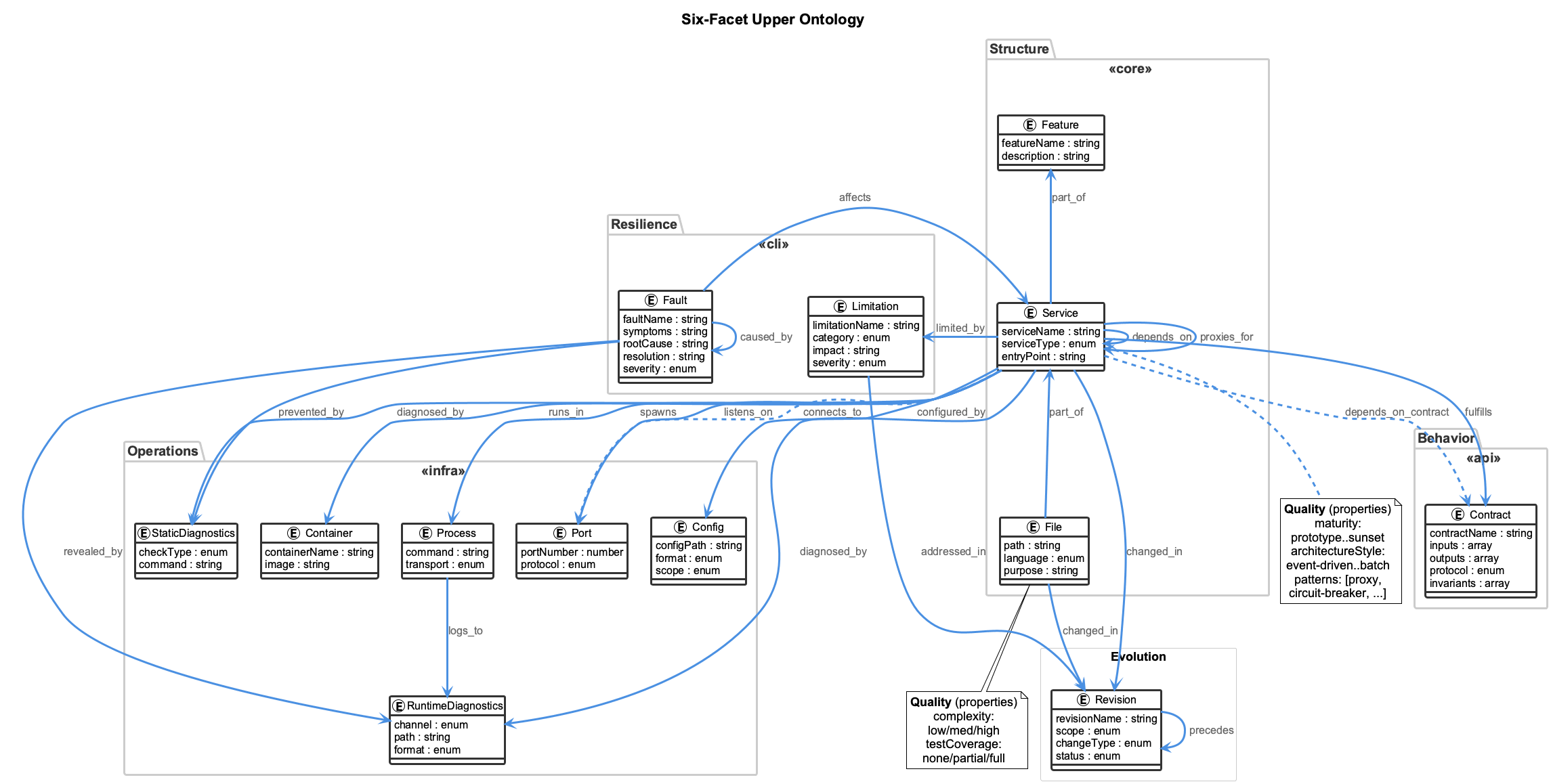
Six-Facet Upper Ontology
The upper ontology organizes all software knowledge into six orthogonal facets -- dimensions along which any software component can be described:
| # | Facet | Question | Entity Types |
|---|---|---|---|
| 1 | Structure | What it IS | File, Service, Feature |
| 2 | Behavior | What it DOES | Contract |
| 3 | Operations | How it RUNS | RuntimeDiagnostics, StaticDiagnostics, Port, Config, Container, Process |
| 4 | Resilience | What goes WRONG | Fault, Limitation |
| 5 | Quality | How GOOD it is | (properties on File/Service/Feature) |
| 6 | Evolution | How it CHANGED | Revision |
Totals: 13 entity types, 20 relationships, 6 quality properties.
Structure Facet
Three-level code hierarchy with explicit composition:
- File -- Atomic source file (path, language, purpose)
- Service -- Deployable unit composed of files (server, proxy, UI, CLI, library, agent, worker)
- Feature -- User-facing capability composed of services
Relations: part_of (File/Service to Service/Feature), depends_on (Service to Service), proxies_for (Service to Service)
Behavior Facet
- Contract -- Specification of what a component promises to do (inputs, outputs, protocol, invariants)
Relations: fulfills (Service/File implements a Contract), depends_on_contract (Service needs a Contract)
Architectural patterns (proxy, circuit-breaker, observer, etc.) are captured as a patterns property on Service.
Operations Facet
- RuntimeDiagnostics -- Observable output while running (log files, stderr, endpoints, docker-logs)
- StaticDiagnostics -- Checks without running (type-check, lint, config-validation, schema)
- Port -- Network port for inter-component communication
- Config -- Configuration source (JSON, YAML, env, shell)
- Container -- Docker container or compose service
- Process -- Running OS-level process
Relations: diagnosed_by, logs_to, connects_to, listens_on, configured_by, runs_in, spawns
Resilience Facet
- Fault -- Known failure mode with symptoms, root cause, resolution, and severity
- Limitation -- Known boundary or technical debt (scalability, missing-feature, design-constraint, dependency)
Relations: affects (Fault on Service), revealed_by (Fault in RuntimeDiagnostics), prevented_by (Fault caught by StaticDiagnostics), caused_by (Fault chain), limited_by (Service/Feature has Limitation)
Quality Facet
No dedicated nodes. Quality is expressed as properties on structure entities:
- File:
complexity(low/medium/high),testCoverage(none/partial/full) - Service:
maturity(prototype/active/stable/deprecated/sunset),architectureStyle,patterns - Feature:
maturity
Evolution Facet
- Revision -- Significant change milestone (not every commit, but meaningful structural or behavioral changes)
Relations: changed_in (File/Service modified in Revision), precedes (chronological ordering), addressed_in (Limitation resolved in Revision)
Upper / Lower Ontology Inheritance
Upper Ontology (13 entity types)
  |
  +-- Lower: coding-ontology.json
  |     LSLSession extends File
  |     MCPAgent extends Service
  |     GraphDatabase extends Service
  |     ...
  |
  +-- Lower: raas-ontology.json
  |     EventMeshNode extends Service
  |     KubernetesCluster extends Process
  |     ...
  |
  +-- Lower: resi-ontology.json
  |     EmbeddedFunction extends Service
  |     MF4Container extends File
  |     ...
  |
  +-- Lower: ui-ontology.json
  |     ReactComponent extends Service
  |     AWSLambdaFunction extends Process
  |     ...
  |
  +-- Lower: agentic-ontology.json
  +-- Lower: code-entities-ontology.json
  +-- Lower: cluster-reprocessing-ontology.json
Inheritance Rules
- Lower ontology entities extend upper ontology entities via
extendsEntity - Properties merge (lower overrides upper)
- Required properties accumulate
- Lower ontologies are team-scoped
File locations:
- Upper:
.data/ontologies/upper/development-knowledge-ontology.json - Lower:
.data/ontologies/lower/{team}-ontology.json - Schema:
.data/ontologies/schemas/ontology-schema.json
4-Layer Classification Pipeline
The classification system determines entity types for knowledge items:
| Layer | Method | Speed | Description |
|---|---|---|---|
| 1 | Heuristic Patterns | >10,000/sec | Fast pattern matching, early exit at >=0.85 confidence |
| 2 | Enhanced Keyword Matcher | <10ms | Multi-keyword scoring with domain terminology |
| 3 | Semantic Embedding | ~50ms | 384-dim vector similarity against ontology definitions |
| 4 | LLM Classification | ~500ms | Fallback via Groq, OpenAI, Anthropic, or Google |
Classification Examples
// Heuristic-only (fast, no cost)
const result = await classifier.classify('MCP proxy restart failure', {
  team: 'coding',
  enableHeuristics: true,
  enableLLM: false,
  minConfidence: 0.7,
});
// => { entityClass: 'Fault', confidence: 0.88, method: 'heuristic' }

// Hybrid (try heuristics, fall back to LLM)
const result = await classifier.classify(knowledge, {
  enableHeuristics: true,
  enableLLM: true,
  minConfidence: 0.7,
});
Configuration
{
  "ontology": {
    "enabled": true,
    "upperOntologyPath": ".data/ontologies/upper/development-knowledge-ontology.json",
    "team": "coding",
    "confidenceThreshold": 0.7,
    "validation": {
      "enabled": true,
      "mode": "lenient"
    },
    "classification": {
      "enableHeuristics": true,
      "enableLLM": false,
      "heuristicThreshold": 0.85
    }
  }
}
Validation
Strict mode -- Enforces all rules, rejects unknown properties (production use).
Lenient mode -- Allows extra properties (development, exploration).
The validator checks: required properties, type checking, enum constraints, pattern matching (regex), range constraints (min/max), nested objects, and array items.
Querying
// By entity class
const results = await queryEngine.findByEntityClass('Service', 'coding');

// By property
const results = await queryEngine.findByProperty('Fault', 'severity', 'critical');

// Aggregation
const counts = await queryEngine.aggregateByEntityClass('coding');
// => { Service: 12, File: 45, Config: 8, Fault: 3, ... }
Design Decisions
- Six facets -- Prevents the ontology from becoming a flat grab-bag. Each facet answers a clear question.
- Node vs property -- Nodes have relationships to other things. Properties are scalar attributes of one thing. This prevents bloat.
- File granularity -- File is the atomic level. Functions/classes are delegated to graphify. Features are the coarsest level.
- Contract as a node -- Contracts are reusable (multiple services fulfill one contract) and testable independently.
- Limitation as a node -- Limitations are shared across services, linked to planned revisions, and can chain causally.
- Quality as properties -- Complexity, maturity, and test coverage are scalar measurements. Promote to nodes only if relationships are needed.
- Revision over git commits -- Semantic change milestones that an agent can reason about, not per-commit noise.
Related
- Knowledge Management -- UKB integrates with ontology classification
- Knowledge Workflows -- UKB analysis workflows use the classification pipeline
- Semantic Analysis -- MCP tools for ontology operations