Continuous Integration
Four GitHub Actions workflows guard this repository — what each proves, and what a red run actually means.
The four workflows
| Workflow | Runs on | Proves |
|---|---|---|
| tests | push to main, every PR | The whole suite passes — lint, jest and node:test |
| Egress Lint | push to main, every PR | No new code dials a provider cloud directly |
| Deploy Documentation | push to main | The published site matches main |
| Cross-platform | every PR | The installer works on Linux, macOS and Windows |
Only Cross-platform skips pushes to main — it is PR-and-dispatch only.
What CI cannot see
No runner has Docker, the agent CLIs, the private submodules, or a corporate proxy. A green run therefore proves the suite passes without those, which is a real guarantee but a narrower one than "everything works".
Two runners, split by content
A test file belongs to jest or to node:test depending on whether it imports node:test — by content, not by filename. That is why a file cannot be claimed by both or dropped by both.
When something goes red
Read which workflow failed first: they mean entirely different things. A red tests is a code problem; a red Egress Lint is a policy problem; a red Deploy Documentation means the site no longer matches main.
Why four, and why independent
Each workflow has its own triggers and its own failure meaning, and between them they cover the test suite, the egress policy, the published documentation and the installer's portability. Keeping them separate is what makes a red run informative — one combined workflow would tell you something broke without telling you what kind of thing.
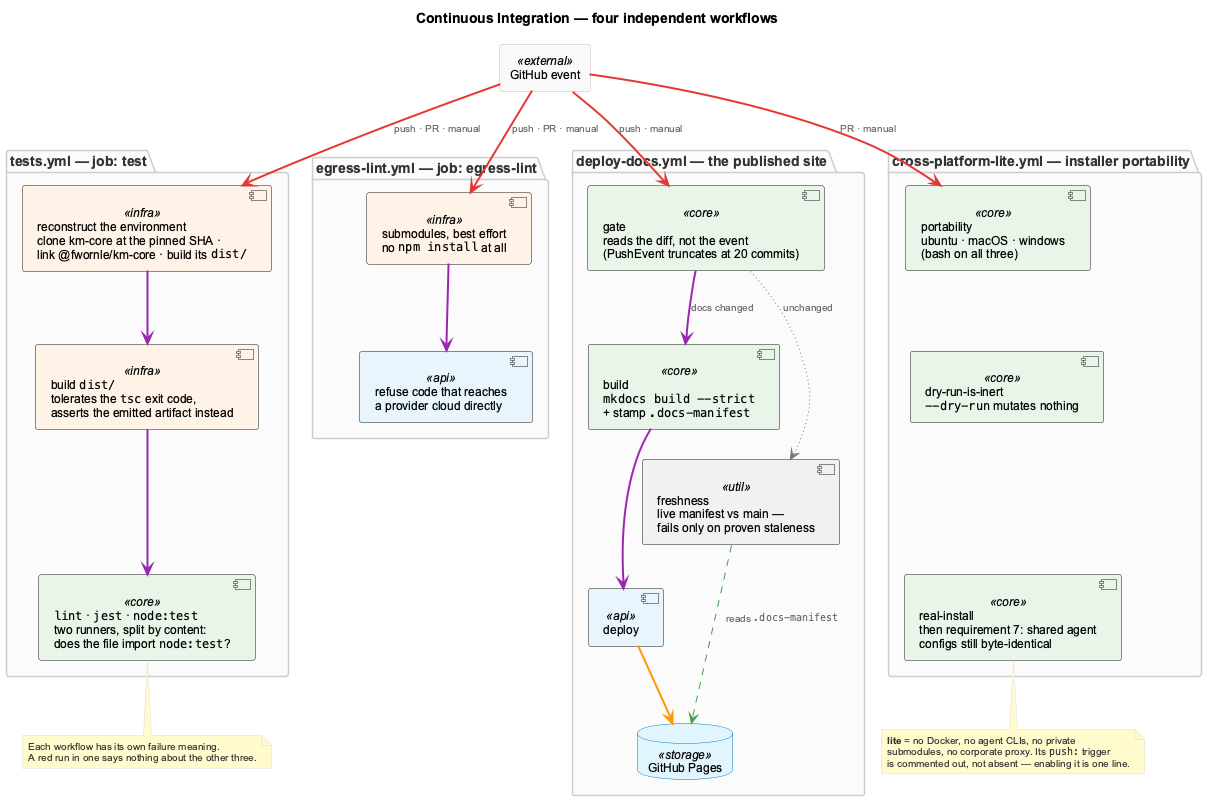
What a green run does and does not prove
Every runner is a stock GitHub-hosted machine. None has Docker, the agent CLIs, the private integrations/* submodules, or a corporate proxy. So green means: the suite passes on a clean machine with none of this project's runtime around it.
That is worth knowing in both directions. It is a genuine portability guarantee — a contributor with none of the local setup can still be told whether their change is sound. And it is a real gap: anything that only manifests with the containers running is not covered here, and is covered by the local suite instead.
The test split
The repository has two test systems, and classification is by content: a file that imports node:test belongs to node:test, everything else matching the jest globs belongs to jest. Both runners read the same inventory, so a file cannot be claimed by both or silently dropped by both.
That mattered because the failure it prevents is invisible. Jest collects .test.js files but cannot see a node:test registration, so it used to report "your test suite must contain at least one test" for suites that were in fact fine — while other suites ran under no runner at all.
The documentation workflow is unusual
It carries a freshness guard as well as a build. The gate decides whether a push touched anything the site renders, and skipping is the normal case. What is not normal is the gate skipping while the site is genuinely stale — a failure that reports success, because a skipped build makes the whole run green.
That has happened: several files under docs-content/ are symlinks into docs/, so editing one changes the symlink's target and not the symlink, and a docs-content-only path pattern did not match. Five consecutive green runs published nothing.
So the guard checks the invariant directly rather than trusting the pattern: the content hash of everything the site renders, symlinks resolved, must equal the hash the live site is serving. It fails only on positive evidence of staleness — if it cannot fetch the live manifest it warns and passes, because a guard that goes red on its own infrastructure gets disabled and then protects nothing.
What a red workflow tells you
| Red workflow | Means |
|---|---|
| tests | A genuine code failure, or a test that depends on local setup |
| Egress Lint | New code reaches a provider cloud directly, bypassing the proxy |
| Deploy Documentation | The build failed, or the site no longer matches main |
| Cross-platform | The installer is not portable — usually a shell or path assumption |
Cross-platform failures are the ones most likely to be real and least likely to reproduce locally, because they are usually about a shell or a path that only behaves differently on another operating system.
Four GitHub Actions workflows guard this repository. They are independent — each has its own triggers and its own failure meaning — and between them they cover the test suite, the egress policy, the published documentation, and the installer's portability.
All four run on GitHub-hosted ubuntu-latest runners except where a job explicitly asks for macOS or Windows. None of them has access to Docker, the agent CLIs, the private integrations/* submodules, or a corporate proxy; what that costs, and where those gaps are covered instead, is set out under Cross-platform below.
| Workflow | File | Triggers | Proves |
|---|---|---|---|
| tests | tests.yml | push to main, every PR, manual | The whole suite passes — lint, jest, and node:test |
| Egress Lint | egress-lint.yml | push to main, every PR, manual | No new code dials a provider cloud directly |
| Deploy Documentation | deploy-docs.yml | push to main, manual | The published site matches main |
| Cross-platform | cross-platform-lite.yml | every PR, manual | The installer works on Linux, macOS and Windows |
Only cross-platform-lite skips pushes to main — it is PR-and-dispatch only, with the push: trigger commented out in the file rather than absent, so enabling it is a one-line change.
tests — the suite
The gate that matters most, and the one that runs on every push to main.
Two runners, and why the split is by content
The repository has two test systems, and a file belongs to exactly one:
| Runner | Owns | Invoked by |
|---|---|---|
| jest | **/test/**/*.test.js, **/tests/**/*.test.js | npm run test:jest |
| node:test | Any file that imports node:test | npm run test:node |
scripts/lib/test-inventory.mjs is the single source of truth for that ownership, and it classifies by content — does the file import node:test? — not by filename. A naming convention would need a second check to enforce it; the import is the fact that actually decides which runner can execute the file. Most node:test suites are .test.mjs, which jest's testMatch never collects at all, so a misfiled suite would be invisible rather than failing.
node:test suites are not confined to tests/. The inventory walks tests, test, src, scripts and lib/lsl, because assertions live in src/live-logging and scripts/ too.
The workflow runs the two halves as separate steps, so the summary says which one failed, and node:test carries if: ${{ !cancelled() }} so it runs even when jest is red. Chaining them would hide the second result for as long as the first was broken.
Locally, npm test runs both.
Reconstructing the environment
Four setup steps are load-bearing. Each exists because its absence was reproduced in a linux/amd64 container, and skipping any one of them fails tests in a way that looks unrelated to the missing piece.
1. Clone lib/km-core explicitly. It is a submodule pinned by an SSH URL. The job checks out with submodules: false — submodules: true would fail on the private integrations/* submodules, which the tests do not need — then clones km-core over HTTPS at exactly the SHA the superproject points at, read from the gitlink with git ls-tree. Testing against the pinned SHA is the point: CI runs the same km-core the developer has.
2. Recreate the @fwornle/km-core symlink. It is hand-made and appears in no package.json, so npm ci neither creates nor restores it. Without it, thirteen suites die instantly with ERR_MODULE_NOT_FOUND. This is the same wiring that breaks on a developer machine whenever node_modules is wiped or pruned.
3. Build km-core. Its dist/ is gitignored, so a fresh clone has no built km-core at all and nothing can import it until npm run build has run there.
4. Build this repo's dist/. Also gitignored. Skipping it costs roughly sixty failures on Could not locate module ../../dist/embedding/embedding-service.js.
The build step tolerates type errors, and verifies the emit instead
npm run build is tsc -p tsconfig.json. It exits 2 on a handful of pre-existing type errors in src/ontology/ — but noEmitOnError is off, so it still emits, and the emitted dist/ is what the tests import.
Failing the job on that exit code would block the suite on type debt unrelated to it, so the step tolerates the non-zero exit and asserts the artifact directly:
npm run build || echo "tsc reported type errors — emit continues (no noEmitOnError)"
test -f dist/embedding/embedding-service.js || exit 1
This has a consequence when reading a red run: those src/ontology/*.ts annotations appear on every run, green or red. They are never the reason a run failed. See Reading a red run.
Dependencies the tests need that the source does not
npm ci at the root must supply everything any suite needs at import time, even when the code under test lives elsewhere.
The clearest case is esbuild. Several node:test suites exercise the dashboard's routing modules — integrations/system-health-dashboard/src/components/llm-routing/*.ts — which exist only as TypeScript, and node's ESM loader does not read TypeScript. The suites transpile them at import time through tests/helpers/dashboard-ts.mjs.
system-health-dashboard is a plain directory rather than a submodule, so its src/ is present on the runner — but its node_modules/ is gitignored and nothing installs it there. Resolving a transpiler out of that directory therefore works on a developer machine and fails on the runner. esbuild is a root devDependency for exactly this reason, so plain require('esbuild') resolves after npm ci; the helper falls back to the dashboard's own copy only for a partially-installed checkout.
Those suites load their modules with top-level await, deliberately. With describe, a root-level async before hook does not gate the suites in this node version: every test reports cancelled, which the runner counts as neither pass nor fail, so the file goes green while executing nothing. An import the module graph itself waits on cannot do that. Do not convert one to a hook.
What does not run on a runner
Two lists in scripts/lib/test-inventory.mjs, with different meanings:
EXCLUDED— never run bynpm test, anywhere. Currently thesrc/ontologynode:test suites no runner can execute, and one deliberate RED stub whose header says it fails by design until named plans land.CI_SKIPPED— skipped only whenprocess.env.CIis set. Locally every one of these still runs, because locally every one of them passes.
A suite belongs in CI_SKIPPED only when the thing it needs cannot exist on a hosted runner: macOS-only tooling, a live obs-api, gitignored local run artifacts, or the sibling _work/rapid-llm-proxy repository. It is explicitly not a way to quieten a failing test — entries once parked there as "not root-caused" turned out to be portability bugs in the tests and were fixed rather than skipped.
Every entry carries the reason it was verified against, and both runners print their skip and exclusion lists on every run, so a skip stays visible rather than looking like a test that does not exist.
Reproducing a failure locally
Set CI=true — that alone activates CI_SKIPPED and matches what the runner executes:
For failures that only appear on the runner, the missing piece is usually an uninstalled directory rather than the platform. Move it aside and re-run:
mv integrations/system-health-dashboard/node_modules{,.hidden}
CI=true npm run test:node
mv integrations/system-health-dashboard/node_modules{.hidden,}
Egress Lint
Fails the build when new code constructs a direct provider-cloud client — a new OpenAI( / new Anthropic( without a baseURL — or a new in-process LLMService outside the ratcheted allowlist. All LLM traffic is meant to reach a provider through the local proxy, and this is the check that keeps it that way.
The scanner is scripts/lint-egress.mjs and it needs no npm install at all; it runs straight from the checkout.
Submodules are initialised best-effort: the job rewrites the SSH pins to HTTPS, then initialises each one individually, and a pin that cannot be reached — a local-only commit, a private repo — downgrades to a ::warning:: rather than failing the lint. The scanner reports which roots it actually covered, so partial coverage is stated rather than assumed.
Sanctioned exceptions live in config/egress-lint-allowlist.json and are reviewed through the diff.
Deploy Documentation
Publishes the MkDocs site to GitHub Pages. Four jobs, and the interesting part is that two of them exist to catch the other two being wrong.
| Job | Runs when | Does |
|---|---|---|
gate | always | Decides whether this push touched anything the site renders |
build | gate said yes | mkdocs build --strict, stamps a manifest, uploads the artifact |
freshness | gate said no, on a push | Asks the live site whether it is still current |
deploy | gate said yes | Publishes to Pages |
The gate reads the diff, not the event
gate compares github.event.before..HEAD with git diff rather than using a top-level paths: filter. GitHub truncates the PushEvent commits array at 20 commits, so a larger push — a multi-day local backlog — cannot match a path filter and silently skips the workflow. A workflow_dispatch always builds.
The pattern it matches covers docs/, docs-content/, mkdocs.yml and the workflow file itself. docs/ is not redundant with docs-content/: several files under docs-content/ are symlinks into docs/, and updating one changes the symlink's target, not the symlink, so git diff --name-only reports only the docs/ path.
freshness — the guard for a wrong gate
A gate that skips is normal; most pushes are code-only and must not rebuild. What is not normal is a gate skipping while the site is stale — and that failure is invisible by construction, because build: skipped reports the whole run as success.
So rather than trusting the pattern, freshness checks the invariant directly: the content hash of everything mkdocs renders, symlinks resolved (scripts/docs-manifest.sh), must equal the hash the live site is serving from /.docs-manifest. It is independent of the gate's pattern by design.
It is asymmetric on purpose: it fails only on positive evidence of staleness, a hash mismatch. If the manifest cannot be fetched — Pages not yet live, a network blip — it warns and passes. A guard that goes red on its own infrastructure gets disabled, and then protects nothing.
When it fails it names the fix: publish now with gh workflow run deploy-docs.yml --ref main, then widen the gate's pattern — preferring a whole source directory over an enumeration, since an enumeration has to be maintained and forgetting to extend it fails exactly this silently.
Cross-platform (installer portability)
Runs on every pull request and on manual dispatch.
| Job | Runs on | Proves |
|---|---|---|
portability | ubuntu, macOS, Windows (Git Bash) | Every tracked *.sh is valid bash; install.sh detects the OS; --ci gates warn-and-continue instead of aborting; test-coding.sh --ci exits 0 |
dry-run-is-inert | ubuntu | install.sh --ci --dry-run exits 0 and mutates nothing — neither the working tree nor $HOME |
real-install | ubuntu | A real ./install.sh --ci completes, bin/coding --help works, and shared agent configs are byte-identical afterwards |
daemon-backends | ubuntu, macOS, Windows | launchd / systemd --user / Task Scheduler: exact command lines with the executor substituted (hard gate), then a live install→start→stop round-trip where the runner can host a user service |
browser-openers | ubuntu, macOS, Windows | bin/statusline-click picks the right browser opener per platform, with each opener stubbed on a hermetic PATH (hard gate); on ubuntu a live tier drives real xdg-open through to a browser |
browser-openers exists because the status-line click handler called macOS's open on every platform for weeks. The tmux binding that makes those fields clickable is not platform-gated, so the script runs wherever the status line does; on Linux open is not a command, stderr was discarded, and a dashboard click was a silent no-op — nothing opened, nothing logged, nothing said. Nothing in CI ran it off a Mac, and it was eventually noticed by a user reasoning about portability rather than by anything that executed.
Its contract tier stubs each opener on a hermetic PATH — only the stubs and the handful of coreutils the script needs. Keeping /usr/bin on the path was not enough: a real gio won the fallback race on macOS (homebrew) and again on Debian (/usr/bin/gio), so the ordering assertions silently tested nothing on both. A stub that records how it was called is also what catches the argument-level mistakes this dispatch is prone to, such as dropping the empty title argument from cmd.exe /c start "" — without it the URL becomes the window title and no browser opens, which fails exactly like success.
real-install is the job that catches what sourcing cannot. Before it existed, CI only sourced install.sh and called detect_platform / check_dependencies / detect_agents, leaving install_node_dependencies unreachable on every OS — the npm and proxy paths were never executed anywhere. Sourcing also leaves set -euo pipefail inactive, so it tested different shell semantics than a real run.
What "lite" means
| Proven here | Not proven here |
|---|---|
| Shell portability across three OSes | A full working service stack |
| OS detection | Docker image builds |
| Unattended gates warn-and-continue | Agent CLI auth (claude / gh copilot) |
| A real install completes on Linux | Private submodules |
A default install leaves $HOME untouched | Behaviour behind a corporate proxy |
Architecture coverage is split deliberately
GitHub's hosted runners are amd64, so real-install exercises the tokenizers-linux-x64-gnu path natively. scripts/test-install-linux.sh builds for the host architecture, so on an Apple Silicon machine it exercises tokenizers-linux-arm64-gnu instead. Between them both Linux architectures are covered, but neither covers both alone — a green local run is not evidence about amd64. Pass --amd64 / --arm64 to pin one explicitly.
Two gaps are covered off-CI rather than here:
- Corporate-proxy behaviour —
scripts/test-install-linux.shruns a real./install.shin an Ubuntu 24.04 container across three network shapes (direct; proxy-only via a squid sidecar with egress blocked; no-egress), plus anarchshape for the platform-specific fastembed tokenizer. It runs from a developer machine, including macOS. - Full stack — register self-hosted runners with Docker, an authenticated agent CLI and submodule access, then run
install.sh --yesfollowed byscripts/test-coding.sh.
Unattended flags
Used by CI, usable by any automation:
install.sh --ci(orCI=true) — non-interactive; declines optional system changes; downgrades missing Docker / agent CLI / core-dep gates from fatal to warnings so a portability run completes with a summary.install.sh --yes(orCODING_INSTALL_YES=1) — non-interactive; auto-approves system changes; keeps hard requirements hard. Does not extend to agent scope or background services, which needCODING_INSTALL_GLOBAL_AGENTS=1/CODING_INSTALL_SYSTEM_SERVICES=1. The full mutation surface is catalogued indocs/install-scope-and-host-impact.md.install.sh --dry-run— prints the mutation manifest and exits 0, touching nothing at all, not even the install log.test-coding.sh --ci(orCI=true) — runs every check but records unsatisfied ones as non-fatal[CI-SKIP], so a healthy headless runner is not marked failed. The requirement-7 check is deliberately exempt: a global write is a real regression, not an unsatisfied precondition, so it fails hard even under--ci.
Reading a red run
Start from the failing step, not the annotations. The Actions summary lists annotations from the whole run, and in tests the src/ontology/*.ts type errors are present on every run including green ones — they come from the build step that tolerates them by design. Open the job and find which step is red:
gh run view <run-id> --repo fwornle/coding --json jobs | python3 -c "
import sys,json
for j in json.load(sys.stdin)['jobs']:
    for s in j['steps']: print(s['conclusion'], s['name'])"
A node:test file that fails with no subtests did not run. A file-level not ok with failureType: 'testCodeFailure', no nested results and a duration of a few tens of milliseconds is a crash during module evaluation — a failed import, not a failed assertion. Look at what the file imports at top level, and at whether that thing exists on a runner.
A suite reporting cancelled also did not run. Cancelled counts as neither pass nor fail, so a file can report it for every test and still let the run go green. This is what a root-level async before hook does to a describe suite; see Dependencies the tests need.
A green deploy-docs run does not mean the site was rebuilt. gate skipping leaves build and deploy as skipped and the run as success. The freshness job is what turns a wrong skip into a red run — if it warned instead of checking, the site's freshness is unverified rather than confirmed.