LLM Routing
Every LLM call made anywhere in coding goes through the proxy on :12435, and two YAML files decide where it lands.
Two files decide everything
Your conversation with a coding agent, and every background cognitive service, reaches the llm-proxy on :12435. The proxy routes from two version-controlled YAMLs in the rapid-llm-proxy repo. Nothing else routes — no hardcoded chains, no policy hidden in startup scripts.
| File | Answers |
|---|---|
config/llm-routing.yaml | Which provider and model serves a given piece of work |
config/llm-fallback.yaml | What happens when that provider can't |
Both hot-reload on save. No restart.
Always write provider/model
A provider id names the account that gets billed, not the company that owns the model. claude-code-max (flat-rate Max subscription) and anthropic-api (metered key) both serve Claude models and are emphatically different money. So never write a bare model name:
claude-code-max/claude-opus-5     personal Max subscription
gh-copilot/claude-sonnet-5        corporate Copilot contract
groq/openai/gpt-oss-120b          Groq API key
The same form is used in the proxy logs, in token_usage.provider, and on the dashboard.
Why did this call go there?
Ask the proxy. It replays the decision the request path makes:
curl -s 'localhost:12435/api/llm/routing/resolve?job=bg-observation-writer' | jq -r .summary
# bg-observation-writer (step 2) -> gh-copilot/claude-haiku-4.5 > claude-code-max/claude-haiku-4.5 > …
Add &tools=true to apply the capability gate, or &network=corporate to evaluate the other network without moving the laptop.
Change it safely
Token Usage → Settings on the dashboard, or edit the YAML by hand. Saves are validated before they are written, and a config that will not parse aborts proxy startup rather than being half-applied.
Where to go next
Standard explains how a route and a model are actually chosen, when work is offloaded to a local model, and what happens when a provider fails. Deep Dive is the full reference, including the measurements behind each default.
How a request finds its provider
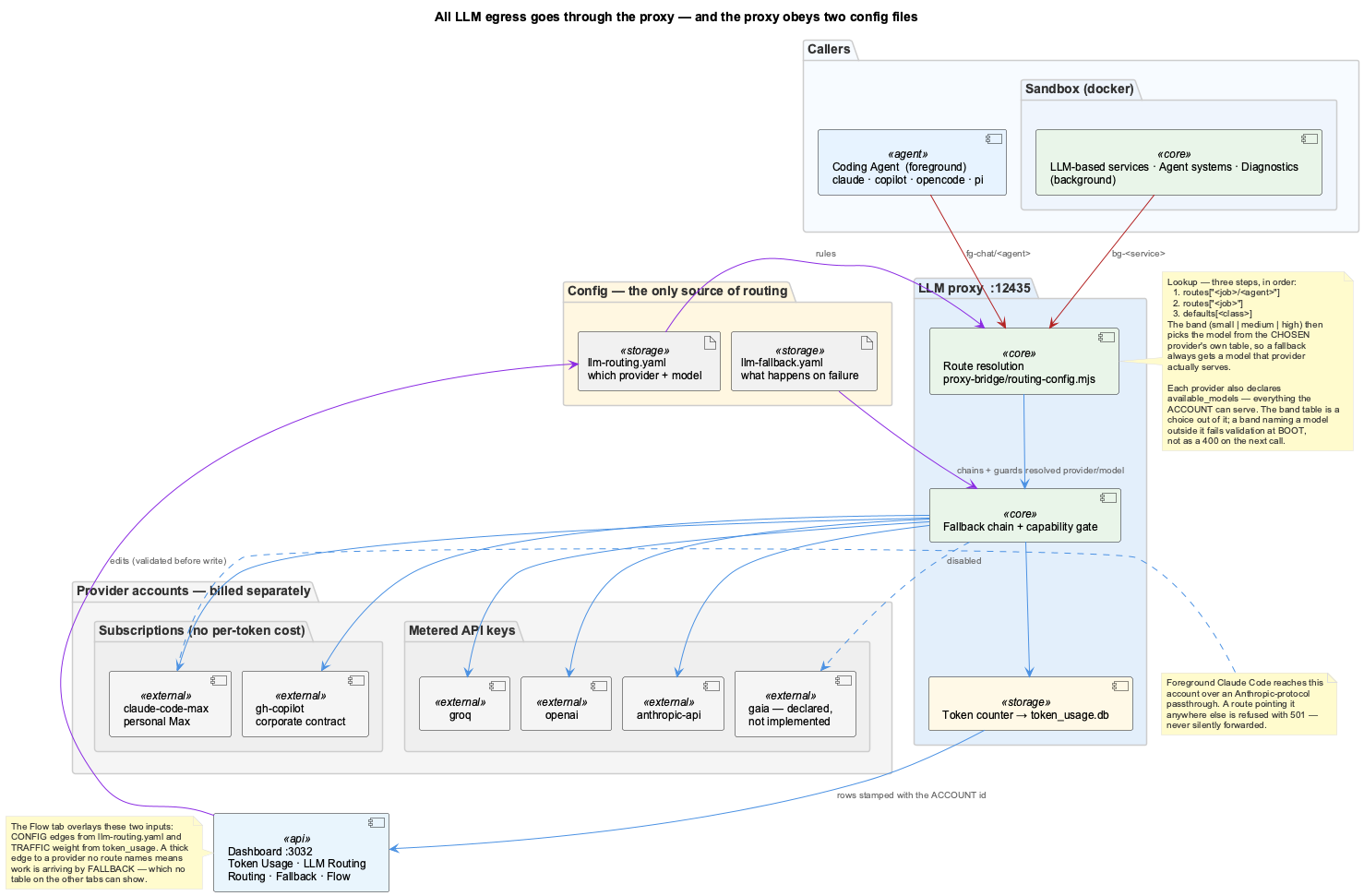
Lookup is three steps, in order — no wildcards, no scoring, no tie-breaks:
routes["<job>/<agent>"]— foreground, where the agent mattersroutes["<job>"]— background, where it doesn'tdefaults[<class>]—fg-chatforfg-*jobs,backgroundotherwise
job is fg-chat for a coding-agent conversation, or bg-<service> for a background service — the process field the caller sends to /api/complete.
Bands pick the model, routes pick the provider
The route names a provider. The complexity band then picks the model from that provider's own table:
routes:
  fg-chat/claude:        { provider: claude-code-max, complexity: high }
  bg-observation-writer: { provider: gh-copilot,      complexity: small }

providers:
  gh-copilot:
    models: { small: claude-haiku-4.5, medium: claude-sonnet-4.6, high: claude-sonnet-5 }
  claude-code-max:
    models: { small: claude-haiku-4.5, medium: claude-sonnet-5,   high: claude-opus-5 }
Deriving the model this way — rather than pinning provider and model on each row — is what makes fallback safe: when bg-observation-writer falls from gh-copilot to claude-code-max it lands on that provider's small model, instead of carrying a Claude model id to Groq.
Each provider also declares available_models, the full set that account can serve. models is a choice out of that catalogue, and a band naming a model outside it fails validation at boot — so a stale id is caught when a vendor retires it, not as a 400 on the next call.
When the caller declares its own band
complexity: from-caller lets the caller supply the band; the provider is still ours to decide. Two routes use it: fg-chat/opencode and fg-chat/pi. This is the only caller input to routing — body.provider and body.subscription are deliberately ignored, because a caller that can re-route itself can quietly move spend onto another account.
A caller can spell the band three ways, strongest first: complexity on the body, an x-complexity header, or OpenAI's reasoning_effort. The third is how pi does it, and it is why lowering pi's thinking level to low/minimal/off is what makes a turn eligible for the local offload. OpenCode has the same seam under --variant (cheap → small, standard → medium, deep → high).
None of this reads prompt content. Every input is a field the caller set on purpose, and GET /api/llm/routing/resolve?…&complexity=<band> reproduces the decision exactly.
There is also a prompt classifier, but it ships disabled and may only ever lower a band, never raise one.
Offloading cheap work to a local model
semantic_routing moves a call whose band is in offload_bands to a local, unmetered endpoint, inserting the route's own provider as the first fallback. There are two possible targets, because no single machine is always reachable:
| Target | What it is | Network | Serves |
|---|---|---|---|
qwen-local | on-prem V100 cluster | corporate only | foreground and background |
qwen-laptop | llama.cpp on this laptop, 127.0.0.1:8081 | public only | foreground only, off by default |
Three switches gate every offload, and each defaults safe:
offload_bands— how hard a call may be to qualify. A target may narrow this list, never widen it.scope— who may be waiting on it (fg,bg, or both). A laptop generating at a few tokens per second is fine for a turn you are watching and wrong for a high-volume background service.enabled— declaring a target says where an offload could go; enabling it says work should actually be sent there.
Both targets fail closed: each is re-probed every 60s and dropped from every chain while unreachable, so a stopped llama-server or an off-VPN cluster costs nothing beyond falling back to the provider the route named. A target is never probed on a network it does not serve.
When an offload does not happen, offloadSkipped says which of the reasons applied — no target for this network, the target is switched off, or the target does not serve this kind of work. They have different fixes.
When a provider can't serve
llm-fallback.yaml gives each provider an ordered list of what to try next:
chains:
  gh-copilot:
    - provider: claude-code-max
      when: { network: [public] }   # claude-code is firewall-blocked inside corporate
    - provider: groq
    - provider: openai
- A candidate whose guard doesn't hold is skipped — not an error; the chain continues.
- Chains are flat, not recursive. Falling back from A to B does not then consult B's own chain, so one route means one visible list of attempts rather than a graph to trace.
- Only the failure classes in
retry_onadvance the chain. A 400, a 401 or a content refusal surfaces verbatim — retrying a caller's bug across three providers just burns three quotas and hides the bug.
A request carrying tools[] may only land on a provider whose capabilities.tools is true; with enforce_capabilities: true a tools-bearing request with no capable provider fails loudly rather than landing somewhere that silently drops the tools and returns prose.
Foreground Claude is a passthrough
fg-chat/claude is special. Claude Code speaks the Anthropic wire protocol, and the proxy forwards those requests verbatim to /v1/messages rather than selecting a provider — so only a provider marked fg_transport: anthropic-passthrough can serve it, which today means claude-code-max alone. Routing it anywhere else is refused with a 501 ROUTE_NOT_IMPLEMENTED rather than silently ignored.
A practical consequence: foreground Claude can never be offloaded to a local model, on any network.
Changing the configuration
Token Usage → Settings at localhost:3032 edits both files. Saves are sent as a patch of only what changed and applied through the YAML document API, so the extensive comments in both files survive editing; the proxy validates before writing, and a rejected save leaves both files byte-identical.
The Flow tab draws the same data as a graph, with edge thickness from real traffic. That combination answers a question neither table can: a thick edge to a provider that no route names means work is arriving there by fallback.
Editing the YAML by hand works too — the proxy reloads on mtime change.
Diagnosing a routing surprise
/api/llm/routing/resolve— did the route resolve where you expected?matchedKeyandstepsay which of the three lookup steps fired;step: 3means nothing matched and you got a class default.- Read
skipped[]before assuming a bug — a guard or the capability gate may have removed the provider you expected, and it says which. - Reproduce with
tools[]. A curl reproduction of an agent call that omits them takes a different chain and can succeed where the agent fails. - Read the log line.
fallbackFromand the[<failure_class>]tag say exactly why the chain advanced.
For what routing did rather than what it would do, every token_usage row carries route_key, route_band, route_step, offloaded_from, chain_position and an attempt_trail. The dashboard renders it at Token Usage → Routing.
Every LLM call made anywhere in coding — your conversation with a coding agent, and every background cognitive service in the container — goes through the llm-proxy on :12435, and the proxy decides where it goes from two YAML files. Nothing else routes. There are no hardcoded provider chains, no policy hidden in startup scripts, and no heuristics that quietly reorder things.
| File | Answers |
|---|---|
config/llm-routing.yaml | Which provider and model serves a given piece of work |
config/llm-fallback.yaml | What happens when that provider can't |
Both live in the rapid-llm-proxy repo, next to the code that obeys them.
Naming: providers are accounts, not companies
A provider id names the account that gets billed, not the company that owns the model. claude-code-max (personal Max subscription) and anthropic-api (metered API key) both serve Claude models and are emphatically not the same thing — one is flat-rate, the other is per-token.
This matters because it used to be collapsed. The dashboard normalized claude-code → anthropic, which merged subscription traffic with API-key traffic under one label, so the By Provider pie could read "anthropic 100%" and tell you nothing about where the money went. Model names alone have the same problem: claude-sonnet-5 on the corporate Copilot contract and claude-sonnet-5 on a metered key are different money.
So a model is always written <provider>/<model>:
claude-code-max/claude-opus-5     personal Max subscription
gh-copilot/claude-sonnet-5        corporate Copilot contract
groq/openai/gpt-oss-120b          Groq API key
That form is used identically in the proxy logs, in token_usage.provider, on the dashboard, and here.
The catalogue
| Provider id | Account | Tools? | Notes |
|---|---|---|---|
claude-code-max | anthropic-subscription | no | The only provider that can serve foreground Claude Code |
gh-copilot | copilot-subscription | yes | Corporate contract, enterprise endpoint |
groq | groq-api | no | Fast and cheap; no Claude models |
openai | openai-api | yes | |
anthropic-api | anthropic-api | yes | Metered — distinct from claude-code-max |
gaia | corporate-api | — | Declared for completeness; disabled, no implementation yet |
available_models — the catalogue, separate from the choice
Each provider declares two different things, and the distinction matters:
gh-copilot:
  available_models:            # everything this ACCOUNT can serve
    - claude-haiku-4.5
    - claude-sonnet-4.6
    - claude-sonnet-5
    - gpt-4o
    - gpt-4o-mini
  models:                      # which of them each BAND currently picks
    small:  claude-haiku-4.5
    medium: claude-sonnet-4.6
    high:   claude-sonnet-5
models is a choice out of available_models. A band naming a model outside the catalogue fails validation at boot, with a message naming the key — so a stale id is caught the moment a vendor retires it, rather than as a 400 on the next call. It is also what lets the dashboard offer alternatives for a band: without a catalogue there is nothing to choose from.
These lists are what each account verifiably serves, taken from 30 days of token_usage plus a catalogue probe — not from a vendor page. Notably the Copilot leg rejects every opus id with 400 The requested model is not supported, so none is listed under gh-copilot. The Copilot CLI's own BYOK path does serve opus, but that is a different catalogue reached by a different route — do not copy ids between the two.
The field is optional, and an empty list constrains nothing, so a provider can be declared before anyone has probed it. gaia is exactly that case. Without that escape hatch, adding the field to one provider would break every other.
How a route is chosen
Lookup is three steps, in order. No wildcards, no scoring, no tie-breaks:
routes["<job>/<agent>"]— foreground, where the agent mattersroutes["<job>"]— background, where it doesn'tdefaults[<class>]— class isfg-chatforfg-*jobs,backgroundotherwise
job is fg-chat for a coding-agent conversation, or bg-<service> for a background service (the process field the caller sends to /api/complete).
The route picks a provider. The complexity band then picks the model from that provider's own table:
routes:
  fg-chat/claude:        { provider: claude-code-max, complexity: high }
  bg-observation-writer: { provider: gh-copilot,      complexity: small }

providers:
  gh-copilot:
    models: { small: claude-haiku-4.5, medium: claude-sonnet-4.6, high: claude-sonnet-5 }
  claude-code-max:
    models: { small: claude-haiku-4.5, medium: claude-sonnet-5,   high: claude-opus-5 }
Deriving the model this way — rather than pinning provider and model per row — is what makes fallback safe. When bg-observation-writer falls from gh-copilot to claude-code-max, it lands on that provider's small model. The old scheme carried the pinned model across "similar" providers and could hand Groq a Claude model id.
complexity: from-caller
One route uses it: fg-chat/opencode. OpenCode picks its own model per call — sonnet for the agentic loop, haiku for titles — and flattening that to a single band would make every cheap call expensive. The caller supplies the band; if it sends none, the class default applies. The provider is still ours to decide.
Two routes use it: fg-chat/opencode and fg-chat/pi.
This is the only caller input to routing. body.provider and body.subscription are deliberately ignored: a caller that can re-route itself is a caller that can quietly move spend onto a different account.
How a caller spells the band
proxy-bridge/caller-complexity.mjs accepts three spellings, strongest first:
| Signal | Who sends it |
|---|---|
complexity on the body | every background service, and the internal /api/complete callers |
x-complexity request header | a client that can set headers but not body fields |
reasoning_effort on the body | any OpenAI-shaped client — this is how pi does it |
The third is the one that made fg-chat/pi work. pi has no complexity field and no way to add one per turn, so it sent nothing, every turn fell to defaults.fg-chat (high), and nothing pi did was ever eligible for the semantic offload — "how many r's in strawberry" was answered by gh-copilot/claude-sonnet-5 while the local Qwen sat idle (2026-08-28).
pi does put its per-turn thinking level on the wire as OpenAI's reasoning_effort. config/agents/pi.sh gives its model a thinkingLevelMap that maps pi's level names onto band names, so the value that arrives is the band and neither side keeps a private table that can drift:
| pi thinking level | band | effect |
|---|---|---|
off / minimal / low | small | eligible for the offload → free local model |
medium | medium | stays on the route's provider |
high | high | stays on the route's provider |
xhigh / max | (hidden) | no band above high exists to map them to |
So lowering pi's thinking level is what routes a cheap turn to the local model. The raw OpenAI words (low, minimal, xhigh, …) are accepted too, for a client with no such map.
Everything above is a field the caller set on purpose — no prompt content is involved, and GET /api/llm/routing/resolve?…&complexity=<band> reproduces the decision exactly.
OpenCode declares with --variant
opencode has the same seam under a different name. models.<id>.variants entries are read off the user message each turn, and reasoningEffort reaches the wire as reasoning_effort:
| opencode variant | wire | band |
|---|---|---|
--variant cheap | reasoning_effort: low | small → offload-eligible |
--variant standard | reasoning_effort: medium | medium |
--variant deep | reasoning_effort: high | high |
| (none) | (no field sent) | falls to defaults.fg-chat → high |
Verified on a capture endpoint 2026-08-30, not inferred from the resulting band. Select with the --variant flag, the TUI variant picker / variantCycle keybinding, or the provider/model/variant model string. Older comments claiming opencode sends an x-complexity header were wrong — it has no headers key on its provider block and never sent one.
The prompt classifier (classifier:, ships OFF)
from-caller only helps when the caller declares something useful, and measurement showed two of the three agents did not: over one session on 2026-08-30, pi sent medium on all 11 turns (its slider's resting position) and opencode declared nothing on all 22. "How many r's in strawberry" ran on gh-copilot/claude-sonnet-4.6 for that reason and no other.
So there is a classifier now, and it is constrained so the reproducibility argument above still holds:
- Downgrade-only — it may lower a band, never raise one. The config's band stays a ceiling.
- Attributed — a lowered band reports
complexitySource: 'classifier', never'caller', on the row and in/resolve. - Reproducible —
/api/llm/routing/resolve?…&classified=truereplays the decision from the config alone, with no prompt. - Scoped —
from-callerroutes only. Background services choose their bands deliberately andfg-chat/claudeis a pinned-highpassthrough, so neither is ever second-guessed.
Cost is bounded by two free stages before any call: a turn already carrying tool results is never classified (74% of in-scope captured turns), then a cheap veto drops anything with code, paths or multi-step phrasing. impl: http is the injection point for your own service.
It is enabled: false and stays that way until node scripts/eval-prompt-classifier.mjs clears its gate. The gate is precision on small — the only metric that matters, since downgrade-only means a wrong medium/high costs nothing and only a wrong small spends a real turn on a weaker model. As of 2026-08-30 the local-llm rubric measures 78% against a 90% bar, so it is off.
Semantic offload: network-scoped, and opt-in per target
semantic_routing moves any call whose resolved band is in offload_bands to a local, unmetered endpoint, inserting the route's own provider as the first fallback.
There are two such endpoints, because there is no one machine that is always reachable — and each carries its own switch:
semantic_routing:
  enabled: true
  offload_bands: [ small ]
  targets:
    - provider: qwen-local     # the on-prem V100 cluster, 10/8
      require_network: corporate
      enabled: true
      scope: [ fg, bg ]        # fast enough for both
    - provider: qwen-laptop    # llama.cpp on this laptop, 127.0.0.1:8081
      require_network: public
      enabled: false           # last resort — see the latency note below
      scope: [ fg ]            # never background — see the same note
Ordered; the first enabled entry whose network matches wins; an entry with no require_network matches everywhere. Two entries claiming one network is refused at boot — the second could never be reached, and whoever wrote it believes it can.
scope defaults to [ fg, bg ] — foreground conversation, background service, or both. offload_bands says how hard a call may be to qualify; scope says who may be waiting on it. The band alone cannot express "cheap, but only when someone is watching", and that gap is what made the laptop target all-or-nothing: enabled for the sake of interactive turns, it took bg-observation-writer and bg-auto-measure-title — the two highest-volume services on the machine — with it.
It is declared per target rather than globally because it is a property of the endpoint, not of the policy: how much latency a box adds is the thing that decides what it may serve. A V100 rack is quick enough that a small foreground turn served there is not a worse conversation. A laptop generating at 3-6 tok/s is not, for anything unattended.
A call skipped on scope says so specifically — target "qwen-laptop" serves scope [fg] and this is bg work — rather than reusing "no offload target for this network". The two have opposite fixes: one wants a target declared, the other wants an existing one widened.
enabled defaults to false. Declaring a target says where an offload could go; enabling it says work should actually be sent there. Keeping those apart is the point: adding a target used to be sufficient to start serving traffic from it, which is how the laptop endpoint took a day of background work nobody had asked it to take. An off target is kept in the parsed config rather than dropped, so the dashboard can list it and switch it back on, and offloadSkipped names it as (off) — "no target for this network" and "the target for this network is switched off" are different operator errors.
Switch a target on or off in Token Usage → Settings → Routing (a checkbox beside each target) or in the YAML directly. The dashboard's PATCH writes the enabled field surgically when the target list is otherwise unchanged, so the prose explaining why a target is set the way it is survives the save; only adding, removing or reordering targets rewrites the sequence and drops their inline notes.
enabled: true with no target enabled is a warning, not a boot failure. Switching the last one off is a single click, and a click must never leave the proxy unable to start; everything simply routes by the pre-offload rules and says so on every resolve.
Until 2026-08-28 this block held a single local_provider with a single require_network: corporate. Off the VPN there was therefore no local target at all, and every small call went back to a paid account — silently, because "the local provider is unreachable" and "there is no local provider here" produced the same non-event. offloadSkipped now says which of the two it was. The old local_provider / require_network keys are refused by name rather than half-honoured.
Both targets fail closed. Each is re-probed every 60s (/models, no tokens) and dropped from every chain while unreachable, so a stopped llama-server or an off-VPN cluster costs nothing beyond falling back to the provider the route named.
A target is not probed at all on a network it does not serve. The routing guard already refuses to send work to qwen-local off corporate, so a probe there could only produce a false the router is contractually going to ignore — and it would open a connection to a private-range address, carrying the corporate bearer token, on whatever network the laptop happens to be on. 10.143.242.184 is not ours at a cafe, and something there may well answer. The endpoint is marked unavailable without being touched, which is the honest state anyway.
Why
qwen-laptopships switched off. Reachability is not usability, and the probe above can only establish the first: the laptop answers/modelson loopback in milliseconds and then generates an order of magnitude slower than the account it displaces. Measured 2026-08-29 over the 66 calls it served:
calls mean latency worst qwen-laptop66 47.0s 932s (a 59-token bg-observation-writercall)gh-copilot3045 5.4s — Worse, the 48 calls that gave up (
Qwen laptop API timed out after 120000ms) paid 92s on average before the real provider was even tried — the offload made those calls slower than not having it.offload_bandswas global andscopedid not exist, so all of this landed on the highest-volume background services (bg-observation-writer,bg-auto-measure-title), not only on interactive turns, and a 50s call sits uncomfortably close to the ETM's 60sisProcessingwatchdog.
scope: [ fg ]is what makes turning it back on safe: switching the target off stopped the damage by stopping everything, which is a blunt instrument for a problem that was entirely on one side of the fg/bg line. Foreground is the case that survives the latency — you are sitting there, you can see it working, and you chose the trade when you enabled it. Nothing chose it on behalf of the background services.Free is not the only axis. Turn it on for a session where cost genuinely beats latency — an unmetered laptop doing bulk cheap work off-VPN is a real case — and turn it back off.
Know before you enable it: off-VPN the foreground agent is
coding --claude, andfg-chat/claudecan never be offloaded — it arrives on the Anthropic wire protocol at/v1/messages, and no local provider carriesfg_transport. With claude this target is therefore reachable only from acoding --opencode/--pi/--copilotsession run off-VPN.
Per-provider timeouts
providers.<id>.timeout_ms caps how long the dispatcher waits for that endpoint before the fallback chain takes over. Omitted means the 120s default.
It is a property of the endpoint, not of the request. 120s is a reasonable ceiling for a metered account working on a hard prompt. It is the wrong ceiling for a semantic-offload target, where three things are true at once: the call was sent there because it was small and cheap, the provider its route names is sitting first in the fallback chain answering in ~5s, and the endpoint is a single local process that can wedge. Waiting two minutes to discover that makes the offload strictly worse than never having offloaded — measured on 2026-08-29, 48 such calls hit the ceiling and averaged 92s before the real provider was even tried, against a 5.4s direct call.
A value below 1000 is refused at boot on the assumption it was meant as seconds: timeout_ms: 20 would abort after 20ms and take the endpoint offline in a way that reads as "the endpoint is broken".
What total_tokens counts
input_tokens is fresh (uncached) prompt tokens and total_tokens is input + output, on every provider. Prompt-cache traffic lives in cache_read_tokens / cache_write_tokens and is additive to those.
This has to be stated because the two wires disagree and the column cannot express both:
| fresh prompt | cache reads | |
|---|---|---|
| Anthropic | usage.input_tokens | cache_read_input_tokens — a separate, additive counter |
| OpenAI | — | prompt_tokens already contains them; cached_tokens is a breakdown |
The proxy recorded each provider's number verbatim, so one column held two conventions and could not be summed across providers. openAIFreshInputTokens() in src/usage-cache.ts now subtracts cached_tokens from prompt_tokens at the parse boundary, making the OpenAI leg agree with the Anthropic one.
What it cost before the fix. Over 24h on 2026-08-29 the dashboard reported intensively-used foreground Opus-5 at 726K tokens — its 320.8M of cache reads were excluded — while a background classifier reported 51.9M with its cache hits counted in full. A 450× understatement of the former, which inverted which of the two dominated the day and made a background job look like the largest consumer on the machine.
Two consequences for anyone reading these rows:
- To display consumption, add the cache columns back.
total_tokensalone answers "what did we newly send and receive", not "what did this cost us". The dashboard'sallTokens()helper is the canonical form. - Historical rows were repaired by
scripts/backfill-openai-wire-cache-split.mjs, which touches only providers served by the OpenAI HTTP leg and refuses to run twice (the correction is not self-marking — 3.4% of corrected rows still match the pattern that selected them, so re-running would subtract again).
Fallback
llm-fallback.yaml gives each provider an ordered list of what to try next.
chains:
  gh-copilot:
    - provider: claude-code-max
      when: { network: [public] }   # claude-code is firewall-blocked inside corporate/CN
    - provider: groq
    - provider: openai
- A candidate whose guard doesn't hold is skipped — not an error, the chain continues.
- Chains are flat, not recursive: falling back from A to B does not then consult B's own chain. One route means one visible list of at most a few attempts, not a graph to trace.
- Only the failure classes listed in
retry_onadvance the chain. A 400 for a malformed request, a 401, or a content-policy refusal surfaces to the caller verbatim — retrying a caller's bug across three providers just burns three quotas and hides the bug.
Sensors are not policy
detectNetworkMode() still exists, but it is a sensor: it reports public or corporate and decides nothing. The when: guards are the policy. Previously the sensor was wired straight into a chain-order ternary, which is why "why did this call go there?" had no answerable form.
Tool capability
A request carrying tools[] may only land on a provider whose capabilities.tools is true. With enforce_capabilities: true, a tools-bearing request with no capable provider fails loudly rather than landing somewhere that silently drops the tools and returns prose.
This is the mechanism behind the August 2026 outage:
gh-copilotwas the only tools-capable provider, so a single exhausted quota collapsed every agent chain to nothing at once. The gate is still correct — silently stripping tools is worse. The fix is to keep more than one capable provider in the config, not to turn the gate off.
Foreground Claude
fg-chat/claude is special, and the config says so explicitly.
Claude Code speaks the Anthropic wire protocol. The proxy forwards those requests verbatim to api.anthropic.com (/v1/messages) rather than selecting a provider — so only a provider marked fg_transport: anthropic-passthrough can serve it. Today that is claude-code-max alone.
Routing it anywhere else is refused loudly:
HTTP 501  ROUTE_NOT_IMPLEMENTED
foreground claude is routed to "gh-copilot" by defaults.fg-chat, but this endpoint
is an Anthropic-protocol passthrough and "gh-copilot" has no fg_transport.
The config validator catches the explicit case at boot, so a fg-chat/claude route naming a transport-less provider will not even load. The 501 covers the subtler case where claude falls through to a defaults.fg-chat that points elsewhere.
Why not just make it work: serving foreground Claude Code on an OpenAI-shaped provider needs a full Anthropic↔OpenAI bridge — request/response translation, SSE re-framing, and tool_use ↔ tool_calls mapping. That is a separate piece of work. Until it exists, the combination is refused rather than silently ignored, which is what the old passthrough did: it never read the config at all, so the config could say one thing while the route did another.
Editing it
From the dashboard
Token Usage → Settings at localhost:3032.
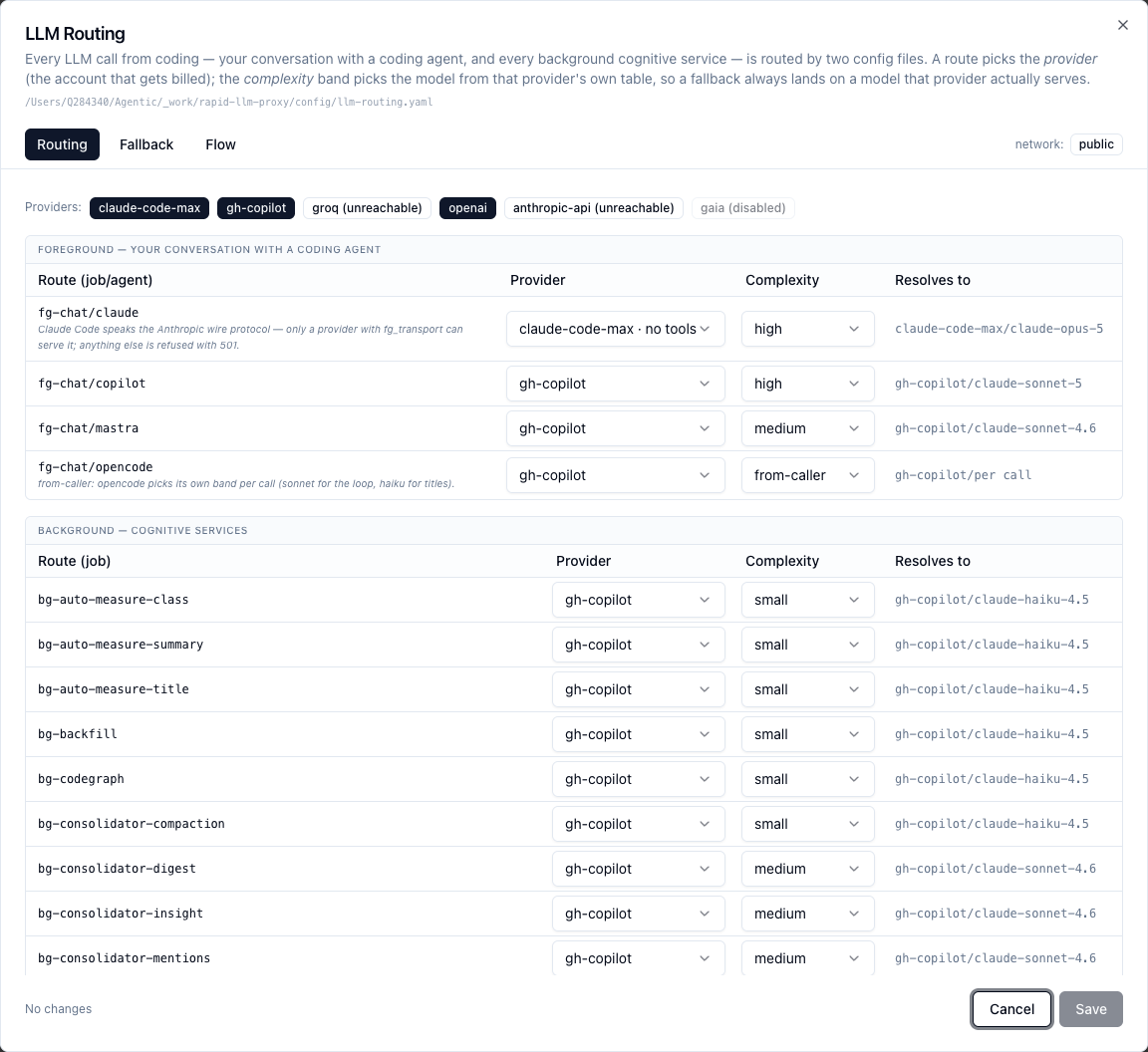
Foreground routes are separated from background services; the Resolves to column derives <provider>/<model> live as you change the provider or band.
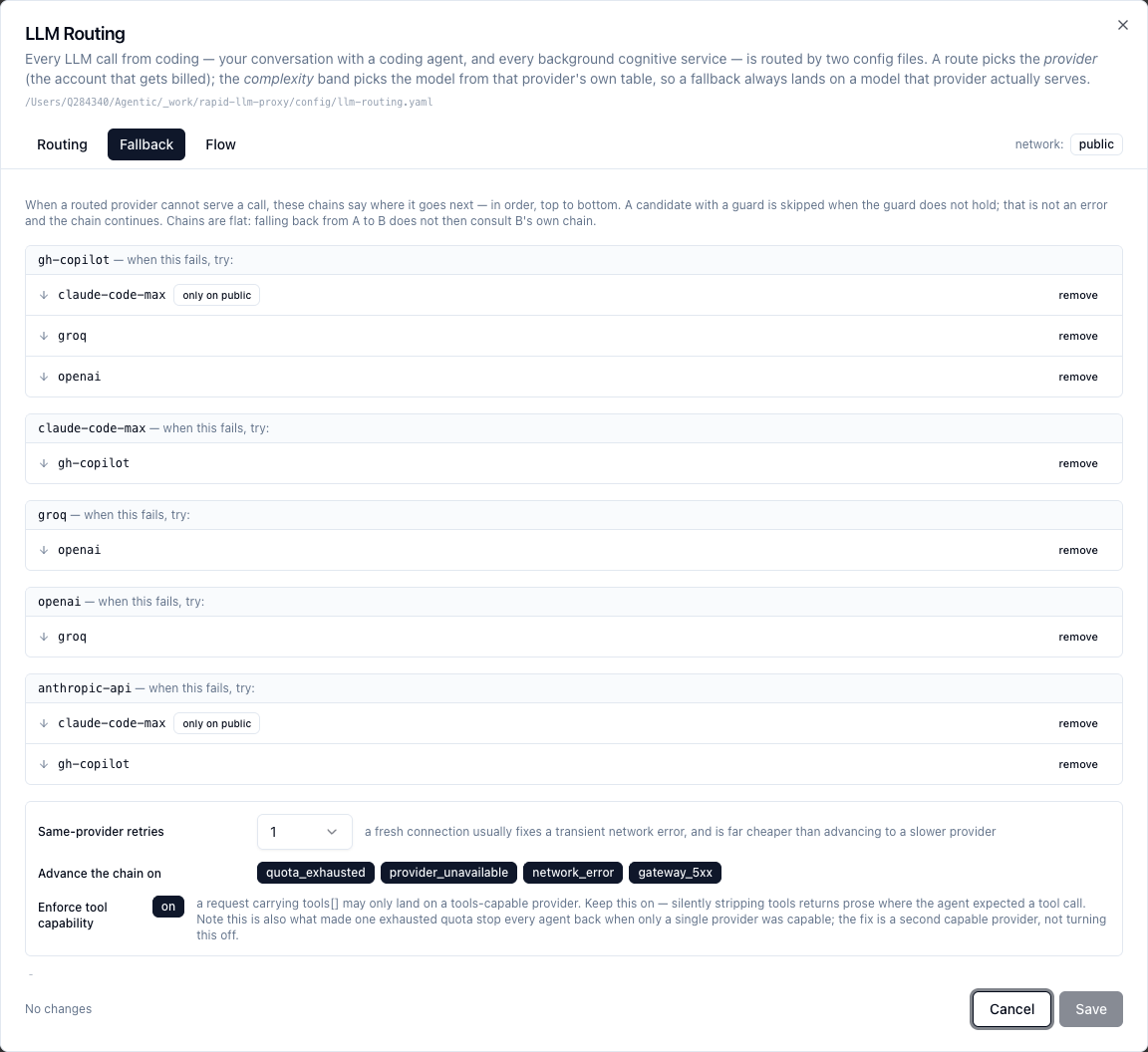
Saves are sent as a patch of only what changed and applied through the YAML document API, so the extensive comments in both files survive editing. The proxy validates before writing — a rejected save leaves both files byte-identical and returns a message naming the offending key.
Provider badges show reachability (unreachable, disabled) separately from configuration. A provider being logged out is a runtime fact, never a routing decision — conflating the two is how "is it configured?" and "is it working?" became the same question.
The Flow tab — config against reality
The two tables above are exact, but answering "what goes where" from them means holding 35 route rows and 5 chains in your head at once. The Flow tab draws the same data — it is the same payload, not a second source of truth.
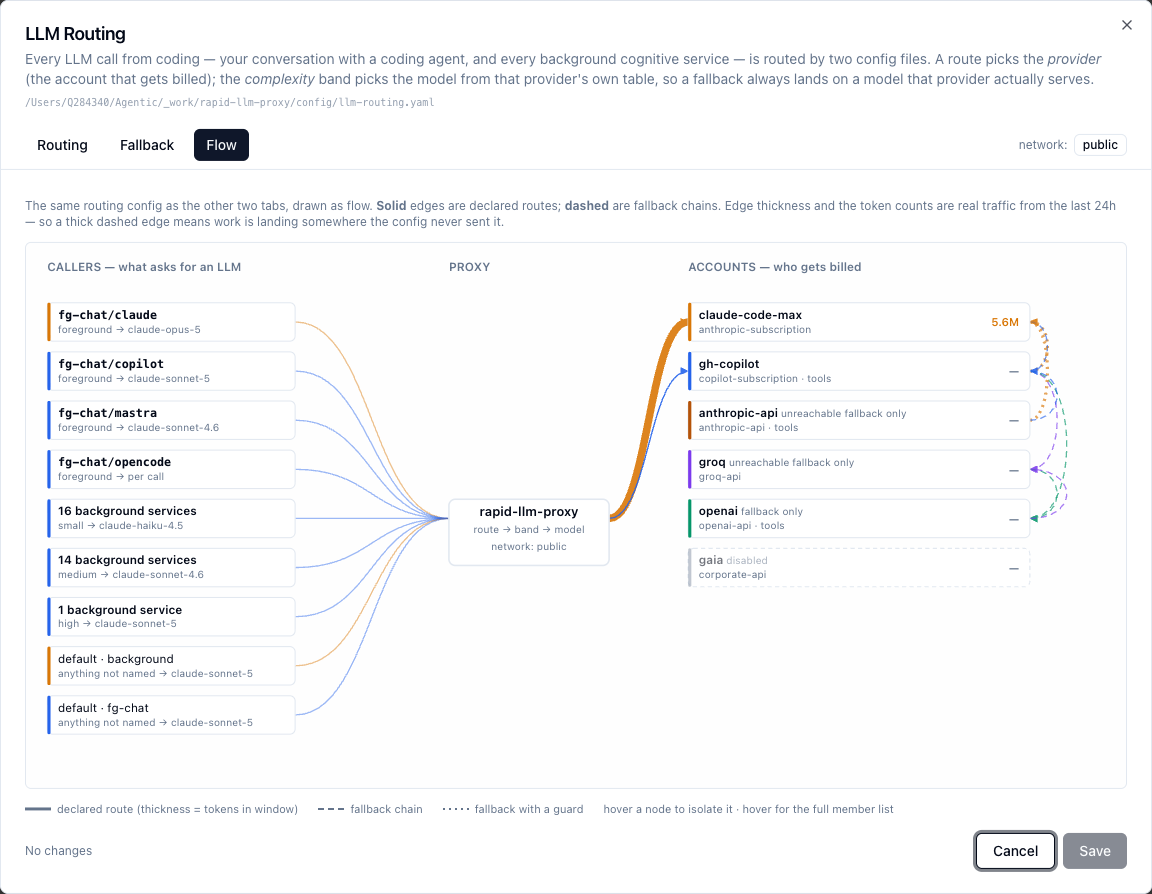
Two things are kept deliberately distinct, because conflating them is the failure mode this whole page exists to avoid:
| Means | Drawn as | |
|---|---|---|
| Config | Where a call is declared to go | Solid edges, always drawn — even for a provider that has served nothing |
| Traffic | Where calls actually went | Edge thickness and the per-account token totals, from token_usage over the page's window |
So a thick edge to a provider no route names means work is arriving by fallback. The screenshot above is that state: gh-copilot is the declared target of nearly every route and served zero tokens, while claude-code-max carries the traffic through the chain — because the Copilot quota is exhausted. Neither table shows this.
Reading it:
- The 31 background routes collapse to the three
(provider, band)pairs they actually target. That fan-in is the point; 31 near-identical nodes would bury it. Hover a group for its member list. - The four foreground routes stay individual, because there the agent identity is the route key.
- Accounts are ordered subscriptions → metered keys → disabled, the config's own grouping, and the one that answers who is paying.
- Dashed edges are fallback chains; dotted are chains with a guard.
- Account tooltips carry
available_models— everything that account can serve, not just the three bands currently pointed at it.
The graph reads the unsaved drafts, so it is a live preview: change a provider on the Routing tab and the edge moves before you press Save.
If token_usage is unreachable the graph still draws the configuration, just unweighted, with a note saying so. A flow diagram that renders nothing because a metrics call failed would be worse than one that renders the config alone.
By hand
Edit the YAML directly. The proxy reloads on mtime change; no restart needed. A config that will not parse aborts proxy startup rather than being partially applied — not knowing where any call should go is not something to serve around.
Runbook: why did this call go there?
Ask the proxy. It answers with the same decision the request path makes:
curl -s 'localhost:12435/api/llm/routing/resolve?job=bg-observation-writer' | jq -r .summary
# bg-observation-writer (step 2) -> gh-copilot/claude-haiku-4.5 > claude-code-max/claude-haiku-4.5 > groq/llama-3.1-8b-instant > openai/gpt-4o-mini
Useful parameters:
| Parameter | Effect |
|---|---|
job, agent | The lookup key — e.g. job=fg-chat&agent=opencode |
complexity | Only meaningful on a from-caller route |
tools=true | Applies the capability gate; shows which providers get dropped and why |
network=corporate | Evaluates guards for the other network without moving the laptop |
The full response includes skipped[] with a stated reason per dropped provider, and chain[].available marking runtime reachability.
The proxy logs the same string on every request:
[llm-proxy] route bg-observation-writer (step 2) -> gh-copilot/claude-haiku-4.5 > … [network=public]
[llm-proxy] gh-copilot: QUOTA_EXHAUSTED: … [quota_exhausted] — falling back to claude-code-max/claude-haiku-4.5
Diagnosing a surprise
/api/llm/routing/resolve— did the route resolve where you expected? ThematchedKeyandsteptell you which of the three lookup steps fired. Astep: 3means no rule matched and you got a class default.- Check
skipped[]before assuming a bug. A guard or the capability gate may have removed the provider you expected, and it says which. - Reproduce with
tools[]. A curl reproduction of an agent call that omitstools[]is not equivalent — it takes a different chain and can succeed where the agent fails, making the agent's problem look like an agent-side bug. Always include them. - Read the log line.
fallbackFromin the response body and the[<failure_class>]tag in the log say exactly why the chain advanced.
After the fact: what routing actually did
/resolve answers what routing would do. For what it did, every token_usage row carries the decision that produced it — route_key, route_band, route_step, offloaded_from, chain_position (0 = the route's own provider served it, >0 = that many fallback hops in) and attempt_trail, a JSON record of the candidates that failed or were never tried. The trail stores error classes, never messages.
It returns per-route call/token counts split by the provider that actually served, the fallback edges that were really taken with their error classes, the skipped candidates separated into config (fix by editing a YAML file) and runtime (fix by a login or a VPN), and the reasons the semantic offload declined to move work.
The dashboard renders all of it at Token Usage → Routing — configuration and observed behaviour side by side, with a per-call table whose rows expand into the full trail. That tab is read-only; editing stays in Token Usage → Settings.
Two things to know when reading those numbers:
routing_source.livewas observed at dispatch.backfillwas reconstructed afterwards byscripts/backfill-routing-decisions.mjs, which resolves against today's config and is therefore wrong wherever routing has since changed. Reconstructed rows are badged in the UI and only ever carryroute_key/route_band/route_step— the fallback and offload fields are genuinely unrecoverable and are left empty rather than filled with a plausible zero.unrecorded_calls. Rows predating the columns entirely. They are excluded from every figure rather than counted as "went to plan", and the count is reported so you can see what share of the window the percentages actually cover.
What this replaced
Routing used to be spread across nine surfaces. Recording them, because most of the confusion came from the ones that looked authoritative and weren't:
| Surface | Was it consulted? |
|---|---|
config/llm-providers.yaml (provider_priority, network_overrides, …) | No — server.mjs contains no YAML parsing. It configures the SDK's standalone path only. |
.data/llm-proxy/llm-settings.json → processOverrides | Yes — the de facto config, 26 entries, all pinned to one provider |
Hardcoded in server.mjs | Yes, and it silently overruled the overrides |
scripts/configure-wave-analysis-routing.sh | Yes — 250 lines of shell+python that PUT policy at startup |
scripts/launch-agent-common.sh | Yes — two different hardcoded models for the same agent |
lib/experiments/agent-routing.mjs | Yes, for experiment cells |
~/.config/opencode/opencode.json | Yes — opencode's own default |
integrations/semantic-analysis/config/model-tiers.yaml | No — dead since a merge |
Five mechanisms inside server.mjs decided routing invisibly: a network-dependent preferenceOrder, a hardcoded { copilot: true } capability map, a CLAUDE_FAMILY set that carried models across providers, a reachability heuristic that reordered the chain, and substring matching on body.subscription. The first two became config keys. The last three were deleted — an unreachable provider is just a failed attempt that advances the chain, which the fallback config already describes.
lib/experiments/agent-routing.mjs deliberately still does not read the routing config. An experiment cell's model is part of its identity: the variant name and composite task_id key off the spec model so task_hash stays constant and runs stay comparable. If it followed live config, editing a rule mid-campaign would change which model a cell launches on while its recorded identity stayed the same. Reproducibility wins over config unification there.
See also
- Token Usage — how per-call rows are captured and attributed
- LLM Architecture (
architecture/llm-architecture.md, docs site) — provider implementations, the Claude worker pool, and the per-agent transports each provider uses