Knowledge Context Injection
Every prompt you type is answered with the project's accumulated knowledge already in context — retrieved, ranked and budgeted, without you asking for it.
What it does
When you send a prompt, the system searches everything it has learned — observations, digests, insights and knowledge-graph entities — and injects the most relevant pieces as invisible context before the agent answers. All four agents get it, through their own native hook mechanisms.
| Agent | When knowledge arrives |
|---|---|
| Claude | Every prompt |
| Copilot | Session start, plus every turn |
| OpenCode, Pi | Session start |
The budget
One thousand tokens per injection: 300 reserved for working memory (project structure, current milestone, known blockers) and 700 for retrieved material.
It never blocks you
Every adapter is fail-open: a 2-second HTTP timeout and a 5-second absolute ceiling, and any error exits cleanly with no output. If retrieval is down, you get an ordinary conversation rather than a hung prompt.
Checking what was injected
The dashboard's Performance → context explainer shows, per turn, what was selected, what was dropped and at which stage. That funnel is the thing to look at when the answer is "why did it not know that?"
How a prompt becomes context
Two paths run continuously. On the write side, the transcript monitor creates observations, which are published over Redis, embedded, and upserted into Qdrant. On the read side, your prompt goes through the adapter for your agent to the retrieval service, which searches, fuses, budgets and returns markdown.
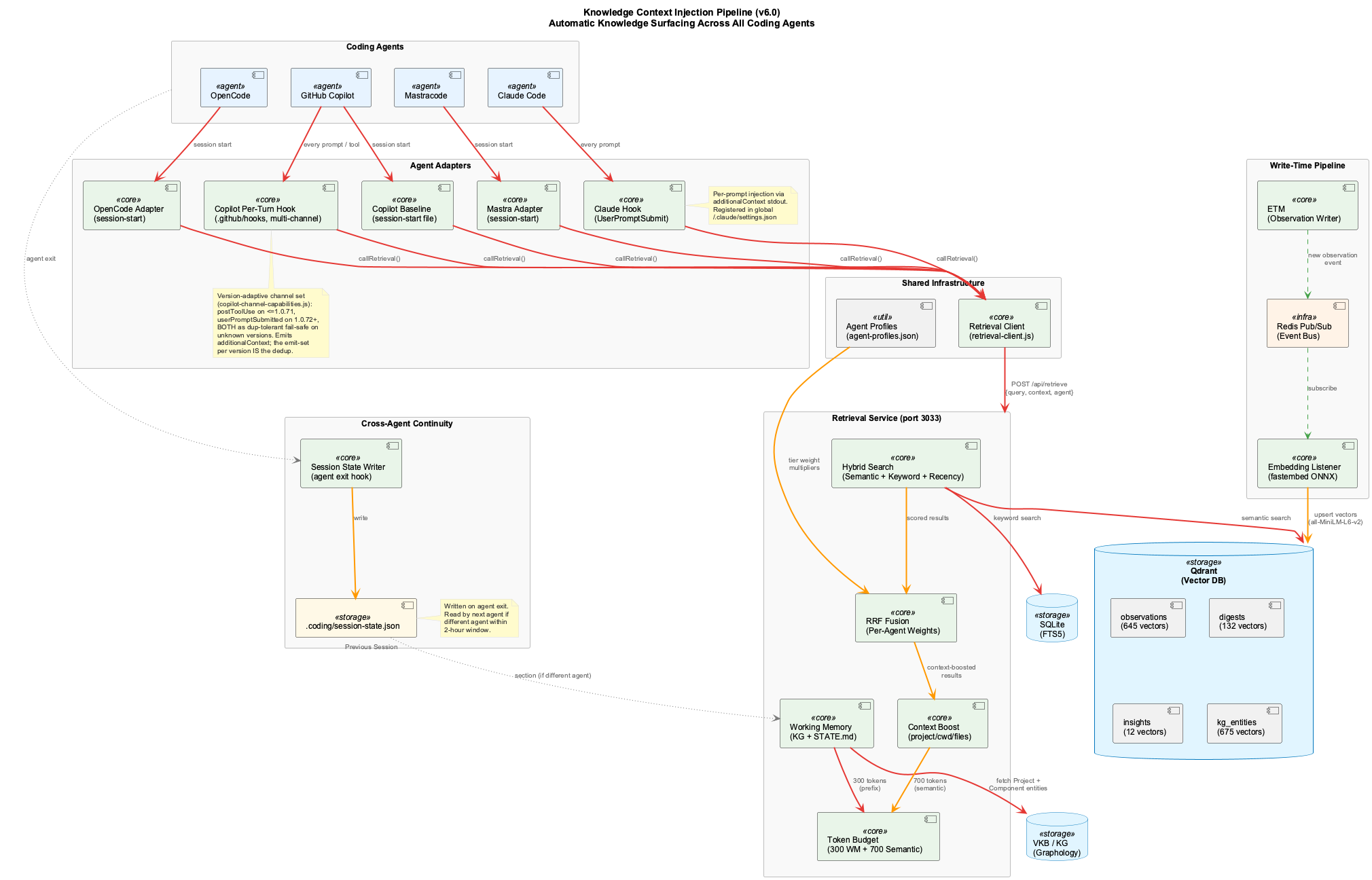
The retrieval service (POST /api/retrieve) runs four steps:
- Working memory — project and component entities from the knowledge graph, plus the current milestone and blockers parsed from
STATE.md. Fixed 300-token budget. - Parallel search — Qdrant semantic search across four collections, SQLite FTS5 keyword search, and recency scoring, all at once.
- RRF fusion — Reciprocal Rank Fusion merges them, weighted by tier (insights above digests above entities above observations), by a per-agent profile, and by context boosts for the project name, working directory and recently touched files.
- Assembly — markdown with tier headers, capped at 700 tokens.
Why the preview length mattered more than the budget
Each retrieved item contributes only its stored summary_preview, so that stored length — not the token budget — is the real ceiling on what any item can say.
It used to be 200 characters. Measured over 1,419 captures and 4,624 injected items, the median turn used 285 of its 1,000 tokens: the block would name a relevant insight and stop mid-sentence, before anything actionable. The budget was never the binding constraint.
At 1,200 characters — chosen because the decisive fact in sampled insights sat at offsets 520, 592 and 769, all lost at 200 — the same measurement gives:
| before | after | |
|---|---|---|
| median tokens used of 1,000 | 285 (28%) | 812 (81%) |
| median items per turn | 2 | 3 |
| decisive fact present (3 sample tasks) | 1 of 3 | 3 of 3 |
The preview is written into the Qdrant payload at index time, so changing it requires a re-index — and the payload carries a preview_version precisely so the backfill does not conclude that nothing changed (the content did not; the policy did).
Per-agent weighting
Each agent gets results weighted for how it tends to work — Claude leaning toward insights, Copilot and OpenCode toward graph entities, Pi toward digests — as multipliers applied during fusion, from config/agent-profiles.json. An unknown agent falls back to 1.0 across the board.
Continuity when you switch agents
On exit, the agent's name, project, recent files and key decisions are written to .coding/session-state.json. If you start a different agent within two hours, working memory injects a "Previous Session" section. Restarting the same agent, or coming back later, injects nothing — the aim is handover, not repetition.
Copilot needs two settings turned on
Copilot gates all filesystem hooks behind two flags that ship off, both set by install.sh: enableFileHooks in ~/.copilot/settings.json, and the repository listed in trustedFolders in ~/.copilot/config.json. Without them the hooks never fire, silently.
Which channel Copilot honours for per-turn context also changes between versions, so the resolver maps the installed version to the channel set to emit on, and falls back to emitting on both when it does not recognise a version. Re-run scripts/verify-copilot-hook-injection.sh after any Copilot upgrade.
Diagnosing a poor injection
The response carries a trace — per-stage in/out counts and the candidates each stage dropped — so "why was nothing injected?" resolves to a named stage rather than a shrug. Each retrieval is also appended to .data/retrieval-captures/<task_id>.jsonl, one line per turn, and rendered in the dashboard as scored cards with a turn picker.
Automatic surfacing of accumulated knowledge into coding agent conversations.
Overview
The Knowledge Context Injection pipeline (v6.0) makes the coding project's accumulated knowledge actionable by injecting relevant context into every agent conversation. When you type a prompt in any coding agent, the system retrieves semantically relevant observations, digests, insights, and knowledge graph entities, then injects them as invisible context that shapes the agent's response.
The pipeline is fully agent-agnostic: Claude, Copilot, OpenCode, and Pi all receive knowledge injection through their native hook/plugin mechanisms. Claude and Copilot inject per turn (fresh, task-relevant knowledge on every prompt); OpenCode and Pi inject a session-start baseline, which Copilot also gets on top of its per-turn injection.
Architecture
Components
| Component | Location | Purpose |
|---|---|---|
| Embedding Service | src/embedding/ | fastembed ONNX with all-MiniLM-L6-v2 (384-dim) |
| Retrieval Service | src/retrieval/retrieval-service.js | Hybrid search + token-budgeted assembly |
| Retrieval Client | src/hooks/retrieval-client.js | Shared fail-open HTTP client for all adapters |
| Claude Adapter | src/hooks/knowledge-injection-hook.js | UserPromptSubmit hook (per-prompt, global) |
| OpenCode Adapter | src/hooks/knowledge-injection-opencode.js | Session-start context file writer |
| Copilot Baseline Adapter | src/hooks/knowledge-injection-copilot.js | Session-start workspace instructions writer |
| Copilot Per-Turn Injector | src/hooks/knowledge-injection-copilot-posttool.js | Per-turn injection via additionalContext (multi-channel) |
| Copilot Channel Resolver | src/hooks/copilot-channel-capabilities.js | Maps Copilot version → honored injection channel(s) |
| Pi Adapter | src/hooks/knowledge-injection-pi.js | Session-start context file writer |
| Working Memory | src/retrieval/working-memory.js | Live KG + STATE.md project summary |
| Agent Profiles | config/agent-profiles.json | Per-agent tier weight multipliers |
| Session State | scripts/write-session-state.js | Cross-agent continuity on agent switch |
Data Flow
- Write path: ETM creates observations → Redis pub/sub → embedding listener → Qdrant upsert
- Read path: Agent prompt → adapter → retrieval client → retrieval service → Qdrant + SQLite → RRF fusion → token-budgeted markdown → agent context
Retrieval Pipeline
Request Flow
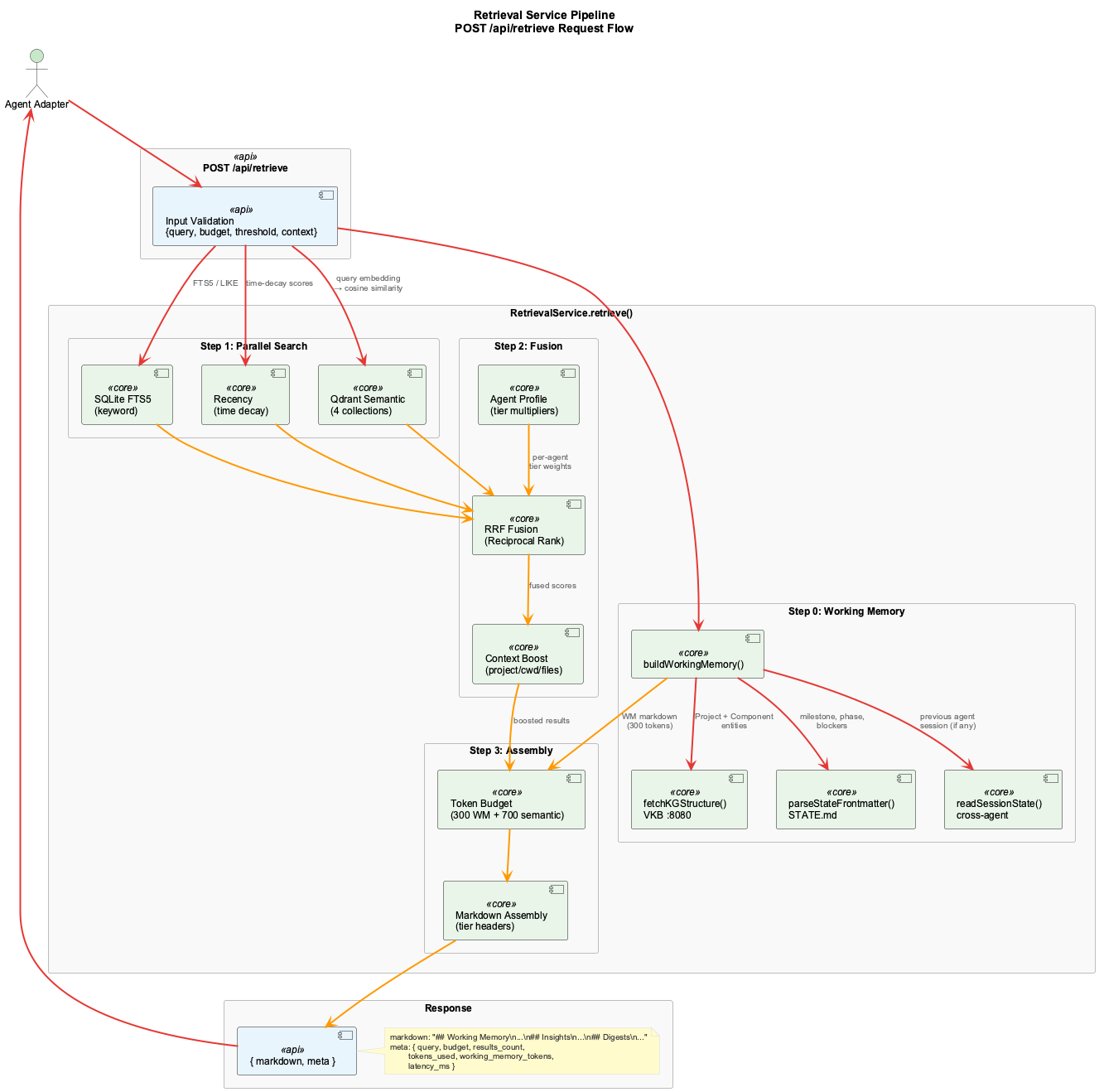
The retrieval service (POST /api/retrieve on port 3033) processes each request through:
-
Working Memory (Step 0): Queries VKB for Project + Component entities, parses STATE.md for current milestone/phase, checks for cross-agent session state. Fixed 300-token budget.
-
Parallel Search (Step 1): Runs three search strategies simultaneously:
- Qdrant semantic search across 4 collections (observations, digests, insights, kg_entities)
- SQLite FTS5 keyword search
-
Recency scoring with time-decay
-
RRF Fusion (Step 2): Merges results using Reciprocal Rank Fusion with:
- Tier weights (insights > digests > entities > observations)
- Per-agent profile multipliers from
config/agent-profiles.json -
Context boost (project name 1.15x, cwd 1.10x, recent files 1.20x)
-
Token-Budgeted Assembly (Step 3): Constructs markdown with tier headers, capped at 700 tokens for semantic results + 300 tokens for working memory = 1000 total.
What limits the injected payload: the stored preview
formatResult (src/retrieval/token-budget.js) renders each item's summary_preview and nothing else, so whatever the indexer stores in that field is the hard ceiling on what any single item can contribute — independent of the token budget.
That length is SUMMARY_PREVIEW_CHARS in src/embedding/preview.ts, the single source of truth for both the live indexer (listener.ts) and the batch re-index (backfill.ts).
It was previously a bare substring(0, 200) duplicated across five call sites, which nothing named and nothing connected to its consequence. Measured over 1419 captures / 4624 injected items under that regime: every preview was ≤200 chars, median 2 items per turn, and median tokens_used 285 of 1000 — 28% of budget. The injected block named a relevant insight and then stopped mid-sentence, before anything actionable. The budget was never the binding constraint; the preview was.
It is now 1200 chars, chosen from where useful content actually sits rather than by feel: insight bodies have a median length of 2246 chars, and the decisive fact in the top-ranked insights for three sample tasks sat at offsets 520, 592 and 769 — all lost at 200, all captured at 1200. At ~3.5-4 chars/token that is ~300-340 tokens, so two items fill most of the 700-token semantic budget and a third truncates gracefully, preserving the multi-tier breadth the pipeline is designed around.
Changing it requires a re-index. The preview is written into the Qdrant payload at index time, so a new value only affects items indexed afterwards. Every payload carries preview_version, and backfill.ts skips a point only when content_hash and preview_version both match — a content-hash-only check would report every point as current (the content did not change; the policy did) and the new length would never reach the index.
--prune deletes points whose id is absent from the source after upserting, so ids that drifted under an older indexing scheme do not survive as duplicates. It never drops the collection: every agent prompt queries it, so the failure mode to avoid is an empty index, and it refuses to prune against an empty source.
Measured on the 200 → 1200 re-index (14,047 points):
| before | after | |
|---|---|---|
median tokens_used of 1000 | 285 (28%) | 812 (81%) |
| median items injected/turn | 2 | 3 |
| decisive fact present in the block (3 sample tasks) | 1 of 3 | 3 of 3 |
The same run resynced the index with km-core, which had drifted badly while the batch tooling was silently a no-op — 636 indexed insights against 709 real ones, and 12,660 observation vectors against 8,026 surviving records (the rest pointed at rows the 7-day pruner had already removed). All four collections now match the source exactly.
The relevance judge deliberately still sees only the first 240 chars of a preview (src/retrieval/relevance-judge.js): it decides topical usefulness, which the title plus opening conveys, and feeding it 12 × 1200 chars would multiply its input tokens fivefold against a 2500 ms interactive timeout — buying explainability with fail-opens.
Response Shape
{
  "markdown": "## Working Memory\n...\n## Insights\n...\n## Digests\n...",
  "items": [
    { "id": "…", "tier": "insights", "rrfScore": 0.374, "score": 0.812, "payload": { "topic": "…" } }
  ],
  "trace": {
    "candidates": { "semantic": 80, "keyword": 0, "fused": 80 },
    "stages": [
      { "name": "idf-floor",  "in": 80, "out": 52, "dropped": [], "dropped_total": 28 },
      { "name": "judge-topk", "in": 52, "out": 12, "dropped": [], "dropped_total": 40 },
      { "name": "judge",      "in": 12, "out":  3, "dropped": [], "dropped_total":  9 },
      { "name": "assembly",   "in":  3, "out":  3, "dropped": [], "dropped_total":  0 }
    ],
    "injected": 3, "tokens_used": 328, "budget": 700, "judge_outcome": "judged"
  },
  "meta": {
    "query": "Docker build pipeline",
    "budget": 1000,
    "results_count": 12,
    "tokens_used": 950,
    "working_memory_tokens": 112,
    "latency_ms": 160
  }
}
items is the structured subset actually injected. trace is the selection funnel — per-stage in/out counts plus the candidates each stage dropped, so "why was nothing injected?" is attributable to a named stage. Each stage names at most its 12 highest-ranked casualties and carries an exact dropped_total, so a capped list never reads as a complete one. Both fields are additive; retrieval-client.js and the four agent adapters ignore them.
Per-Turn Capture
When /api/retrieve is called with a task_id, obs-api appends one JSONL line per retrieval to .data/retrieval-captures/<task_id>.jsonl via src/retrieval/capture-store.js — {task_id, turn, capturedAt, meta, items, trace}. Turn ordinals resume from disk after a restart.
This replaced a writer that wrote <task_id>.json and overwrote it every call: because task_id is the session UUID for interactive sessions, a 39-turn session kept exactly one capture, always the last. Legacy .json files are read as a single turn-0 fallback and are not migrated. A turn that injected nothing is still recorded whenever a trace explains the silence — the old writer discarded that case outright.
GET /api/retrieve-capture?task_id=…[&turn=N] serves them: top-level items/meta are the selected turn (default: the last), with the full history under turns[]. The dashboard's Performance → context explainer renders these as scored cards, a turn picker, and the funnel. Retention is 14 days via the existing com.coding.context-turns-sweeper job.
Agent Adapters
Claude Code (per-prompt injection)
The Claude adapter runs as a UserPromptSubmit hook registered in ~/.claude/settings.json (global — works in all projects). On every substantive prompt (4+ words, not a slash command):
- Reads prompt from stdin JSON
- Calls retrieval service with prompt as query + project context
- Writes JSON to stdout with
additionalContextfield - Claude sees the knowledge as a
<system-reminder>block
Fail-open: 2-second HTTP timeout, 5-second safety ceiling. Any error exits 0 with no output.
OpenCode, Copilot, Pi (session-start baseline)
These adapters run once at session start via launch-agent-common.sh:
| Agent | Context File | Mechanism |
|---|---|---|
| OpenCode | .opencode/knowledge-context.md | Custom instructions file |
| Copilot | .github/copilot-instructions.md | Workspace context (marker-based merge) |
| Pi | AGENTS.md in pi's config dir | Read via pi's own context-file discovery |
The launch system calls _inject_knowledge_context() at step 12.5, which dispatches the appropriate adapter with a 10-second timeout. For Copilot this is only the baseline — task-relevant per-turn injection is layered on top (see below).
GitHub Copilot (per-turn, version-adaptive multi-channel)
On top of the session-start baseline, Copilot injects fresh knowledge per turn through its native filesystem hooks (.github/hooks/hooks.json → lib/agent-api/hooks/copilot-bridge.sh → knowledge-injection-copilot-posttool.js).
The churn problem. A Copilot filesystem hook can only inject context the model reads via an additionalContext field, and which event's additionalContext is honored changes version to version:
| Copilot version | Honored per-turn channel |
|---|---|
| ≤ 1.0.71 | postToolUse only (userPromptSubmitted output is dropped) |
| 1.0.72 – 1.0.x | userPromptSubmitted (honored & reliable; postToolUse went flaky) |
| unknown / ≥ 1.1.0 | undetermined — treated as fail-safe |
A single fixed channel is therefore never upgrade-safe.
The design — the emit set is the dedup. copilot-channel-capabilities.js maps the installed version (via copilot --version, file-cached 6 h) to the set of channels to emit on, and that set is itself the deduplication:
- Known single-honored version → emit on that one channel ⇒ injected exactly once, no duplication.
- Unknown / newer version → fail-safe: emit on both
postToolUseanduserPromptSubmitted(tolerating one duplicate to guarantee delivery), and log a note to extend the map.
This deliberately rejects "emit everywhere, then suppress after the first hit": on 1.0.71 the userPromptSubmitted hook process runs first and emits, but Copilot silently drops it — so suppression would kill the postToolUse channel that actually works. Keying the emit set to the version avoids that trap.
Mechanics. The injector runs in two modes from the bridge:
| Mode | Fires on | Behavior |
|---|---|---|
prompt | userPromptSubmitted | Starts a fresh turn; stashes the prompt + resolved plan. If the plan includes userPromptSubmitted, retrieves and emits additionalContext. |
tool | postToolUse | If the plan includes postToolUse and it hasn't emitted this turn, injects (reusing the cached block if the prompt channel already retrieved). Once per turn. |
Retrieval runs at most once per turn — the retrieved block is cached in a per-session stash ($TMPDIR/coding-copilot-kb/<sid>.json), so the fail-safe second channel reuses it rather than making a second HTTP call. Fail-open throughout: a disabled toggle, a short/slash prompt, no plan, or any error emits a no-op and never blocks a request.
Prerequisites. Copilot gates all filesystem hooks behind two settings that are OFF by default; install.sh install_copilot_file_hooks sets both:
enableFileHooks: truein~/.copilot/settings.json- the repo folder present in
trustedFoldersin~/.copilot/config.json
Diagnostics & overrides. scripts/verify-copilot-hook-injection.sh runs a deterministic firing check plus an N-run, neutral-token injection probe per channel — run it after any Copilot upgrade, and feed the delivering channel back into KNOWN_RANGES. COPILOT_KB_CHANNELS forces the channel set (or none to disable); COPILOT_VERSION overrides the version the resolver reasons about (for tests).
Working Memory
Every retrieval response begins with a Working Memory section containing:
- Project structure: Top-level Project + Component nodes from the Knowledge Graph (e.g., "LSL System", "ETM Pipeline", "Docker Services")
- Current state: Active milestone, current phase, status from STATE.md
- Known issues: Blockers/concerns from STATE.md
- Previous session (if switching agents): Summary from the previous agent's session state file
Budget: 300 tokens, enforced via gpt-tokenizer. Progressive truncation: drop descriptions first, then components, then fall back to project + state only.
Per-Agent Profiles
Each agent gets differently weighted retrieval results based on their typical work patterns:
{
  "claude": { "insights": 1.3, "digests": 1.2, "kg_entities": 1.0, "observations": 0.9 },
  "opencode": { "insights": 1.0, "digests": 1.0, "kg_entities": 1.2, "observations": 1.1 },
  "copilot": { "insights": 0.9, "digests": 1.0, "kg_entities": 1.3, "observations": 1.1 },
  "pi": { "insights": 1.1, "digests": 1.3, "kg_entities": 1.0, "observations": 1.0 }
}
Profiles are applied as multipliers during RRF fusion. Unknown agents fall back to default weights (all 1.0).
Cross-Agent Continuity
When you switch agents mid-task (e.g., Claude → OpenCode), the new agent receives context from the previous session:
- On agent exit,
write-session-state.jscaptures: agent name, project, timestamp, recent files, key decisions - Written to
.coding/session-state.json(gitignored) - On next agent start, working memory reads the state file
- If the previous agent is different AND within 2 hours: injects a "Previous Session" section
- Same agent restart or stale session: no injection
Configuration
| Setting | Location | Default | Purpose |
|---|---|---|---|
| Token budget | retrieval call parameter | 1000 | Total injection size |
| Working memory budget | working-memory.js WM_BUDGET | 300 | Fixed WM prefix size |
| Relevance threshold | retrieval call parameter | 0.75 | Minimum score for inclusion |
| HTTP timeout | retrieval-client.js | 2000ms | Retrieval call timeout |
| Safety timeout | knowledge-injection-hook.js | 5000ms | Absolute hook ceiling |
| Min words for injection | knowledge-injection-hook.js | 4 | Short prompt filter |
| Agent profiles | config/agent-profiles.json | per-agent | Tier weight multipliers |
| Session staleness | working-memory.js | 2 hours | Cross-agent window |
| Copilot channel set | COPILOT_KB_CHANNELS env | version-resolved | Force Copilot injection channel(s), or none to disable |
| Copilot version override | COPILOT_VERSION env | detected | Version the channel resolver reasons about (tests) |
| Copilot file hooks | ~/.copilot/settings.json + config.json | off | enableFileHooks + trustedFolders gate all Copilot hooks |