Architecture
The design principles behind the infrastructure, and where each of them lives in the code.
Four ideas explain the design
- The agent is replaceable. Everything shared lives outside the agent; adding one is a single config file in
config/agents/, not a change to common code. - Knowledge is stored in tiers. Fast in memory, durable in LevelDB, reviewable as git-tracked JSON exports.
- Enforcement happens before execution. Constraints are PreToolUse hooks, so a bad call is blocked rather than reported.
- Supervision is layered. Watchdog, coordinator, verifier and service health escalate progressively instead of one monitor trying to catch everything.
Where things live
| Concern | Where |
|---|---|
| Agent definitions | config/agents/<name>.sh |
| Shared startup | scripts/launch-agent-common.sh |
| Session wrapping | scripts/tmux-session-wrapper.sh |
| Knowledge storage | .data/knowledge-graph/ |
| Session logs | .coding/history/ |
Read next
Health Monitoring for the supervision layers, Data Flow for how information moves between systems, and LLM Routing for how a model is chosen for a piece of work.
Agent-agnostic by construction
Claude Code, Copilot CLI, OpenCode and Pi all run on identical infrastructure. That is enforced structurally rather than by convention: the shared behaviour lives in layers none of the agents own.
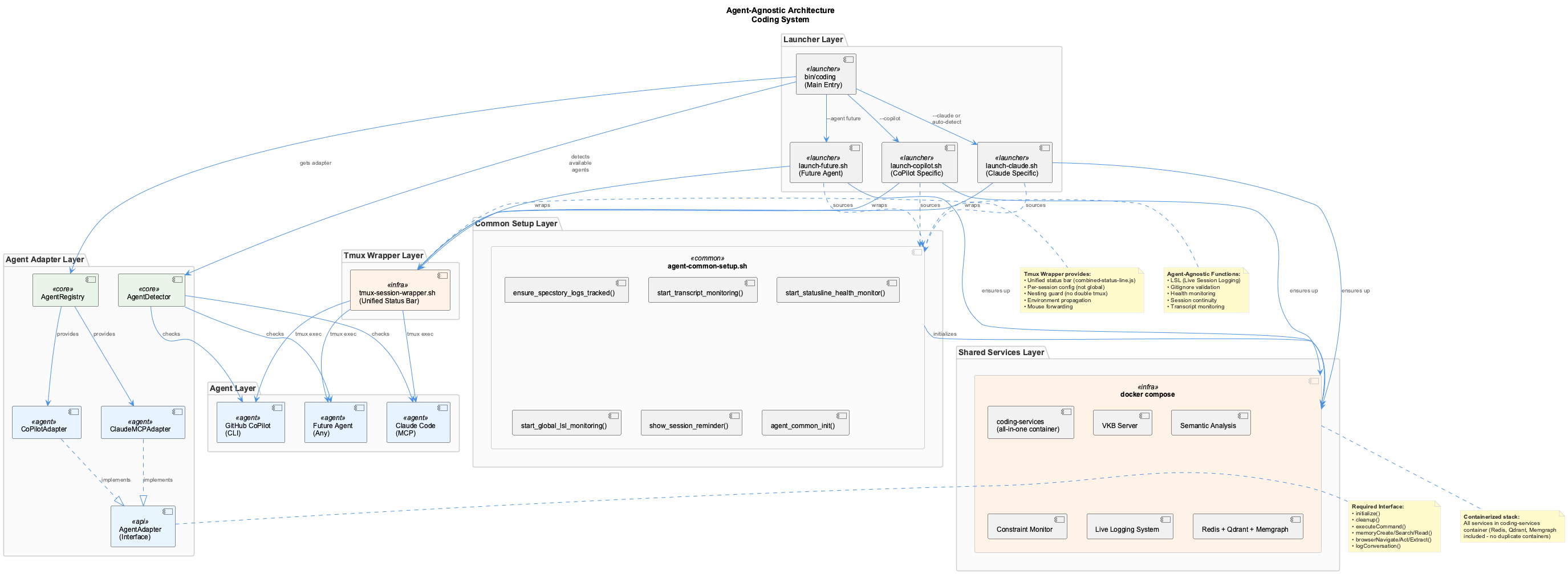
From the outside in — the agent itself; a tmux wrapper providing the status bar, nesting guard and I/O capture; a per-agent config file of 10–30 lines; a shared orchestration script handling Docker detection, service startup and session management; and beneath those the shared services and a thin adapter interface resolved by naming convention.
The proof that the seam is real: config/agents/opencode.sh is 25 lines and buys full integration. Adding an agent touches nothing else.
Where knowledge is kept
Three tiers, chosen for different failure modes:
- Runtime — an in-memory Graphology graph, fast enough to query mid-session.
- Persistent — LevelDB, which survives restarts.
- Reviewable — JSON exports committed to git, so knowledge changes show up in diffs and can be reverted like anything else.
Enforcement happens before the tool runs
flowchart LR
    A[Agent tool call] --> B[PreToolUse hook]
    B --> C[Constraint monitor]
    C -->|Violation| D[BLOCK + suggested fix]
    C -->|Clean| E[ALLOW]
    E --> F[Tool executes]
Constraints are declarative — an id, a pattern, a severity and the message shown when they fire — and a blocked call can be overridden deliberately by naming the constraint, which keeps the escape hatch explicit and auditable rather than tempting you to reword around the rule.
Supervision in layers
| Layer | Component | Catches |
|---|---|---|
| 4 | Service health | An individual service failing |
| 3 | System verifier | Logging and constraints drifting |
| 2 | Coordinator | Overall health and metrics |
| 1 | Watchdog | Critical failures worth alerting on |
Each layer assumes the one below it may be wrong, which is why a wedged process that still answers ps is caught — the layer above notices it has stopped producing work.
How it is deployed
Services run as HTTP/SSE endpoints in Docker containers; the host-side agent CLI reaches them through stdio proxies. coding --claude brings the whole stack up, so Docker must be running before you launch.
Adding an agent
Create config/agents/<name>.sh with AGENT_NAME, AGENT_COMMAND and any optional hook functions. Detection, launcher routing and tmux wrapping follow automatically. The Agent Integration Guide has the full contract.
System design principles and patterns for the coding infrastructure.
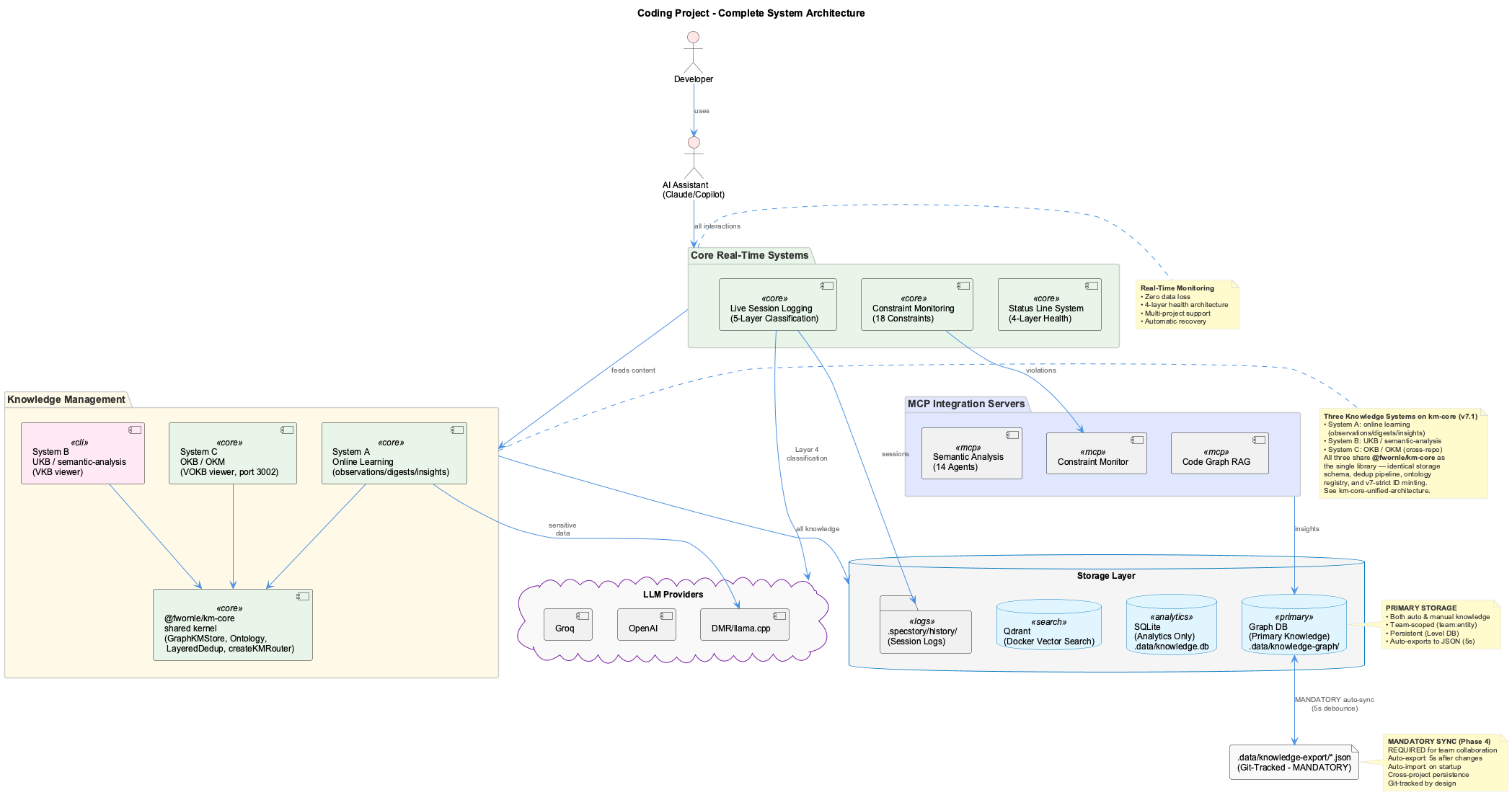
Key Principles
1. Agent-Agnostic Design
Multi-Agent Support
Both Claude Code and GitHub CoPilot are fully supported with identical infrastructure (containerized services + stdio proxies on the host) and a unified launcher. Adding new agents follows a documented adapter pattern.
The architecture supports multiple AI coding assistants through a unified adapter pattern:
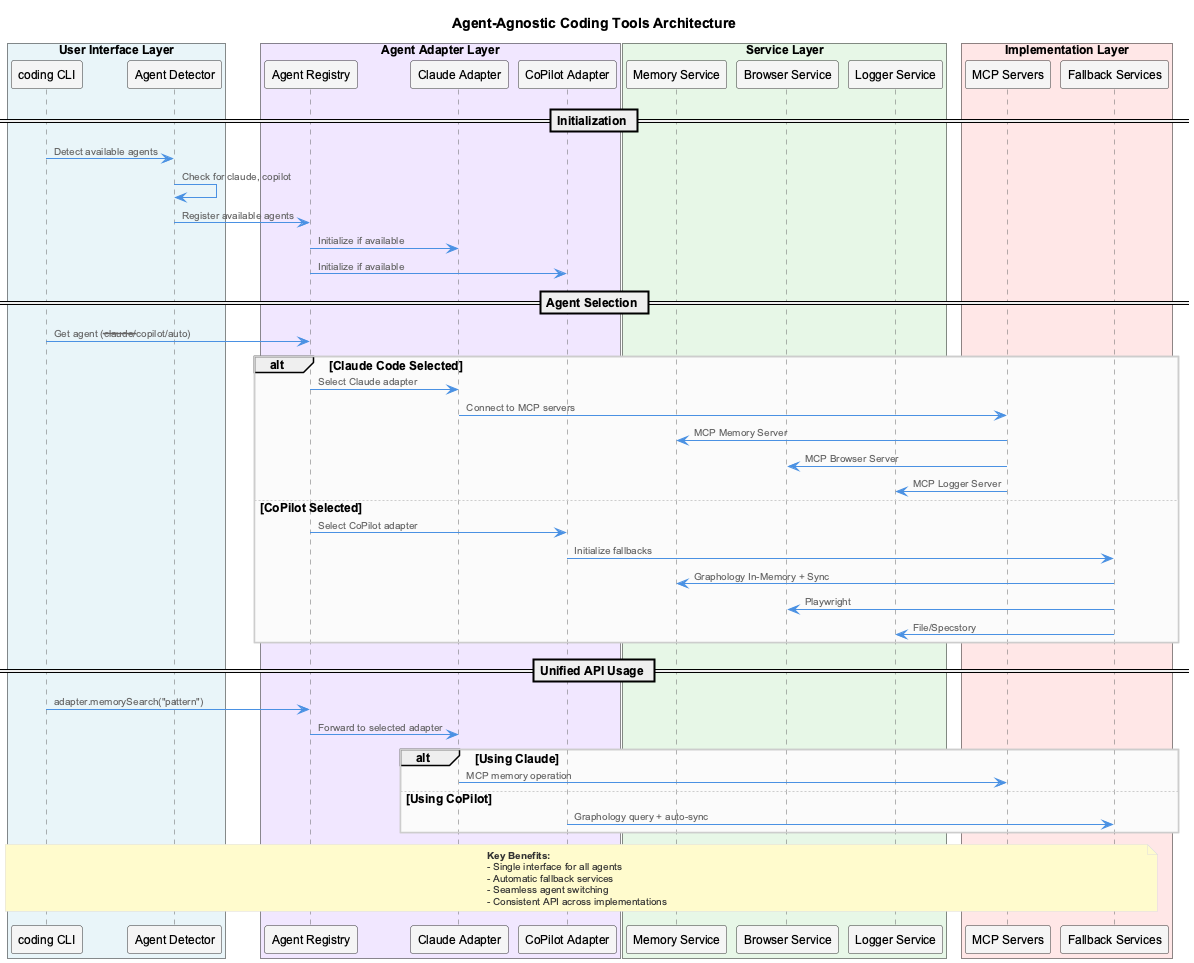
Layers:
- Agent Layer - AI assistants (Claude Code, GitHub CoPilot, OpenCode, future agents)
- Tmux Wrapper Layer - Unified session wrapping via
tmux-session-wrapper.sh— status bar, nesting guard, env propagation, optional pipe-pane I/O capture - Config Layer - Agent definitions in
config/agents/<name>.sh(10-30 lines each) - Orchestration Layer -
launch-agent-common.shhandles all shared startup (Docker detection, service startup, monitoring, session management) - Common Setup Layer - Shared initialization (
agent-common-setup.sh) - Shared Services - VKB, Semantic Analysis, Constraint Monitor, LSL
- Adapter Layer - Abstract interface + agent implementations (dynamic import by convention)
2. Knowledge Persistence
Multi-tier storage for reliability and performance:
Runtime (Fast):
- MCP Memory (Claude)
- Graphology Graph (in-memory)
Persistence (Reliable):
- LevelDB (persistent graph storage)
- JSON exports (git-tracked)
.coding/history/(session logs)
3. Real-Time Quality Enforcement
PreToolUse hooks intercept tool calls BEFORE execution:
flowchart LR
    A[Claude Tool Call] --> B[PreToolUse Hook]
    B --> C[Constraint Monitor]
    C -->|Violation| D[BLOCK]
    C -->|Clean| E[ALLOW]
    E --> F[Tool Execution]
4. 4-Layer Monitoring
Progressive escalation for reliability:
| Layer | Component | Function |
|---|---|---|
| 4 | Service Health | UKB, VKB, Semantic Analysis |
| 3 | System Verifier | LSL, Constraints |
| 2 | System Coordinator | Overall health, metrics |
| 1 | System Watchdog | Critical failures, alerts |
Deployment
MCP servers run as HTTP/SSE services in Docker containers; the host-side Claude/Copilot CLI talks to them via lightweight stdio proxies. Docker Desktop must be installed and running. The stack is launched automatically by coding --claude. See the Docker Deployment Guide for container details.
Development Patterns
Constraint-Based Development
Define constraints before implementation:
constraints:
  - id: no-parallel-versions
    pattern: /(v\d+|enhanced|improved|new|fixed)_/
    severity: CRITICAL
    message: Never create parallel versions - edit originals
Agent Detection
const detector = new AgentDetector();
const available = await detector.detectAll();
// { claude: true, copilot: true }

const best = await detector.getBest();
// 'claude'
Knowledge Capture
# Auto-analysis from git commits and session logs
semantic workflow run wave-analysis --team coding

# Progress of the run it started
semantic workflow status

# Visualization
vkb
Adding New Agents
Adding a new agent requires only a single config file — zero changes to shared code.
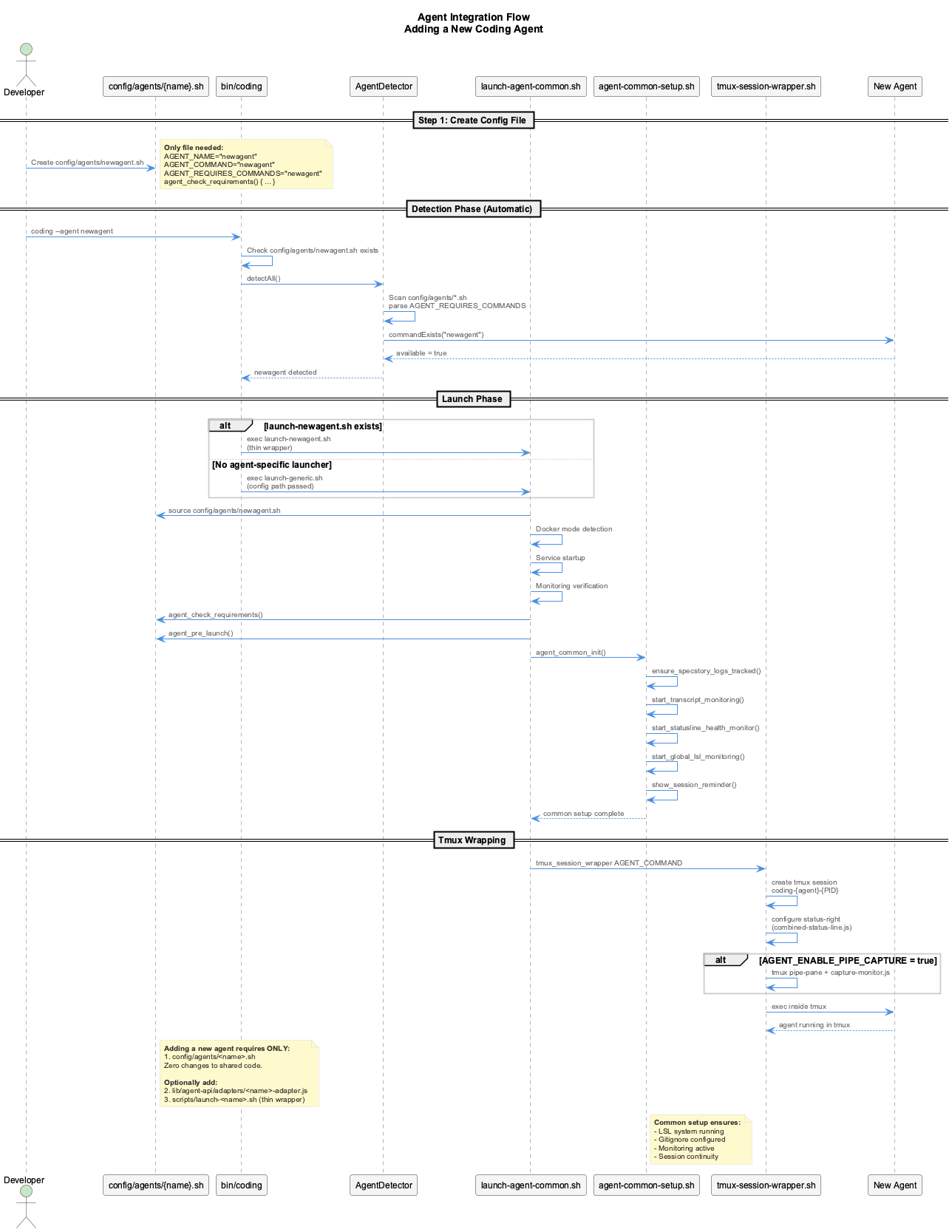
Create config/agents/<name>.sh defining AGENT_NAME, AGENT_COMMAND, and optional hook functions. Agent detection, launcher routing, and tmux wrapping all happen automatically.
Proof: The OpenCode agent (config/agents/opencode.sh) is a 25-line file providing full integration.
See the Agent Integration Guide for the complete walkthrough, config reference, and API contract.
Related Documentation
- Health Monitoring - 4-layer architecture details
- Data Flow - System data flow diagrams
- Integrations - MCP server architectures